I remember spending a lot of time in my local library as a kid. It was close, within safe walking distance from my house, and beyond a few people who hung out and read magazines they didn’t want to subscribe to, it was just me, the librarians, and a whole lot of books. Browsing the stacks one day, I found these gigantic treasury editions of 60s and 70s Marvel Comics, which I checked out and read every week for three years. My favorite of them was Marvel’s Greatest Superhero Battles, its cover promising an epic clash between The Hulk and The Thing, my two favorite characters in the yet cinematically undiscovered country that was the Marvel Universe. This was the 1990s, and, say what you will about Stan Lee, but the way he wrote his superheroes (and the way Jack Kirby, Herb Trimpe, Sal Buschema, and John Romita (among others) drew them) still had a way of speaking that appealed directly to this very particular sense of selfhood I was developing. Bruce Banner was a quiet man, Benjamin Grimm a soft-hearted lunk. One wanted to be left alone. The other was doomed to be forever unhappy with his body. I got that. I identified with it. And, sealed away in these treasury books, they belonged to a world that only I had access to.
Had you told nine-year-old me that The Hulk would be a cornerstone of one of the world’s most successful film franches—man, I don’t even know. 27-year-old me can hardly believe it, and I have lived experience of summers spent in multiplexes that weren’t showing a superhero of some kind. Sitting in the dark waiting for Avengers: Age of Ultron to start, there were three trailers for upcoming superhero films, and I was late. The next in Disney’s Avengers sequence, Ant-Man, is coming out in July. We barely get a month to rest up between episodes now, such is the cultural demand for city-destroying bacchanalia. I was tired. I was restless. I wanted to shove nine-year-old me into a locker for liking this stuff. And when the film started, I was largely still exhausted. Joss Whedon’s latest venture into the Marvel Cinematic Universe is overstuffed and overlong, struggling to contain itself, even at two-hours and 20-minutes. A lot of the bloat, at this point, must be attributed to the fact that an Avengers movie isn’t just a movie—it’s part of a cycle, and, as such, is part of a feedback loop that looks back as far as 2008 and looks forward as far as the heat death of the universe. Around that, Whedon, admirably, is going for something more here than in Avengers. Meglomaniacs get smashed-up real good and the physical and psychic trauma of 9/11 is exported to a countries real and imaginary, but it’s clear at this point that Whedon is most in his element when the world is quiet and his team has divested itself of their spandex.
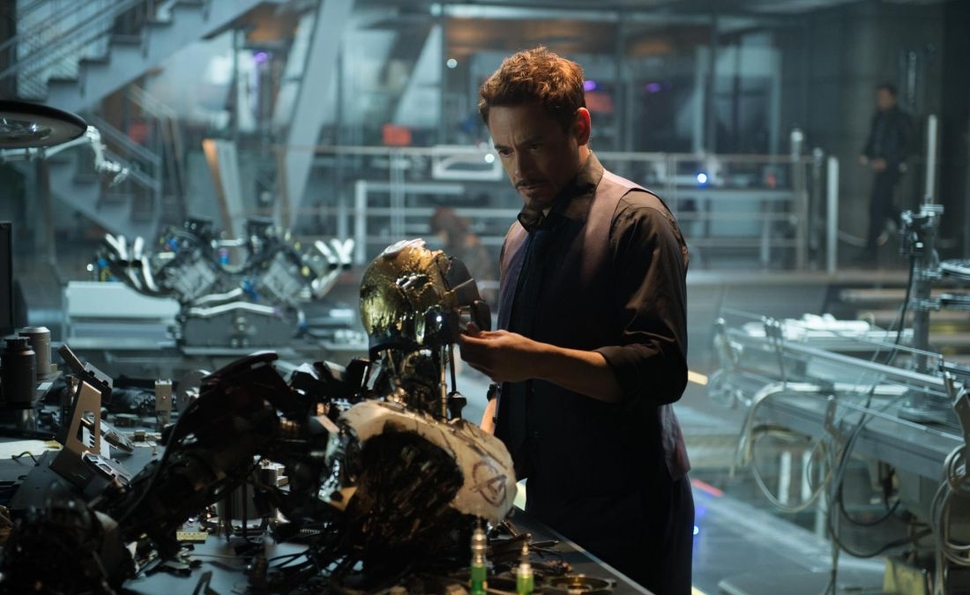
Then, he can get down to the real meat of Marvel Comics, which is that beneath the spectacle and muscle, superheroes are really just damaged human beings who are very uncomfortable with their bodies. This has been a sub-plot of most MCU films for awhile now, the whole “He’s just a man, but I’ve got an army!” deal, but Whedon’s script ventures beyond that, ruminating on the fallibility of flesh. His villain, Ultron (James Spader), a malevolent, sassy robot whose AI bears a striking resemblance to Tony Stark (Robert Downey, Jr.), sees the body as a necessary step forward in his evolution. Stark knows he will die, leaving his project of world peace unfinished. Hawkeye (Jeremy Renner) is just a regular dude with a bow and arrow. Captain America (Chris Evans) is still acclimating to a world where most of his friends have died. Bruce Banner (Mark Ruffalo) is doomed to be ashamed of his monstrous, green alter-ego, and Black Widow (Scarlett Johansson) has a past that involves bodily disfiguration. Where a villain like Ultron (or Loki, or the assembled horde of Hydra bad guys, or men in knock-off Iron Man gear) see this as the team’s weakness, it’s the axis upon which the whole thing spins—there aren’t many people who could understand their individual circumstances, but they’re all here in a room together, drunkenly trying to lift the hammer that lets Thor (Chris Hemsworth) lay claim to the throne of Asgard.
But at this point, it’s not enough to truly satisfy. MCU films are, like a hang-out sitcom, an excuse to sit around and chuckle with a group of favorite characters, mind turned off. Battle sequences are well-executed, if perfunctory and consequence free. If you don’t check in on Marvel’s televised output, it’d be easy to assume that the fallout from any given fight is a paycheck from the Stark Relief Fund (which, man, that name) and a new life in a city that maybe won’t host a rampaging Hulk. I feel like complaining about the lack of stakes after eleven Marvel films, far from being a fruitless endeavor, reveals something about the limits of popcorn filmmaking, or at least the men responsible for making them. The Avengers: Age of Ultron can be nitpicked to death or praised for things that happen or are imagined to have happened at its fringes, but at heart this is a big, dumb action movie trying a little too hard to sound smart. This, in general, works for me. I am, if anything, overly enthusiastic about The Fast and the Furious‘ focus on makeshift chosen families, and am still fascinated with The Dark Knight and The Dark Knight Rises‘ attempt and failure to engage with philosophical theory and political science. Whedon does the same here, toying with ideas of fatherhood, Catholicism, and ruined women, but all too frequently it feels like he’s wrestling a Wikipedia page and not the idea itself. The drama will continue in the next wave of Avengers movies, we’re promised, but just once I’d like to see a Marvel movie that is a movie first, rather than an advertisement for an upcoming slate. I’d like something real to chew on. I’d like to go home not dreading the prospect that, someday soon, it will not be enough for a comic book movie to merely entertain me for three hours. Like the villains of these pieces so frequently say, it’s time to evolve. If only the folks behind the camera were listening.
The Avengers: Age of Ultron. With Robert Downey, Jr. (Tony Stark/Iron Man), Chris Hemsworth (Thor), Mark Ruffalo (Bruce Banner/Hulk), Chris Evans (Steve Rogers/Captain America), Scarlett Johansson (Natasha Romanoff/Black Widow), Jeremy Renner (Clint Barton/Hawkeye), Aaron Taylor-Johnson (Quicksilver), Elizabeth Olsen (Scarlet Witch), James Spader (Ultron), and Samuel L. Jackson (Nick Fury). Directed by Joss Whedon from a screenplay by Whedon, based on the Marvel Comics characters created by Stan Lee and Jack Kirby.