Tag: Guillermo del Toro

  • Movie Review: The Hobbit: The Battle of the Five Armies (2014)

    Movie Review: The Hobbit: The Battle of the Five Armies (2014)

    The Battle of the Five Armies 01

    If ever there was a reason for Peter Jackson to split his adaptation of The Hobbit into three movies, this, I presume, is it: All-out war between dwarves, elves, men, and orcs. Forgetting how slim J. R. R. Tolkien’s novel is for a moment, the progression of this trilogy makes plenty of sense. A party of travelers leave The Shire for The Lonely Mountain, where there is a great trove of treasure and a long-dead dwarven kingdom where lies the dragon who rent it asunder. The mountain must be journeyed to, the dragon must be dealt with, and, with the dragon slain, the fate of the mountain must be decided. Of those three movements, The Hobbit: The Battle of the Five Armies is, thankfully, the installment with the least amount of fat.

    The first piece of business this film attends to is the slaying of the dragon who necessitated the quest. Smaug, after surviving the dwarves’ attempt to kill him with molten gold, flies off to destroy Laketown, forcing his enemies to witness the destruction of their friends and allies from afar. Laketown is so much kindling to the dragon, who sets most of the village on fire in one pass. There is much wailing and gnashing of teeth as the town tries to evacuate. Bard (Luke Evans) breaks out of prison and is the only man who tries to defend the town, firing arrows at Smaug in futility until he is given one that works. Smaug falls dead, but the town is ruined and winter is coming. The survivors decamp to the Lonely Mountain to ask for their share of the dragon’s horde, so that they might rebuild. News of the dragon’s death also reaches the woodland elves, who set out to reclaim some elven heirlooms.

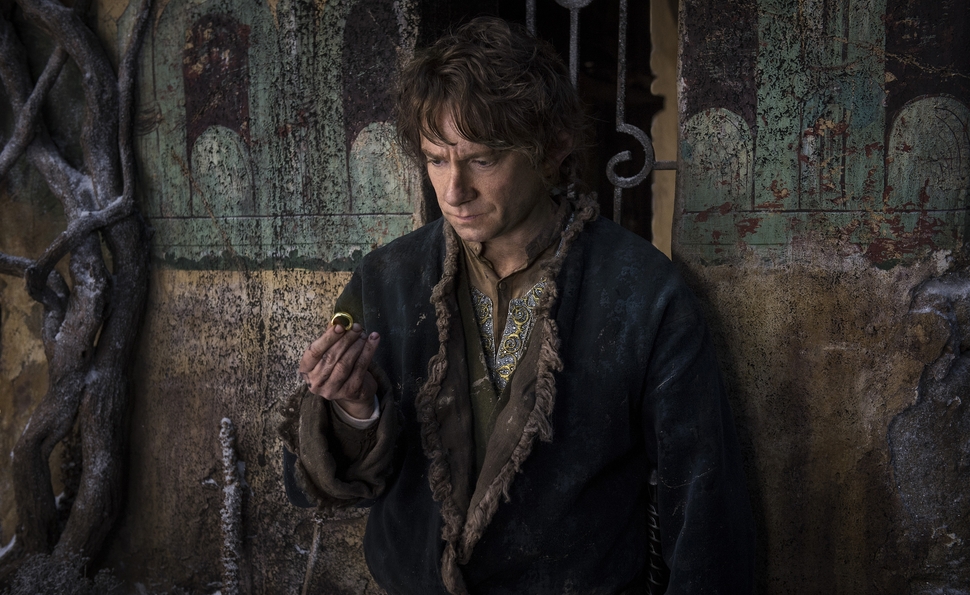
    In the Lonely Mountain, however, Thorin Oakenshield (Richard Armitage) is overcome by his lust for gold, glowering and mad with desire for the Arkenstone, the crown jewel of the king of the dwarves. This stone is in the possession of Oakenshield’s burglar, Bilbo Baggins (Martin Freeman), who has claimed it as his 1/14th of the keep. When Bilbo sees that his friend is so lost that he would go to war over gold, he parlays with Bard and the elf king Thranduil (Lee Pace), giving them the Arkenstone so that they might ransom it, averting war. It so happens that war is coming regardless of what happens, because the two unaccounted for armies, both of them Orc hordes, can’t be reckoned with.
    The Battle of the Five Armies 02

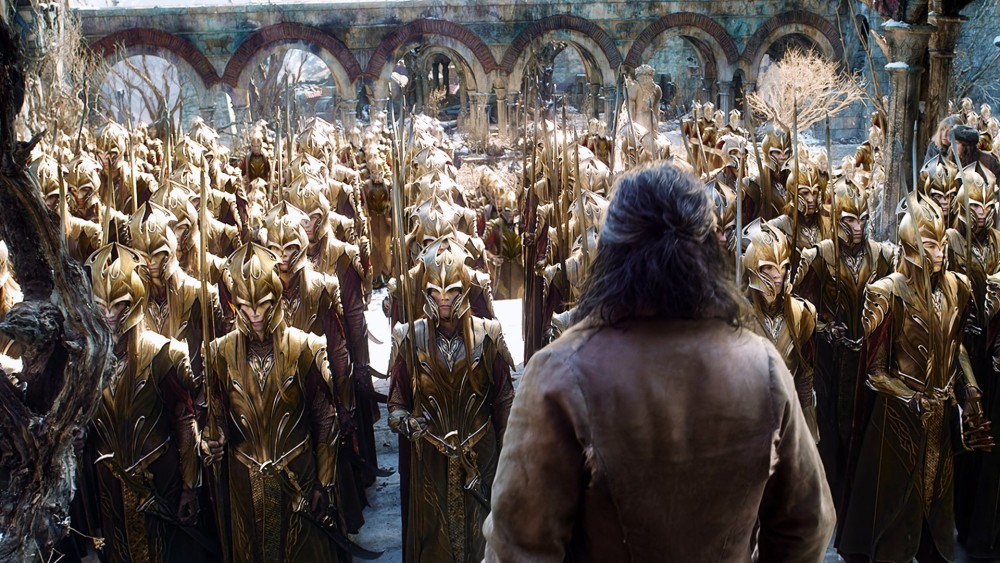
    When the battle actually starts, it’s like Jackson is finally expelling all the breath he’s been holding since the outset of The Hobbit: An Unexpected Journey. Jackson and cinematographer Andrew Lesnie use the series’ trademark sweeping long shots to show the movements of huge blocks of elves, dwarves, and orcs across the valley at the foot of the Lonely Mountain, and they are as breathtaking and spectacular as ever. The camera revels in the glint of elvish armor and the iron of dwarven shields, the blocking of bodies and the breaking of ranks. In close quarters, however, the fighting only works to show how thin Jackson’s conception of the novel as three films was. A dragon lays waste to a city, armies clash, but when a sequence focuses on a man or a dwarf or an elf or an orc as a singular entity, they’re as wraith-like as the Nazgul, apparitions of little substance because they’re meant only to serve as preamble to something else.

    And while it’s so often fruitless to complain about the problem with prequels and adaptations, that so much of The Battle of the Five Armies serves to set up The Fellowship of the Ring often leaves poor Bilbo Baggins standing around with Gandalf, waiting for his inevitable happy ending in the Shire. That’s a shame, too, as the best sequences of The Hobbit, like Jackson’s Lord of the Rings before it, have so often been the ones that show how stout its little protagonist is in the face of problems that are too large even for the gods and immortals whose company he keeps. Martin Freeman, as Bilbo, is as engaging as ever, and the scenes where he speaks with or for Thorin Oakenshield are the best of this film. They’re quiet. They’re meaningful. They aren’t undercut by odd bits of comedy. This, however, is not a film about Bilbo Baggins. Rather, it’s the one that leaves him behind, old and doddering, so that his younger relations can go off and deal with necromancers, rings of power, and the return of a certain king. There has never been a moment where The Hobbit didn’t feel subordinate to The Lord of the Rings, and that, more than bloat or pacing or anything else, is what’s so bothersome about this film in particular. Like a relative who has already finished the book, The Hobbit is always tittering excitedly about what’s going to happen next instead of appreciating the story being told.


    The Hobbit: The Battle of the Five Armies. With Martin Freeman (Bilbo Baggins), Ian McKellan (Gandalf the Grey), Richard Armitage (Thorin Oakenshield), Orlando Bloom (Legolas), Evangeline Lilly (Tauriel), Lee Pace (Bard), Christopher Lee (Saruman), Hugo Weaving (Elrond), Cate Blanchett (Galadriel), and Benedict Cumberbatch (Smaug/Sauron). Directed by Peter Jackson from a screenplay by Jackson, Fran Walsh, Philippa Boyens, and Guillermo del Toro. Based on the novel The Hobbit, by J. R. R. Tolkien

  • Movie Review: The Hobbit: An Unexpected Journey

    Movie Review: The Hobbit: An Unexpected Journey

    The Hobbit

    Peter Jackson’s The Hobbit: An Unexpected Journey, attempts a rare trick, inflating the narrative of a relatively short novel to accommodate a studio’s need for a franchise. By revisiting his earlier Lord of the Rings movies, plumbing the depths of other Tolkien works, meandering, as The Fellowship of the Ring did, in the Shire, and through invention, Jackson has succeeded in his task—J.R.R. Tolkien’s The Hobbit, as interpreted by Jackson, Guillermo del Toro, and an army of writers, producers, actors, extras, and digital effects artists, will indeed fill the overlarge frame it’s been mandated. The question going into The Hobbit, and this is of particular importance following the bloat of the underrated King Kong and the nigh unforgivable The Lovely Bones, is whether or not Jackson would be able to pull back on his particular brand of bombast long enough to tell a good, engaging story about a band of outsiders questing to rid a mountain of a gold-loving dragon.

    Yes and no. At times, The Hobbit: An Unexpected Journey manages to recall the highest points of Jackson’s Lord of the Rings trilogy. The characters are warm, the landscapes vast and pristine, the CGI mostly an enhancement. In adapting a beloved book as a prequel to a beloved film franchise, Jackson invites nostalgia from the film’s opening moments, as Bilbo Baggins (played as an older hobbit by Ian Holm, and for the majority of the film by Martin Freeman) is shown writing an account of his life for the benefit of his nephew Frodo (Elijah Wood), himself a future adventurer. Gandalf the Grey (Ian McKellen), Elrond (Hugo Weaving), Galadriel (Cate Blanchett), Saruman (Christopher Lee), and Gollum (Andy Serkis) appear throughout, if not to propel the plot, then to gently remind viewers of the elements shared by this trilogy and the one from the recent past.

    The bulk of this chapter deals with the preparations made by Bilbo, Gandalf, and a company of dwarves—led by the brooding, kingly Thorin Oakenshield (Richard Armitage)—before attempting to infiltrate the former dwarven homeland, now occupied by a dragon named Smaug. Much has been made of how slowly the first hour of The Hobbit slogs through these details, and that’s true; however clever it seems to have the old Bilbo coyly writing his memoirs as Frodo waits for the arrival of Gandalf with his fireworks, one can’t help but feel cooped up in Bilbo’s den, especially when entering the film with the knowledge that Bilbo sets off on an adventure, finds a ring, gains the respect of his company, and so on. This is an inferiority complex unique to prequels, one that has damned many such efforts in the past, but once Jackson sets his company out into Middle Earth, things pick up considerably.

    The Hobbit also suffers from some of Jackson’s penchant for self-indulgence. I saw the movie in 2D, and while the vistas of New Zealand and its populace of CGI orcs, mountain trolls, and giant eagles looked mostly good, there were times, when panning through the goblin kingdom or over a vast mountain, when the visuals were noticeably less crisp than in any recent Jackson film, as if I were being punished for choosing not to see the film in 3D and at a higher framerate. In one of the film’s huge battle sequences, pitting the dwarves and Gandalf against a gleefully Dickensian goblin king (Barry Humphries) and his army, the disconnect between what’s real and what was filmed against a greenscreen becomes too much. It’s obvious that none of the dwarves will die, but they rack up the kills on the poor, witless goblin army like an expert video gamer in the early levels of a well-worn arcade game.

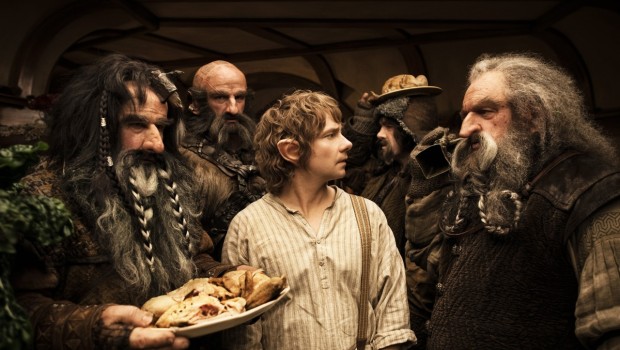
    Though he certainly tries, Jackson is unable to differentiate many of the dwarves tagging along with Bilbo and Gandalf on their journey. Some are fatter, older, or jollier than others, but, for the exception of the mopey, vengeful Thorin, they’re all mostly the same. The Hobbit: An Unexpected Journey relies upon Freeman and McKellen to carry the bulk of the film’s 169-minutes, which they’re quite capable of. When Gandalf the Grey is held back by a largely ominous, slow-moving discussion foreshadowing the conflict of the second film, Bilbo finds himself matching wits against Gollum. As Gollum, King Kong, Cesar the Ape, or Captain Haddock, few actors have meant as much to special effects spectacles as Andy Serkis, who could probably lend humanity to a broomstick. The tragedy of Gollum and the character’s madness, however, are two well-trod roads, and his game of riddles against Bilbo Baggins, though vital to series lore, never rises above being a witty aside. Compared to Gandalf’s conversation with Elrond, Galadreil, and Saruman, however, it’s pressing, kinetic stuff. Still, for all its down moments, The Hobbit: An Unexpected Journey is that rare creature: a good, mainstream fantasy film, a franchise-extending artifact that manages to find enough warmth to justify its existence.

    I’ll admit, when it comes to splitting book adaptations into an endless succession of questionable sequels, I’m a bit of a skeptic. It’s a recent trend, the franchise addendum, and begs an odd indulgence of its core audience, the fans of the book: pay for some now, and pay again for the rest later. Harry Potter did this. The Twilight Saga did this. Upcoming adaptations of The Hunger Games and 50 Shades of Grey will likely follow suit, with little question of the studio’s motive in releasing as many gigantic blockbusters as possible in successive years. But that’s decidedly not the tone of the coverage surrounding this particular adaptation. A relatively slim volume, especially compared to the tomes that contain the largely empty prose of E.L. James, Stephanie Meyer, or Suzanne Collins, the only precedent for turning Tolkien’s fantasy into a full-blown sojourn on the level of the Lord of the Rings trilogy are the expanded editions of those films, which further packed and padded a series of movies that were, at times, already overstuffed. For many fans of Harry Potter or Twilight, the added film served as an opportunity to bring the series to a fitting, properly epic conclusion. As a casual onlooker, I can’t say I agree with their enthusiasm. I try, as much as possible, to separate a book from the film based upon it, but, for me, the adaptations that work the best are the ones that pare down on the impulses a blank page grants an author, rather than eat-up more than an already considerable chunk of time trying to please every die-hard in the audience.

    What Jackson has done with The Hobbit is rare in that the decisions he’s made in adding to The Hobbit are decidedly not made for the benefit of his die-hard audience, who, to paraphrase the words of The Mountain Goats’ John Darnielle, want a one-film version of The Hobbit where a dragon is slain in the end. I won’t suggest that Jackson’s planned trilogy (who knows—maybe they’ll split the third film in two, like a magician with a saw) isn’t an opportunity for Warner Brothers, New Line Cinema, and MGM to fashion themselves a clutch of gold, but if any literary universe is capable of sustaining the sort of expansion the director and his writers have undertaken, its Tolkien’s. The horde of books, short stories, note cards, and outlines the author left is breathtaking, and the odds of any of that material making its way to the theatre on its own are slim. Some of Jackson’s additions, like Radagast the Brown (Sylvester McCoy)—a wizard who speeds his way through Middle Earth on a rabbit-driven sled, his goofiness in the face of world-ending danger a reminder of the sillier aspects of George Lucas’ Star Wars prequels—add nothing. A necromancer (Benedict Cumberbatch in name only—he appears momentarily as a CGI construct, bits and bytes over flesh and blood) from another Tolkien story serves to perhaps unnecessarily tie together events from this film and the Lord of the Rings. But the film’s main addition, the Pale Orc, is not only something created wholecloth for this film, but is a character whose quest to murder Thorin Oakenshield for the loss of his arm is more immediately relatable to on screen than, say, a pack of talking dogs or a flock of hyper-intelligent eagles. The stakes of prequel films, whose outcome is determined by prior movies whose success does not always equal interest in “the rest of the story,” are notoriously low. By playing with elements from Tolkien’s expanded Middle Earth, Peter Jackson has found a way to infuse his prequels with tension and suspense. In its best moments, The Hobbit: An Unexpected Journey easily meets the expectations of its pedigree. The Hobbit may not be either a perfect film or adaptation, but neither were those sainted films preceding it.


    The Hobbit: An Unexpected Journey. Directed by Peter Jackson. With Ian McKellen (Gandalf the Grey), Martin Freeman (Bilbo Baggins), Andy Serkis (Gollum), Richard Armitage (Thorin Oakenshield), Sylvester McCoy (Radagast the Brown), Hugo Weaving (Elrond), Cate Blanchett (Galadreil), Christopher Lee (Saruman), Ian Holm (old Bilbo), and Elijah Wood (Frodo).