Tag: First Issue Collector’s Item

  • First Issue Collector’s Item: Fashion Beast #1 (2012)

    First Issue Collector’s Item: Fashion Beast #1 (2012)

    First Issue Collector’s Item is a periodic, ongoing look at that most illusive (and, in many instances, ultimately valueless) pop-culture artifact: The first issue of a comic book series. This week, Alan Moore returns to monthly comic books with Fashion Beast #1.

    I can’t exactly say I was shocked to learn that the genesis of Fashion Beast was an unrealized script from the mind of punk rock provocateur Malcom McLaren. Afterall, McLaren had as chaotic a relationship with film as he did with music. In 1977, McLaren hired Russ Meyer to make a movie about the Sex Pistols. Meyer, in turn, hired Roger Ebert to write the movie, and the two men responsible for Beyond the Valley of the Dolls set out to create a film about a band neither had listened too. Ebert’s brilliant script, Who Killed Bambi, includes scenes wherein Johnny Rotten confronts a religious group quite like the Church of Scientology and Sid Vicious shoots heroin with his mother. When Russ Meyer—whose tastes were good and clean, if perverse—asked McClaren if Vicious would be up for that sort of thing, he shrugged the question off entirely. “Why wouldn’t he?” McClaren said. “It’s all based on fact.” Why not, indeed? McClaren, after all, was just throwing every idea he had into a manic, potentially unfilmable script.  (more…)

  • First Issue Collector’s Item: Suicide Squad #1

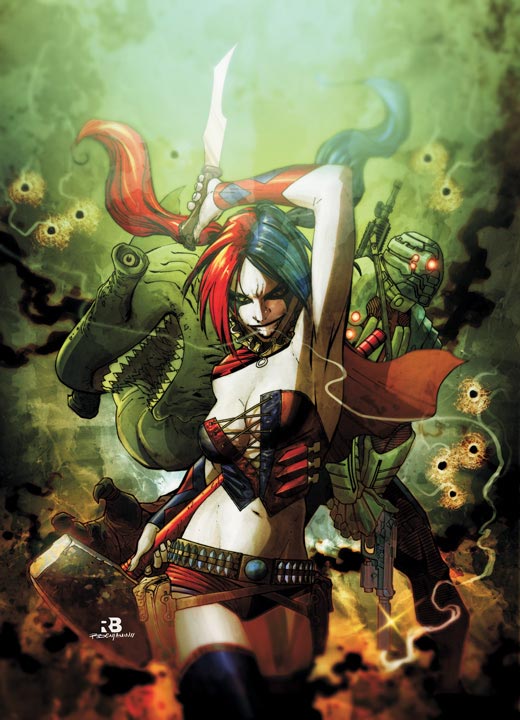
    First Issue Collector’s Item: Suicide Squad #1

    Suicide Squad harley quinn

    One of my difficulties in getting into DC Comics (and when I worked at a comic shop and had free reign with my pull list, believe me, I tried) is that the collection of villains faced by guys like the Flash, Green Lantern and Green Arrow are often, well, boring. Even Batman has some rogues that were just impossible for me to get into, as they had, in my estimation, no real purpose. A guy like the Penguin, for example. Great in the old TV show. Great in Batman Returns. Terrible in the comics, where he was a nightclub owner who may or may not have been running guns, who may or may not have been a good source of wisdom. Too often, a member of the Bat Family would drop in on his club, beat up Penguin until he squawked, and that’d be it. Deadshot, one of the main characters of Suicide Squad has kind of the same problem. He’s an assassin, and that’s it. You pay him, he shoots people, he moves on. Oh sure, he’s a talented assassin, and he only misses if Batman screws up his shot, but if you think about the number of superheroes and supervillains in the DC universe…there’ve got to be HUNDREDS of guys just like Deadshot out there, making a pretty good living despite the fact that they’re not dressed in some snazzy armor or carrying a wrist gauntlet gun. What’s so exciting about that?

    The Suicide Squad, as created by John Ostrander, has a way of re-contextualizing these villains. Taken from their cells by a secret government agency and fitted with a tiny bomb that will blow up if they disobey orders or drop off the grid, the men and women who make up the team of ex-cons are sent to do some of the DCU’s more ruthless tasks–at the end of this issue, for instance, they’re sent on a mission to attack an NFL-sized stadium with some 60,000 people inside. Not only does it give a nobody like King Shark something to do with his life beyond biting the arms off of passers-by, it gives dudes like Deadshot something to fight for–not only will the agency kill him if he screws up, but they know his secrets and can hurt him that way, too. (more…)

  • First Issue Collector’s : Batgirl #1

    First Issue Collector’s : Batgirl #1

    Batgirl Gail Simone Adam Hughes

    I don’t know how damning this is as a comic book nerd, but I’ve never had an affinity for Barbra Gordon, Batgirl. Barbra Gordon as the Oracle being something totally different, in her original form Gordon evolved from a swinging mod-librarian more excited about accessorizing than fighting crime to one of Batman’s many interchangeable sidekicks, only she was the daughter of Jim Gordon, so she had certain advantages, story-wise, that both Nightwing and Robin didn’t have–imagine the chief of Gotham P.D.’s daughter being captured by the police and revealed as a vigilante! Of course, the Joker shot Barbara Gordon in the spine, paralyzing her from 1988 to 2011, a remarkable era of consistency in a medium that resurrects characters who didn’t die violently enough in the past.

    With Batgirl #1, that’s over, and all of Barbara’s post-Killing Joke stories seem to have been tossed out the window. The Joker still shoots her, the gunshot still paralyzes her, but after three years she’s able to walk again. Gail Simone doesn’t put much effort in explaining the whys and wherefores of this development in Barbara’s life, but she doesn’t exactly need to. Like Grant Morrison in Action Comics #1, Simone is less concerned with history and more concerned with character building. So it’s not important to Gordon why she’s able to walk again, but what she’s going to do now that she can. The answer, obviously, is to go back out on the streets and fight crime.

    Things are hardly perfect on her first night out, however. She’s rusty, prone to error, and almost gets herself and her perp killed. What’s obvious, however, is that Batgirl will soon have more pressing issues than the local murder gang. There’s a supervillain going around town calling himself Mirror. He’s none too pleased with individuals who should have died in random accidents and, like death (the metaphorical concept of death, I suppose) in the Final Destination movies, he takes it upon himself to finish nature’s job. This suburbanite watering his grass, for instance:

    A confrontation between Mirror and Batgirl is inevitable (Barbara Gordon is on his list), and when it does happen, we find that Batgirl is very much afraid of what should happen to her if she is shot through the spine again. This…is actually rather shocking, as it’s not everyday that a superhero demonstrates fear of anything, let alone something as practical as a gun pointed at her stomach. Most superheroes, you will recall, have some sort of weakness. Superman has kryptonite. Green Lantern has yellow. Batman is merely human. But these guys charge headlong into threatening situations without thinking twice and, to be frank, it’s a little boring. Barbara Gordon goes into situations where guys have guns even though she’s terrified of guns and, though one is pointed right at her, she wills herself to continue. If every issue has a moment where a bad guy gets the drop on her and she freezes up, it’ll get old quickly, but it’s nice to know that Gordon isn’t just headed back to the field, carefree, like nothing ever happened. She’s got scars, and she’ll need to battle those.

    Mirror, though, is kind of a lame villain. Beyond the awful name and his spike-knuckled gauntlets, the guy is dressed in black and kills people in a decidedly 1990s way, with as much violence as possible. This may be Simone’s intent, since, as the former curator of Women in Refrigerators, she knows a thing or two about 90s violence, a lot of which can trace its roots back to Moore’s Killing Joke (and his Watchmen, and Frank Miller’s The Dark Knight Returns). Looking at the guy stroll through a hospital blasting cops in half is a stark reminder of what I dislike about comic books, and while Simone does it well enough and, I’m sure, is pushing Mirror in a logical direction, something about the later realism of his killings takes a lot of the fun out of this issue.

    As far as the art goes, I can’t imagine that Batgirl’s costume stays the way it is for long–the only thing here not covered in intricate line-work is the cape. Adrian Sayf does a good job with it, though, as Batgirl is never portrayed inconsistently. Eventually, though, I suspect a lot of that detail will go away, like when Spider-Man’s costume lost half of its webbing when Steve Ditko left the book. There are moments when the action from panel to panel is so cluttered that the backgrounds melt away into solid color, which is a little annoying, but I suppose that can’t be helped and nothing gets lost along the way.

    It’ll be interesting to see where they go with Barbara, who moves out of her dad’s place and into a new apartment with an activist roommate, the Craigslist special. Simone is one of the best mainstream superhero authors when it comes to depicting women (this is a skill many comic scribes lack) and shortcomings, and it’s clear that Barbara has a lot to deal with. If she’s allowed to deal with it, this’ll be a successful book, and one of my favorites of DC’s relaunch. If she’s a free-swinging airhead this time next year, consider it a lost opportunity.


  • First Issue Collector’s Item: Action Comics #1

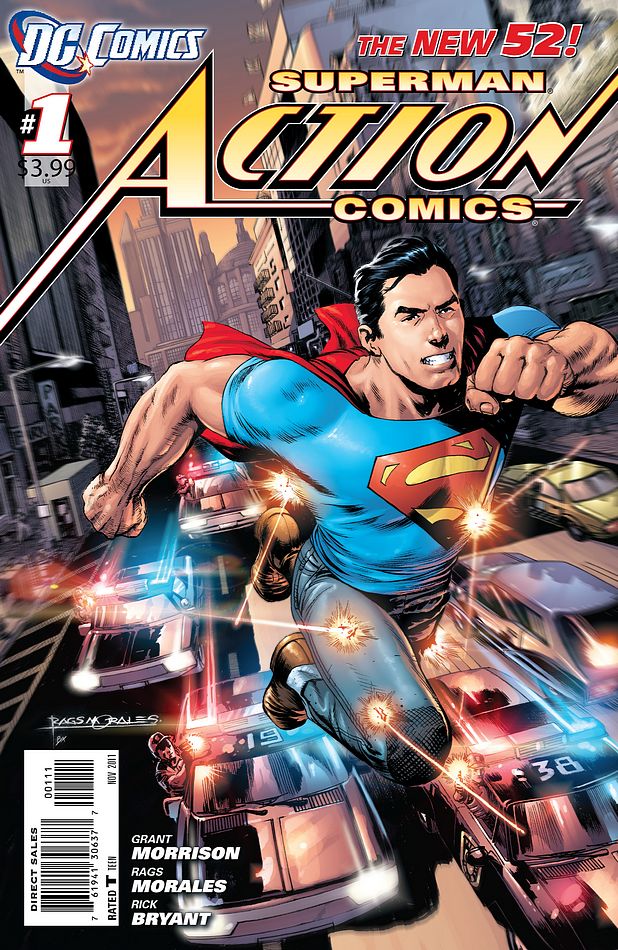
    First Issue Collector’s Item: Action Comics #1

    Action Comics 1 Grant Morrison Rags Morales

    Yes, Superman is wearing jeans. And a t-shirt. And work-boots. But lost amid the hubub over the Man of Steel ditching the baby blue onesie in favor of a decidedly more working class look is the challenge that comes with taking Action Comics, which has run continuously since June, 1938, stamping a new #1 on the cover and rebuilding the Superman mythos from scratch. This, along with the renumbering of Detective Comics and the rebooting of Batman’s mythos, is the big risk of DC Comic’s push to make its way back into the hearts, minds and hands of America’s children and casual comic book readers, but beyond maybe making a few number-crazy fanboys upset, Superman’s new look and new(ish) mission should come as no surprise–in comicdom, everything is up for revision.

    Everything.

    Unlike Superman-Red/Superman-Blue, the Clark Kent presented by Grant Morrison and Rags Morales actually seems like he’s able to bring the character into a new era. Rather than spending time on his origins (Morrison has already captured Superman’s birth as perfectly and as quickly as possible in All-Star Superman), Action Comics jumps right into Kent’s formative days as a superhero. His mission is to make sure that the ultra-rich of Metropolis abide by the same laws as the ultra-poor, which makes his choice of wardrobe nothing if not appropriate. With his jeans rolled up and his cape hanging to his t-shirt by the force of will, this Superman looks more comfortable putting in a hard day’s work than being a paragon of virtue. (more…)