Tag: Dusty Rhodes

  • Shoot Fight: Hulk Hogan vs. Roddy Piper (10/26/1997)

    Shoot Fight: Hulk Hogan vs. Roddy Piper (10/26/1997)

    This is a column about kayfabe. By this, I mean that I’m writing about magic, a very specific, working class, queer, dirty magic that has worked its way into the roots of my being since my first exposure to it. A kind of magic that feels like a curse sometimes, especially when it tries to deny that grit, which it should be proud of but so often isn’t. When wrestling fans talk about kayfabe, they’re usually talking a magic that does not exist beyond childhood (if it ever did at all): The distorted world that wrestlers and promoters create to give the illusion that the contests in the ring are real and for real things: Money, championships, respect. Cue the YouTube clip of a man in the bleachers in a high school gym, sobbing as he tells his heroes that wrestling is still real to him. Realize that he’s saying this because it isn’t, and that when people say things like this they mean it was better when they were younger, which either is or isn’t true of everything depending on how much nostalgia rules your perception of culture.

    The fact is this: We have always known that wrestling is fixed, and to pretend otherwise is to do an entire art form an injustice. Kayfabe, then, isn’t so much about how the world of wrestling is so much as how it is seen by those observing it. There’s no strict definition because every fan and performer has their own, a thing that works for them and nobody else. For me, kayfabe is a vibe. For me, kayfabe is less the feeling that wrestling is or can be real than it is about the struggle to tell a good story or craft a good poem despite the limitations of form, which are the limitations of the human body, which is the struggle. That is what this column is about, but I’m calling it Shoot Fight as a reference to another way of talking about wrestling in terms of its realness or fakeness. A work is something that’s planned, part of the show. A shoot is anything that isn’t, whether that be an injury, an angry wrestler saying something he shouldn’t into a live microphone, or any strike that isn’t pulled. But that kind of realness is too literal for me and is often contrived to draw attention to the product. Shoots, then, are often works. Here, a shoot is something that makes it impossible for me to turn away from a wrestling match. A fight is a struggle. This is a column about kayfabe. This is a column about magic.

    ***

    In 1997, Hulk Hogan is evil. He wears black and leads a gang that uses spray paint to tag what’s theirs: title belts, the ring, the flesh of their fallen opponents. It’s a hot storyline, drawing record numbers of viewers to pro wrestling, and every broadcast they appear on ends in their so-called New World Order standing in the ring while the crowd pelts them with garbage. The genius of the “Hollywood” Hulk Hogan character was in his portrayal of a shredded demi-god, a man who had felled communism, natural disasters, and otherwise dark nights of the soul, as a sniveling coward. Once, an old woman took a swing at him. In World Championship Wrestling, the Hogan/Piper feud that launched Hulkamania for the rival WWF in the 1980s was flipped, Hogan becoming the heel to Piper’s roguish hero. Halloween Havoc was the temporary end of a feud that began on MTV with Cyndi Lauper. That night, it ended with Hulk Hogan beating up a fan.

    Between those two points, twelve years elapsed. Mr. T got involved, Roddy Piper spoke in tongues and swam in the ocean off of Alcatraz Island, and Piper managed to beat Hogan clean on several occasions, which was not something that happened often. It’s easy to think of Roddy Piper now as this macho relic of the 1980s, sunglasses-clad and murdering aliens in a bank because he’s all out of bubblegum to chew, but he possessed of a kind of magnetism that’s hard to describe, everyman… but not. In 1997 he was appearing as a born-again Christian wrestler in reruns of Walker Texas Ranger and on WCW Monday Nitro talking about his knee replacement in interviews designed to build to his matches against Hollywood Hogan, but when he said that what WCW needed was a real man, fans responded to that loudly. When he beat Hogan, putting him down with a sleeper hold, the fans responded to that, too. Folks with a long view of wrestling history often claim it was a fatal mistake for WCW to rely so heavily on men like Piper and Hogan to sell tickets, but that’s a hindsight thing. The cage match at Halloween Havoc drew terrible reviews, but it worked. Listen to that crowd when the referee counts Hogan out. They’re eating it up.

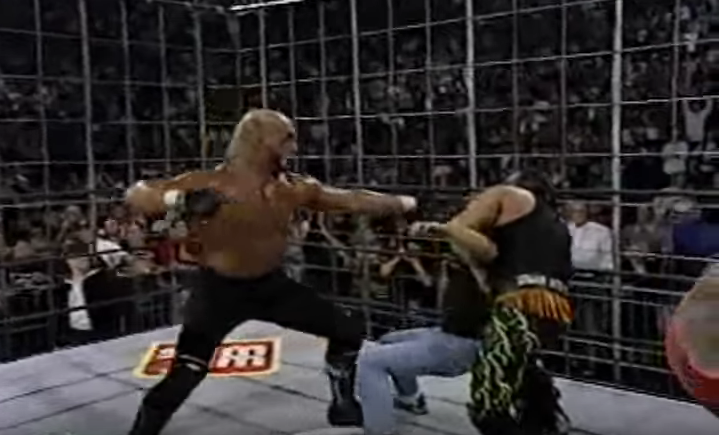
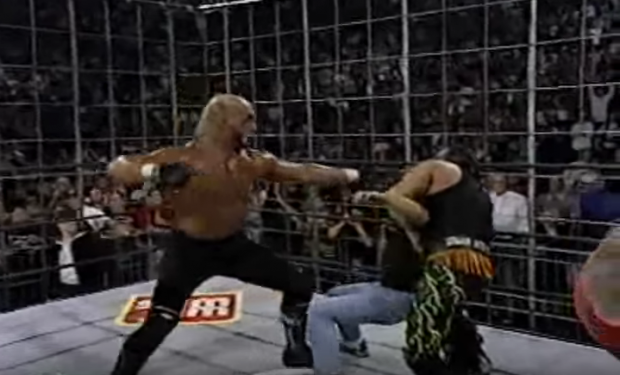
    Hogan playing the role of coward is essential context because, despite his lawsuit against Gawker over a sex tape, despite his racism and effort to mitigate that on morning television, the image of Hulk Hogan that persists in culture is that of the hero. But in 1997 fans wanted to fight him. Or they wanted someone who could fight him for them. You’d think that might be Piper, given his superhuman ability to defeat Hulk Hogan, but in reality that man was Sting, a dejected WCW icon who had taken to painting his face like Brandon Lee in The Crow and rappelling to the ring from the rafters, where he would fight eight, nine men at a time with his baseball bat. He wanted to fight Hogan, the dark image of 90s heroism against the dark image of 90s villainy, but Hogan was running scared. At Halloween Havoc 1997, the story was that Hogan refused to wrestle Piper in a cage unless WCW could guarantee that the mercurial man in the rafters wouldn’t be in the arena at all. Hogan got his wish, but was psychologically tested (really stretch your ability to believe this) by the presence of a bunch of people who kind of looked like Sting because they were wearing trenchcoats and Sting merchandise and, well, it was Halloween Havoc. One of these lookalikes enters the cage and is attacked by Randy Savage, who interferes on Hogan’s behalf, but all of this is, as we say, a work. The shoot, if that’s what it was, is this: A fan jumps the guardrail, climbs the steel cage, and tries to rescue Roddy Piper. He’s painted like Sting, the hero, because of course he is. He is beaten mercilessly by Hogan and Savage, two of the biggest names in wrestling, because of course he is.

    I think of this moment frequently. It sticks out to me more than most matches I really enjoy. I thought of it recently, sought it out, because something I saw from the fourth row of a local wrestling show shook it loose from my memory. A drunk dude jumped a guardrail. This happens all the time, maybe once every three or four weeks. A person in the audience is bored or hammered or trying to impress their friends, so they jump the rail. At a World Wrestling Entertainment show, this person is usually tackled immediately by security and taken to jail without anybody noticing. This is indie wrestling, though, and there’s no security. In the ring, there’s a wrestler—some sweaty straight-edge type with a green-tipped Mohawk, a man who had earlier done a no-look backwards leap from the top of a basketball hoop—and he’s snarling about something the drunk dude had said, spitting at him, egging him on. The fan thinks it’s all a joke—the wrestler’s anger, wrestling itself. He’s smiling as he slides into the ring, maybe thinking about a photo op, but before he can stand, the wrestler crushes his head with one black leather wrestling boot.

    The fan at Halloween Havoc 1997, he’s someone whose name I don’t know, someone whose story is unknown to me. After the match, with Roddy Piper victorious but handcuffed to the steel cage, the producers cut away from the action where a camera catches him leaping the guardrail to climb the cage structure. There is nobody there to stop him. Nobody has mentioned him since. It takes another act of wrestler-on-fan violence to kick up his ghost, or the ghost of his ghost. He exists as an afterimage now, a footnote. “We are desperately out of time,” one of the announcers says as security pulls Hulk Hogan and Randy Savage off of a person for whom time is frozen, but what does it mean to live forever in a minute the world has forgotten?

    I’m stretching a bit here, but wrestler-on-spectator violence dates back to the origins of the sport. Matches were first held at carnivals and fair, exhibition bouts featuring a traveling “hooker,” a legitimate toughman who could torture joints and break bones with an array of simple submission holds. Laymen would pay admission to fight this grappler, hoping to last three minutes to win a cash prize. There were regular Joes who could give the hooker a run for that money, but usually even the best audience member could be grappled over to a side of the ring that was curtained off from the crowd. There, someone else would club the challenger secretly with a blackjack or a billy club, preserving the hooker’s reputation and ensuring that the house always won. As wrestling moved out of traveling tent shows and into major sports arenas, this kind of fan interaction evolved. Newspapers made a big deal about wrestling being phony. Fans were passionate about the subject of wrestling’s legitimacy, and promoters, passionate about the money those fans brought to the show, encouraged their men to play their characters outside the ring at all times. Wrestlers would start and win fights at the bars. Journalists, when they were interested in wrestling, often encountered the surliest looking man on the roster, someone who’d slap the shit out of them for presuming that wrestling was “fake.” You can look them up: Dr. D. David Schultz slapping John Stossel, Big Van Vader menacing the host of Good Morning Kuwait while on tour in that country. Hulk Hogan even made Richard Belzer pass out in a sleeper hold once. All in the interest of “protecting the business.”

    But fans that stick around for a while don’t care if wrestling is fake or if the moves hurt. They can be riled up or made to cry or, at the very least, made to buy a ticket, which is all any promoter worth his salt cares about. Still, listening to some wrestlers talk, listening to some wrestling fans talk, there’s no end of nostalgia for certain time periods or territories, the 1970s in Memphis or Louisiana or Texas, the National Wrestling Alliance of the mid 1980s. A lot of wrestlers talk about the scars they picked up from their encounters with fans who were carrying chains or knives or worse, run-ins with old women who’d stick them with their hatpins and cackle with glee while high-fiving everybody around her. If you were a member of the Fabulous Freebirds and you used hair cream to blind the Junkyard Dog, preventing him from seeing the birth of his first daughter, well, the Louisiana Superdome was probably the least safe place on earth to be. But they went there, brother, and they survived the spit and the epithets and the broken bottles. They laugh about it now, evidence that they did their jobs well.

    Having a fan jump the rail in 2017, or in 1997, or, really, in any era, seems proof of a masterwork, ring artistry that is unparalleled and mostly impossible, given that we’re all in on the act. There are idiots who look at professional wrestlers—muscle-bound, scarred, missing teeth—from their seat way up in the upper bowl of an NBA arena and think Man, I could take that guy, but those people are almost never the ones who jump the rail. Sometimes the people jumping the rail are just seeking attention. Sometimes they are brave and deluded. Sometimes, they actually make it into the ring before security can touch them. They have a special destiny, these people who are drawn to the choreographed illusion before them, and what happens next is beyond their control.

    The thing of is, Halloween Havoc 1997 is actually a really good wrestling show; boredom isn’t an excuse. One of the matches, a mask vs. title match between Rey Mysterio, Jr. and Eddie Guerrero, is one of the most influential matches of the past twenty years. Randy Savage and Diamond Dallas Page put on a good show in a “Sudden Death Match” where nobody died. The main event, if nothing else, contains the spectacular visual of Savage leaping from the top of the cage into the ring to interfere on Hogan’s behalf. WCW cards were structured like this so that fans felt like they got something for their money, even if the big payoff—the vanquishing of Hogan—was never going to happen. Most times, watching a fan get in the ring, there’s a certain amount of satisfaction in seeing security or a referee tackle them before they touch a wrestler, in knowing that he’ll be spending a night in jail for rupturing the liminal space between the ring and the stands. But it’d been a year since Hogan went sour and started calling himself “Hollywood” because he’d been the star of such films as Mr. Nanny and Santa with Muscles. They’d teased and teased and teased that somebody—anybody—from World Championship Wrestling would be able to cut the head from the snake that was the New World Order, and, finally, Roddy Piper had managed to do it. He won clean, despite Randy Savage and despite the chaos and turmoil that surrounded the cage, and for his trouble he found himself handcuffed and whipped and otherwise punished. Somebody had to do something, and somebody did.

    The key narrative element of the match being the presence of a gaggle of fake Stings, it’s understandable how security lets a fan wearing Sting face paint jump the barricade. It’s easy to understand why “The American Dream” Dusty Rhodes, from his place at the announcer’s table, loses sight of what is happening. “YES! YES! YES!” he cheers, watching that fan scale the cage. What the fan hopes to accomplish here is clear. After his moment of triumph, Hogan and Savage handcuff Piper and beat him mercilessly. Sting, the only man capable of saving him, is true to his word and is not in the building. Nobody else is coming to help. The camera follows that fan’s every move because even the people in charge can’t tell what’s real and what’s fake here. Everything is real and nothing is fake. Everything is fake and nothing is real.

    I’ve thought about this scene was planned or not a lot since I was nine years old, but I’ve never wanted to ruin the illusion, if that’s what it is, that this fan was acting purely out of passion. World Championship Wrestling played ringside security a little looser than World Wrestling Entertainment ever did, constantly testing the boundary between the ring and the fans. Beyond the Stings in the audience tonight, there’s a stable of alt-rock rejects-cum-wrestlers who sit at ringside during matches. Diamond Dallas Page celebrates his victories by going out into the crowd. Clip after clip of interviews from this time feature perfectly aimed beverages flying from the stands into the faces of those who would abuse our heroes. Here, there’s a camera in position to catch the fan jumping. The live editing almost makes the whole thing seem like a set-up. Hogan puts on a Sting mask and laughs, preparing to whip Piper. We cut to ringside, where a cameraman is out of position for everything except the fan in his face paint. If he’s a plant, why is he dressed differently from the other plants? If he’s a fan, why is the camera on him?

    It doesn’t matter, I suppose. I love this kid, this fan who hasn’t aged a day since 1997, this boy who is wedged forever in this moment that is his and not his, who tried to do something on behalf of all of us, who tried to help we who were helpless. I love that there is no hesitation in his motion. He begins climbing the cage. He slips. He continues to climb. He reaches the floor and is tackled by the planned fake Sting, pinned against the cage for his own safety. Hogan and Savage take notice of the situation and begin to beat up the fan. Watch any punch Hulk Hogan throws in his career. Watch the one he levels this child with. There’s no cartoon exaggeration here, just a 24-inch python striking some nobody armed with greasepaint and his courage. Security gets involved, but Savage won’t let go. Hogan kicks the fan in the ribs while the announcers remark upon the situation, trying to keep some balance between the storyline that’s happening with Hogan, Savage, and Piper and this scene with the fan, something that will never go commented upon again.

    Real? Fake? I don’t care. I feel for this kid the same way Neko Case feels for the child at the bus stop in “Nearly Midnight, Honolulu.” His situation is so unbelievable, so fucked up, that I just want to say that it happened. If you’re out there and you’re telling the story of how you got your ass kicked by Hulk Hogan and the Macho Man, I believe you because it happened. And if you’re wondering, nearly twenty years later, how differently things may have played out had Roddy Piper not been handcuffed to the cage, know that he would have punched you, too. You can’t play the hero for your heroes.


    This essay was originally published by Entropy in 2015 and has since been edited. Entropy is an incredible website bringing together a wide variety of writing from the broader literary community. Support them! Also, while you’re at it, support me via Patreon.
  • Wrestling Review: WWE Fastlane (2/22/15)

    Wrestling Review: WWE Fastlane (2/22/15)

    WWE Fastlane Daniel Bryan Roman Reigns

    World Wrestling Entertainment decided to re-brand their February pay-per-view event Fastlane to play off the fact that they call the long stretch between Royal Rumble and WrestleMania the Road to WrestleMania. In every documentary I’ve seen about the event, the 31st edition of which takes place on March 29, a member of creative or a wrestler, perhaps Triple H or Vince McMahon, even, will claim that the Road to WrestleMania starts the day after the show, when the exhausted crew gathers in the basketball arena adjacent to the stadium they’d just occupied and begins plotting out the next episode of Raw. This was true once, perhaps, before World Wrestling Entertainment was the only game in town, before it had to fill five hours of broadcast television and yet more for their online outlet, but the days of WrestleMania being plotted out a year in advance have been over for some time. If anything, it’s called The Road to WrestleMania because that’s when the pieces for the show really start to fall into place. The fallout from the big show may string things along until SummerSlam, but everything from that August show until about the Royal Rumble is about the promise that WrestleMania will be worthwhile.

    This year, unable to promote an Elimination Chamber event because the titular construction is expensive to set up in arenas that can’t easily accommodate it, Fastlane held the promise, due to its punning title, of accelerating the company’s storylines heading into WrestleMania. One problem (the problem) is that the WWE hasn’t had much in the way of success with many of its storylines of late. Really, they’ve been treading water since Daniel Bryan, fresh off his triumphant double header at WrestleMania XXX, suffered an injury that took him out of the picture for nearly a year. There were glimmers of hope, here and there. Brock Lesnar destroying John Cena at SummerSlam. The finish to Team Cena vs. Team Authority at Survivor Series. Daniel Bryan’s emotional return to Raw and his declaration that he would not have to retire. But 2014 was something of a lost year for World Wrestling Entertainment, and the Road to WrestleMania has been a hard one thus far. Last year, Raw was must-see television. This year, one had to pin one’s hopes to this new, generically-titled pay-per-view to kickstart the build necessary of a show that’ll be held at Levi’s Stadium, that glittering beacon of publicly subsidized, corporately overseen athletic carnage. And, on paper, Fastlane looked like a great card, the sort of show that would get lost because it was between Royal Rumble and WrestleMania, but that would be discovered again and again by those curious enough to put in the time on the WWE Network. To be blunt, that’s exactly what this show was not.

    The crowd at the FedEx Forum were pumped for Fastlane for about the first three seconds of Dolph Ziggler’s theme song, then dead from the minute Erick Rowan’s theme hit to the closing stretch of the main event. I can get over a bad crowd (the way WWE has paced their shows over the last year, one has to get over a bad crowd), so I settled in for the expected sleeper classic. And the opening six-man tag team match, with a muddled storyline dating back to November, had me hopeful. Ziggler/Ryback/Rowan vs. Big Show/Kane/Rollins looked like it had no reason to be on this (or any) card, despite how much I dig Ziggler, Ryback, and Rollins. After Ziggler’s win at Survivor Series over the Rollins-led Team Authority went nowhere, another meeting between these two teams in any configuration was the last thing I wanted. Ryback, a physical freak who won me over by being a physical freak, may be the most improved wrestler of the calendar year. Erick Rowan, himself a huge man, may prove to be the most surprising. The story of any match involving The Authority is that they always have the numbers advantage and have more of a reason to stay a cohesive unit. Seth Rollins is on another level when it comes to his ability to put together creative, amazing sequences. Early, he rolls out of the way of a Ryback splash and has his curbstomp countered into a big powerbomb. Later, he looks to hit Ryback with a blockbuster, but is caught in the Shellshock. These are big, impressive spots to be landing in what’s essentially a throwaway match to end (hopefully) a long stagnant feud, but Rollins is so good that he’s able to elevate whatever material he’s given. In the end, though, it’s a nice bit of double teaming from Kane and The Big Show that gives The Authority a somewhat surprising win. After the match, a five-on-three assault (J&J Security are involved, of course) is too much for Ziggler, Rowan, and Ryback. Just when things seem hopeless, Randy Orton finally returns, dispatching the majority of The Authority with his RKO. Waaaaaay back in November, Triple H officially chose to back Seth Rollins over Orton, leading The Authority to injure his former Evolution running buddy. This is his revenge, though it’s hardly complete. Rollins was pulled from the ring by Big Show, and he ran at top speed to the parking garage. Orton vs. Rollins seems like a lock for WrestleMania, and it should be a good one. Where it leaves Ziggler, Ryback, Rowan, Kane, and Big Show is a mystery that’ll either be solved over the next five weeks, or during the catch-all battle royal that exists to eat 20-minutes of time at the show.

    Backstage, Dusty Rhodes is with his son Dustin, garbed, as he customarily is, as Goldust. It’s been hard times for the Rhodes family of late, what with Cody going crazy and figuring that he really is the cosmic entity known as Stardust, but Dusty doesn’t want Dustin beating up his youngest son too badly. Love, Dusty Rhodes believes, is what will heal this freshly developed rift. Goldust, however, doesn’t think so. To bring Cody Rhodes back, he’s going to have to beat Stardust out of him. This match, Dustin Rhodes vs. Cody Rhodes or Goldust vs. Stardust, is what I’ve been waiting for since Goldust came back for yet another WWE run, and in the best in-ring shape of his career. It seems to be the one Dustin wants to retire on, too. This match, then, was crushed somewhat by the weight of expectation, as well as by a serious error on the part of referee Rudy Charles. Everything is good, at least in the early going. Stardust’s new gear, essentially his Goldust tribute gear without a top, was a nice, weird twist on his brother’s most famous look, and the psychological aspect of the contest—Stardust getting distracted by “CODY!” chants, Goldust using his experience to outsmart his brother, Stardust taking advantage of Goldust’s reluctance to cause any serious damage to take control—was quite excellent, especially as a first chapter. The WWE’s dead crowd problem plagued it, though, as did the finish, which saw Goldust roll Stardust up and the referee make a two count before calling for the bell. Usually, mistakes that happen during the course of a match can be worked through. The referee forgetting how to count to three, however, is egregious. That’s the function of a referee. The look of confusion on Goldust, Stardust, and even Dusty Rhodes’ face at the end of the match was not good. Stardust was able to redeem things a bit afterwards with another killer promo on his family and how Cody Rhodes died when Dusty sent Goldust to fight Cody’s battle against The Authority. His beatdown of Goldust, complete with one last no-look kick after the promo, saved their night.

    The WWE Tag Team Championship, like everything that isn’t the World Heavyweight Championship, are albatrosses, title belts that are spoken highly of on commentary but which doom their owners to the relative obscurity of four or five minute matches on Raw and SmackDown!. The “art” of tag team wrestling has largely been lost (Vince McMahon reportedly isn’t a fan, and most teams don’t stay together long enough to build anything like real chemistry), but The Usos are a solid enough foundation for a division that always seems to be in the midst of a rebuild. Cesaro and Tyson Kidd are “the best new tag team we’ve seen in awhile,” meaning “the tag team we are focusing on this month.” This match stems from the scripted marital drama of Total Divas, where Natalya is seemingly always on the verge of ending things with her husband Tyson Kidd, and Naomi is enjoying her new marriage to Jimmy Uso. Natalya thought it would be fun to have a double date with Jimmy and Naomi, but Tyson Kidd invited Cesaro along (their relationship being an interesting one, too), and the ensuing altercation at a “restaurant” gave us this match. Kidd and Cesaro are still a new team, but they seem to be meshing well. Cesaro’s power and Kidd’s speed are impressive when combined, particularly on moves like Cesaro’s deadlift superplex and Kidd’s slingshot elbow drop. They spend most of the match working on Jimmy’s leg. Cesaro even alters his swing so that he whips Jimmy Uso around by the damaged leg before sinking in a single-leg crab. It’s good stuff, then it falls apart when The Usos go into their comeback. It’s hard to explain why, but it just does. The flying Uso stuff leads to some convoluted action at ringside highlighted by a Samoan drop into the crowd barricade, and then Kidd manages to win once the match moves back inside the ring with a fisherman’s neckbreaker. The Kidd/Cesaro/Natalya character work continues when Cesaro pulls his partner away from a celebratory kiss with Nattie, but it’s tough to say where any of it is going. Tyson and Natalya have been playing a will-they-or-won’t-they game since Kidd re-debuted on Raw last year, and the Cesaro stuff gives the angle the appearance of a love triangle with Kidd being pulled between the affections of his wife and his tag team partner. That can’t be where they’re going with it, though, so we just have this weird angle where one member of a tag team was trying to respect dinner and the other brought his angry, well-dressed friend as a third. Now we enter the period of title feuds where the former champion talks about automatic rematch clauses. How exciting.

    The face-to-face meeting between Triple H and Sting existed as a means of setting up their match at WrestleMania. Really, the whole “confrontation” was had on Monday, when Triple H shoved his sad, old mentor Ric Flair to the ground after Flair insinuated that Triple H was perhaps taking Sting too lightly. We got the gist of Triple H’s issue right there: Sting’s a WCW guy. WCW has been dead since the year 2001. But in 2014, Sting finally showed up to a WWE event, temporarily causing Triple H to lose control of a company that he sees as his and his family’s legacy. So he came out to Fastlane not in his suit and tie, but in his tough guy leather jacket, with his hands taped so heavily he could hardly make a fist. He went through those talking points again, which brought out Sting. Without his WCW music and with 18 years between him and his 1997 peak, all silent, “Crow” Sting accomplishes at this point is to give us a match between Sting and Triple H without being given a reason for the guy’s reemergence. WWE is calling him “The Vigilante” because Batman, but really? The injustice Sting chose to fight was the off chance that some big dude in a sheep mask might be fired for losing a wrestling match? Triple H tries to catch Sting off guard, but his play to grab his customary sledgehammer allows Sting to grab his trademark baseball bat, which he backs Triple H up with by sticking it to his throat. Sting says that he wants a match at WrestleMania, which he gets. Triple H’s second attempt at attacking Sting ends with him getting hit in the gut with the bat and dropped with the Scorpion Death Drop. This segment existed to give Sting a reason to point at the great WrestleMania logo in the sky with his baseball bat. Even today, it seems the general consensus is that Sting vs. The Undertaker is the preferred match-up, but this overlooks two crucial facts: Sting’s last great match probably happened in 1994, and The Undertaker wasn’t having great matches until around 1996. Of any “marquee” guy who can still have the occasional match, Triple H, garbed as Ric Flair’s protegé, is the one most able to do something with a 55-year-old man whose shine and mystique were largely wasted through a decade spent in TNA. Of all the “realities” wrestling has to face now, the biggest one is that a name like Sting’s “disappearance” can be explained by Wikipedia. Sting’s “legacy” has long been tarnished, and a match against The Undertaker at WrestleMania, even without The Streak on the line, is not how one rebuilds a legacy. I don’t have much faith that a Sting/Triple H match will be any good, let alone coax Sting into wrestling without wearing his goddamn t-shirt, but Triple H is smart enough and driven enough as he ages and starts to write his own legacy that he’ll get out of Steve Borden whatever he has left.

    Sting and Triple H were going to be a hard act to follow even if the crowd was feeling it, but after a revisionist history of WCW lecture and a 30-second brawl that left two middle-aged men winded, the FexEx Forum was practically somnambulist for both the WWE Diva’s and Intercontinental Championship matches. To be fair, it’s not like they were given much reason to care about either, beyond the cult charisma of Paige, Bad News Barrett, and Dean Ambrose. While I am bone tired of women’s storylines centered around one woman or another not looking like a supermodel, the Bella Twins are rather natural heels, so it makes sense that they’d try to embarrass the pale “Anti Diva” by spray tanning her, stealing her mall punk gear, and so on. Tiresome but sensible is not high praise. The two had a great match on Main Event last year, and Nikki is nose-to-nose with Ryback for most improved wrestler, but nothing clicked here. Just a pile-up of moves until the Raw women’s match finish of a surprise roll-up. They tried to use a GoPro camera to show that Nikki had Paige’s belt, but a) if she cheated, she barely cheated, and b) if you’re going to wear stupid stuff in the ring, expect to have it used against you. Really, 90% of any Paige/Nikki Bella match should be Nikki trying to rip out Paige’s body piercings. Over on the men’s side of inadequate championship matches, Dean Ambrose wanted him some of Bad News Barrett because he thinks that the Intercontinental Championship should be worth something, and Bad News Barrett, on his fifth reign, hasn’t done much to raise that title’s prestige. That’s a fair enough critique, I suppose, though it really doesn’t help the previous few years of booking to point out how poorly the Intercontinental Championship has fared. Barrett’s a talented dude and Ambrose remains one of the more fascinating guys on the roster, but this match had nothing going for it. Nothing. Dean Ambrose is an UNHINGED LOOSE CANNON, but his spots are so routine you could compile a supercut of John Bradshaw Layfield saying that dropping an elbow on a standing opponent is crazy. Rudy Charles, already the goat for his performance during the Goldust/Stardust match, looks pretty bad again when he disqualifies Ambrose for beating Barrett up too much in the corner, ignoring the count which skips from three to five without much drama. That finish, I swear, is the worst thing the WWE has come up with over the past 10 years. What does it accomplish? Ambrose looks about as confused about the disqualification as Goldust was by his victory. He continues to stomp at Barrett, hits him with Dirty Deeds, then leaves with the title. Did he steal it, or did he give it back to Barrett backstage? I guess we’ll find out on Raw. Speaking of which, Bray Wyatt cut a live version of his pre-taped Raw promos on The Undertaker, this time employing the Deadman’s entrance music, druids, and casket motif. I really like Wyatt in the ring, but after a few years of hearing him speak I’m past the gimmick, which is pretty much listening to a sophomore in a dumb hat talk about Nietzsche. That’s not exactly Wyatt’s fault and he does it well, but he’s in a situation where they really need to pull the trigger on his winning a big, meaningful match or two, something to build on the following he’s managed to build and sustain despite every obstacle. A classic against The Undertaker at WrestleMania would help. Whether or not The Undertaker is capable of one at this late stage will remain unknown until March 29.

    This was a wasted show until the United States Championship match. I say that as if the title matters, but really, it’s just the garnish to John Cena vs. Rusev, WWE’s spin on Rocky IV where Cena, fifteen time champion of the world, must play Apollo Creed first before he can become Rocky Balboa. John Cena has been the end game for Rusev since the Bulgarian debuted on the main roster during the Royal Rumble, and his rise serves both as a crucial ray of light in an otherwise dark period of WWE storytelling, and as proof that wrestling’s oldest formula’s still work. Cena, throughout this contest, is treated as an aging fighter whose best years may be behind him, as if he roundly crushed every wandering monster who passed his way. That’s not necessarily true, but the thought of Cena as a less than sure bet because he’s an old-model heavyweight against a guy like Rusev is appealing and works very well. Rusev and Cena hurl themselves at each other for nearly twenty minutes—even Rusev’s rest holds look snug enough to cause some damage. Where plenty of Cena matches lately have made his Attitude Adjustment finish look like an automatic two count until the twenty minute mark, Rusev’s strategy is to effectively avoid the move altogether, to counter out and hit Cena with one of his big, bruising strikes. Cena, meanwhile, needs to avoid Rusev’s Accolade. That a camel clutch works as a finish in 2015 is nigh miraculous, but Rusev and his opponents are able to make it look like a struggle. Mark Henry managed to shed a single tear for America before tapping out to it, and here John Cena pays a tremendous amount of respect to the big stomp Rusev uses to set the move up, rolling away or countering it into his own submission, the STF. John Cena’s character is never going to pull an about face and the boos he gets are never going to be the WWE’s intent, but its interesting to see him grow as a character in other ways. Getting older, for example, or the way he’ll add a new move to his arsenal because he knows everybody expects two shoulder tackles, a power bomb, a five knuckle shuffle, and an Attitude Adjustment. Here, it’s a tornado DDT that catches Rusev off guard, not to mention the rarely seen Crippler Crossface. Rusev is able to break that with his bare hands. He’s actually able to effectively counter or kick out of most of Cena’s bombs. When Cena finally lands the AA late in the match, it’s a triumph. When Rusev kicks out, it’s a surprise. The Accolade that finishes the match is great, due largely to Cena’s positioning and facial expressions. When Cena digs down deep and manages to stand with Rusev on his back, gets into the ring, United States Championship in hand, and argues with the referee. This gives Rusev an opening to kick Cena between the legs, kick him again in the face, and reapply the Accolade. Thus compromised, Cena is unable to fight back, and the referee has to call for the bell. This is a great match, one that leaves a little left in the tank for WrestleMania. I see criticisms of Rusev’s storylines all the time online, usually with the hashtag #RusevIsAFace, that say Rusev is either a bad heel or the folks who book his routine are stupid because he’s a proud immigrant with a smart woman by his side who wins most of his matches cleanly, and so on. That’s a fine argument for a smart fan to make, and there may be some merit to it, but most of the folks packed into a 15,000 seat arena aren’t “smart,” or, if they are, then its in the sense that they know this proud immigrant is a super athlete whose every action is meant to glorify the regime of a political figurehead who has committed a good number of human rights violations. Against John Cena, Rusev has moved beyond the tenants of Cold War wrestling storytelling by attacking the institution of John Cena. He’s a heel all the way, from the lack of respect he shows John Cena at the start of the match to the way he kicks him in the dick at the end. Cena’s Rocky moment is coming, and I can’t wait.

    For most, however, the prospect of a good WrestleMania began with and was ended by Fastlane‘s main event, Daniel Bryan vs. Roman Reigns with a shot at Brock Lesnar and his WWE World Heavyweight Championship on the line. During the pre-show, Paul Heyman, interviewed by The Miz, said that his client didn’t care who won the main event. Daniel Bryan has the adulation of the crowd and Roman Reigns has the family pedigree, but Brock Lesnar has an inhuman desire to destroy every human he sees in a wrestling ring. Paul Heyman’s suggestion that the entire WWE roster line up to fight Brock Lesnar for the title was no joke: Lesnar is an otherworldly presence, and he is here to destroy the WWE Universe. It’s been obvious from the start that Roman Reigns would be the one to challenge Lesnar for the WWE World Heavyweight Championship, but Bryan was thrown in there to complicate things a bit by insinuating that he deserved a championship rematch, which, considering the circumstances under which he was stripped of the title last year, he certainly does. In my opinion, Daniel Bryan hasn’t been written too well since his return. He was booked poorly during a very bad Royal Rumble match, then came out on Raw as a man who felt so entitled to a championship match that he’d play The Authority’s game just for a shot. Reigns hasn’t been done any favors either, but he needed something to further validate him in the eyes of a die hard audience of Daniel Bryan fans who are never going to cotton to him and will go into WrestleMania chanting “YES!” until they’re blue in the face. So we’re given this match, its outcome dreaded and certain. What happens?

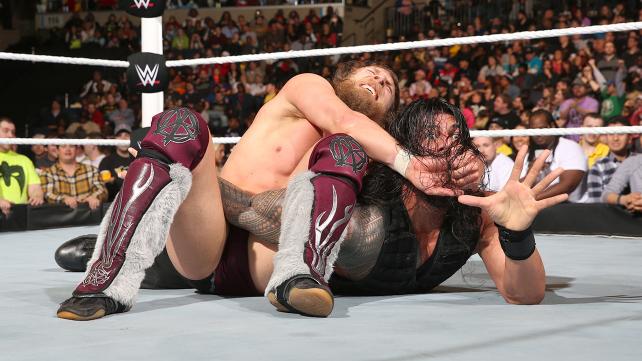
    Well, first off, Daniel Bryan returns to the throne he abdicated to Seth Rollins as the best overall wrestler in WWE. Seriously. This is his first match of true consequence since returning, and he kills it, leading Reigns to what will likely stand as one of his best matches at the end of his career, but that probably isn’t even top 20 for Bryan. Too many times in “wrestling” matches, the competitors go through the motions of chain wrestling, working through wristlocks and hammerlocks and headlocks until some dude in the crowd yells “WRESTLING!” to get the crowd clapping politely. From the start, this is a fight. Daniel Bryan is the wrestler. Roman Reigns is the brawler. Bryan can and does outwrestle Reigns, but the Royal Rumble winner makes the former champion fight for everything. Daniel Bryan claims to have mastered over 100 submission moves. Focusing on Reigns’ legs, he breaks out more than a few, but those often bring him close enough to Reigns that one or two stiff shots are enough to cause a break. Reigns can live with Bryan that close, but needs space so that he can land his big moves, the spear and the Superman punch. The first time he goes for the punch, Bryan is able to sidestep Reigns and kick him in the stomach. This staggers Reigns for the rest of the match, as Bryan’s more pronounced mean streak comes out and his kicks move from trying to charlie-horse a leg to trying to make a man vomit. Reigns stays on his power game, though, powerbombing Bryan after blocking an attempted top rope rana and stopping a suicide dive with a belly-to-belly suplex. Despite that, Bryan is always a step ahead, always the veteran wrestler. He moves just in time to avoid a spear, sending Reigns into the ring steps. He counters a spear with a small package after being knocked for a loop by the Superman punch. Bryan seems to clinch the match with the running knee, but Reigns is the first to kick out of it. From there, the two take it into another gear. Daniel Bryan kicks Reigns in the face until Reigns catches the foot and dares Bryan to do something. Bryan responds with a number of slaps, but Reigns is having none of it until Bryan goes for a cross armbreaker. When that doesn’t work, Bryan transitions into the YES! Lock, which Reigns manages to slip before laying Bryan out with some nasty forearms. The sequence gets even better from there, with Reigns over a seemingly prone Bryan, as the wrestler manages to surprise the brawler with a triangle choke attempt. Reigns uses his overwhelming power advantage to pick Bryan up off the canvas with a sit-out powerbomb. After an eight count, they exchange punches and kicks from the ground until Bryan gets the advantage and hits his big kick to Reigns’ temple. This is the set-up for a second attempt at the running knee, but Reigns recovers while Bryan is mid-sprint and manages a spear, which sends him to WrestleMania. Nobody is happy about this finish, but that does nothing to diminish what is a great effort on the part of two men. One found his footing again and is in good position for another chase at the championship depending on what his WrestleMania program is. The other pulled his weight, too, so much that any doubt about his ability to perform at a high level on a big stage should be assuaged. Should be, but who knows. Reigns is still wrestling with the crutch of The Shield supporting him. He’s still got their music, their entrance, and their gear. What he doesn’t have, even at the end of the night, is the crowd’s support as a WrestleMania main eventer. The WWE has five weeks to make that happen. Luckily (or unluckily, depending on how you see it), every move the WWE has made since WrestleMania XXX goes to show that, in wrestling, even just one week can feel like an eternity.


    Results

    1. Seth Rollins, Kane, and Big Show def. Dolph Ziggler, Ryback, and Erick Rowan via pinfall. GRADE: B-

    2. Goldust def. Stardust via pinfall. GRADE: C

    3. WWE Tag Team Championship Match: Tyson Kidd and Cesaro (w/Natalya) def. The Usos (Jimmy and Jey, w/Naomi, Champions) via pinfall to win the titles. GRADE: C+

    4. WWE Diva’s Championship: Nikki Bella (w/Brie Bella, Champion) def. Paige via pinfall. GRADE: C-

    5. WWE Intercontinental Championship: Bad News Barrett (Champion) def. Dean Ambrose via disqualification. GRADE: C-

    6. WWE United States Championship: Rusev (w/Lana, Champion) def. John Cena via referee stoppage. GRADE: A-

    7. Roman Reigns def. Daniel Bryan via pinfall. GRADE: A


  • Wrestling Review: WWE Raw (2/16/15)

    Wrestling Review: WWE Raw (2/16/15)

    WWE Raw Daniel Bryan vs Roman Reigns

    Quietly, the WWE has done a very good job of building up to Fastlane, which they’re billing as a “new pay-per-view concept” though, really, it’s just a regular pay-per-view without the usual February Elimination Chamber main event. The lack of a Chamber match, I think, is the reason why Fastlane is so compelling. The WWE calendar is littered with pay-per-views that are branded by one kind of match or another that the matches themselves, no matter how violent or how good, feel more inevitable than special. Without the crutch of putting six guys in a goofy chain-and-plexiglass rig with the absent WWE Championship on the line, instead what we have is the supposed fast lane on the road to WrestleMania. Considering how slow that road has felt thus far, having a date on the calendar where everything will supposedly get back in gear feels like a blessing. “Quietly” in this case also means “glacially,” especially compared to the stretch between last year’s Royal Rumble and WrestleMania, when nearly every Raw had a standout match or segment. Raw will need to pick up the pace sooner rather than later, but, as the last show before a pay-per-view that looks, on paper, like the strongest card since SummerSlam, the WWE does a good enough job of getting everybody in place.

    That includes Rusev, who gets trucked by John Cena in the opening segment. This is not the first time a foreign monster has charged the 15-time WWE Champion with losing a step before Cena Rises Above Hate and proves him wrong. I doubt it will be the last. Since the beginning, it seemed like the endgame for Rusev was going to be a loss to John Cena, who, quite honestly, is going through the motions at the start of Raw. Every John Cena promo from 2007 forward is thrown in the blender. Cena loves the WWE. He loves when fans cheer him. He loves when fans boo him. He hates that there is a monster out there who isn’t from America and who can’t be beaten, and he promises to destroy him. This brings out Rusev and Lana, who are, really, a politicized make-over of the old Armando Estrada/Umaga pairing from 2008, an act that has risen above cartoon parody to become one of the most enjoyable aspects of a show that is frequently hard to enjoy. Lana in particular continues to evolve, relying less and less on the merits of Vladimir Putin and the Raw audience’s hatred of being told to shut up (by a lady who ain’t from here to boot!) and more on the merits of her freakish charge, who I also enjoy on the microphone. Rusev is a blunt object used to smash the opposition, a warhammer who only knows how to kill. John Cena’s gambit is that bringing Rusev down relies on taking the fight to him, which he does by charging up the ramp and hurling the burly Bulgarian into a panel of LED lights. Beyond some shoddy camerawork (really, why would you zoom in and out on bodies in motion?), the physicality of Cena vs. Rusev was quite satisfying. Cena proved his point about his strategy, but wrestling matches don’t work like street fights. Whether or not his plan will work when a referee calls for the bell is the story now, and it’s a good one. Rusev’s mystique isn’t compromised unless he’s pinned or he taps out to the STF. Only an idiot would pull the trigger on that at Fastlane.

    The rest of Fastlane‘s undercard was built solidly here, as well, with the exception of the upcoming match between Paige and Nikki Bella. That should be a good match (Nikki Bella is easily the most improved wrestler on the main roster over the past year), but its plot is stuck in the muck and mire of the past ten years of the Diva’s division. It was actually somewhat brilliant when the Bella Twins attacked Paige and spraytanned her, as Paige had been clinging to the frankly stupid notion that simply not looking like a model made her better than all the other Divas. But now we’re in the usual Bella Twin holding pattern where they’re “pranking” (read: assaulting or stealing from) Paige in a variety of ways designed to brag that they look better than her. This week, they steal Paige’s clothes, which forces her to wrestle a match against Summer Rae while dressed in a Rosebud’s clothes. Considering that Paige kills Summer Rae handily, it hardly matters. Women have also factored into the Tag Team Championship storyline between The Usos and Tyson Kidd and Cesaro, as a blown double date between Kidd and Jimmy Uso and their respective wives Natalya and Naomi (sample line: “I’m here trying to respect this dinner”) led to a husband and wife mixed tag team match. The mainstream format of such matches is really dated, but Kidd’s unwillingness to wrestle Uso leads to three good minutes between Natalya and Naomi. Naomi, as is standard in non-title Divas division matches, wins with a roll up, allowing The Usos to celebrate that they got one over on their rivals while continuing to build on the will-they-or-won’t-they saga that is the relationship between Kidd and Natalya. Right now, it wouldn’t be at all surprising if Kidd left Nattie and got an apartment uptown with his buddy Cesaro, but I’m probably just authoring mental slash-fiction. Probably. The tag team division has been a long-running quagmire, but the Usos vs. Kidd and Cesaro match looks enticing, and the Prime Time Players reunited when Titus O’Neil stormed to the ring to help his returning buddy Darren Young escape a whooping at the hands of The Ascension. With the Miz/Mizdow team slowly breaking up, The New Day entrenched in the wasteland that is their racist gimmick, and tonight’s official dissolution of the Rhodes Brothers/Stardust and Goldust, a full-time return of the Prime Time Players, who always seemed on the verge of making some noise in the division, is a good thing.

    Speaking of Stardust and Goldust, this Raw, like most, was built around promos. There was John Cena’s opening promo, Triple H’s Ric Flair-assisted promo about a confrontation (read: promo) with Sting at Fastlane, and the promise of Dusty Rhodes addressing the problems between his sons (not to mention the usual Seth Rollins interview). Only Dusty didn’t speak much and, of all the interviews, tonight, the one that most stole the show was Stardust’s declaration that Cody Rhodes was dead and never coming back. Dusty Rhodes’ are shoes no man can fill, but Stardust stood there, painted purple and silver and wearing a rubber suit, and delivered fire right in his father’s face. Stardust has, to this point, felt like a needless, pandering rip-off of Goldust, which was unfortunate given their role in the early iteration of the Authority storyline, but on Raw Stardust was given a purpose and a mission. It’s obviously impossible to separate the character from the Rhodes lineage, but it’s good heel motivation coming out of a brother/brother tag team, and this all should culminate in the Rhodes vs. Rhodes match that Goldust has been rather open about wanting to retire on.

    Dusty looked (and is) old, but still acquits himself rather well. That’s less true of his lifetime rival Ric Flair, who surprised Triple H mid-speech to remind him that Sting, ancient old man or not, is still Sting and needs to be respected. Flair sounded drunk, but getting drunk and talking about his glory days is pretty much his job now, so he did well enough that Triple H shoving him on his ass felt sad because The Game was disrespecting a legend he openly admires, not because Flair’s condition continues to darken his legacy. Fallout from Sting’s debut at Survivor Series continues to be the theme heading into Fastlane, as Dolph Ziggler and Seth Rollins seem to be moving into a singles program. Rollins’ promo, unnecessary though it was, signaled that he is being shifted away from the WWE Championship for the time being to focus on the Zigglers, Rybacks, and Rowans of the card.  Ziggler continues to be an unconvincing babyface on the microphone, (I’m not interested in white meat, I guess) but an incredible one in the ring. The match between Rollins and Ziggler was good. Not up to the pace they established at Survivor Series, but a good teaser for what the two should be able to do without distraction. They’ll wrestle on SmackDown! in this week’s Raw rematch, though another contest at Fastlane (and perhaps another at WrestleMania) isn’t out of the question.

    Beyond Rollins/Ziggler and the main event between Big Show and Daniel Bryan, most of the wrestling on Raw this week as an afterthought. Even a singles match between Dean Ambrose and Luke Harper, while solid, existed more to set-up a later contest than to tell its own story. There were plenty of good spots, but Harper is wandering aimlessly at the moment, and WWE doesn’t do a very good job of protecting big dudes who aren’t in an active storyline. Harper lost clean to Ambrose to establish Ambrose’s credentials against current Intercontinental Champion Bad News Barrett, who beat Damien Mizdow in a match that nudged forward the issue between Mizdow and The Miz. Barrett was fantastic when Ambrose ziptied him to the ringpost and forced him to sign the contract, screaming for a knife to cut himself free and how it wasn’t his signature on the sheet and that the contract wasn’t legal. Had they cut bait on a weird skit where Ambrose “auditioned for Weekend Update,” announcing that he’d make Barrett sign the contract, everything on this front would have been great. Barrett is an effective heel, and, well, if Ambrose is going to be a goofy dude whose popularity the writing team doesn’t understand or know how to harness, he’s best when his goofiness is channeled through a bit of menace, rather than a bad suit. The Intercontinental Championship is always on the verge of meaning something. What matters more than Barrett vs. Ambrose at Fastlane is whether or not the issue continues to build, or if the title reverts to its usual miserable pattern, where the champion loses every non-title match until he is required to defend the title.

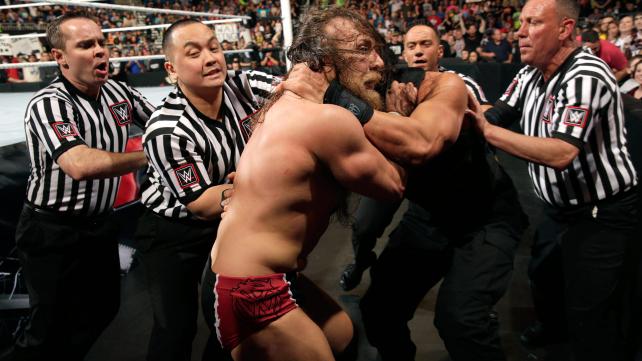
    The confrontation that will set up Sting vs. Triple H at WrestleMania is an important part of Fastlane. Bray Wyatt’s continued promos that are (vaguely) about The Undertaker (this week he hammered some nails into a coffin) continue to be important. Those are two of the marquee matches at WrestleMania. They are happening. There is no turning back. Less certain is the fate of the WWE World Heavyweight Championship, currently held by Brock Lesnar. He’ll be there, defending, but his opponent is yet to be decided. Roman Reigns earned a shot by virtue of winning the Royal Rumble. Daniel Bryan feels that he deserves one because he was stripped of the championship in 2014 without having lost it and, as he points out, made only one fewer defense of the championship. Reigns wrestled Kane and Bryan wrestled Big Show, but the matches and results were secondary to the simmering issue between the two men, which threatens to boil over into something personal in the main event of Fastlane. After an interview where Reigns questioned the manhood of Bryan for going about a championship match by asking for one instead of earning it, Bryan came to ringside for Reigns match and participated on commentary, where he did a very good job of making clear how slighted he felt by Reigns’ assessment of the situation. He thought there was mutual respect between the two, but there clearly wasn’t. When Reigns had an advantage over Kane, Bryan would stand and lead the Orlando crowd in a YES! chant, which succeeded in distracting his man. Reigns won the match, but not in his usual dominant fashion, and Bryan would later say that, if he wants to beat him, Reigns had better get used to the crowd being in Daniel Bryan’s pocket. During the main event match between Big Show and Bryan, Reigns sat at ringside and watched (he didn’t join the commentary team, for good reason). Reigns took to the crowd, signing autographs and giving away t-shirts, and this caused Daniel Bryan no end of distraction. An exchange near the announce table led Big Show to spear Reigns, who would recover and hit Show with the Superman Punch with Daniel Bryan perched on the top rope for a missile dropkick. With the match over, Bryan would instead hit Reigns with the dropkick, sparking a brawl that closed the show.

    This sequence was fantastic, a sprint around the ring and through the crowd that ended in a pull-apart with Reigns bleeding from the mouth and Bryan seething. Initially it looked as though they were going to do with Roman Reigns what they did with Batista last year, turning the hand-chosen WrestleMania main event guy into a heel due to the overwhelming popularity of Daniel Bryan, but this year is much more vague than last. Batista was universally despised from the moment it was clear that Daniel Bryan was not in the Royal Rumble, but Reigns plays pretty well in all but the hottest towns in wrestling. And where Batista had little reason to respect Bryan, Reigns has some respect for the former champion, not only for his in-ring accomplishments and what history they had together when The Shield clashed with Team Hell No, but for his resilience in the face of a career ending injury. But both men want to fight Brock Lesnar at WrestleMania, and it doesn’t look like there will be an opening for a third man in the main event, so that respect had to give way towards animosity with so much on the line. Daniel Bryan is a master at his craft, so the reemergence of his pre-rise mean streak has been subtle and brilliant. The wrinkle that they’ve added to Reigns’ story, that he’s trying to accomplish something not even the most legendary member of his family could achieve, is the most compelling angle Reigns has had since The Shield folded, and has managed to find some interesting space here, too (the t-shirts he was throwing to the crowd were Uso shirts, after all). What initially seemed like a capitulation on the part of WWE in the face of post-Royal Rumble fan revolt has turned into their best story since the SummerSlam domination of John Cena. The match at Fastlane will be telling in Reigns’ ability to become what the WWE so obviously wants him to be, but for now, the table is set. Sunday night will be an interesting one for a number of reasons, none moreso than this. For the WWE to pull itself out of the rut it has so clearly been stuck in since September, Fastlane is going to need to be that rare February pay-per-view that’s more about wrestling than WrestleMania. For once, the uncertainty surrounding a pay-per-view event feels like a good omen.

    Results

    1. Dean Ambrose def. Luke Harper via pinfall. GRADE: B-

    2. The New Day (Kofi Kingston & Xavier Woods w/Big E) def. Goldust and Stardust via pinfall. GRADE: C+

    3. Roman Reigns def. Kane via count out. GRADE: C

    4. Paige def. Summer Rae via pinfall. GRADE: C-

    5. Dolph Zigger def. Seth Rollins via disqualification when J&J Security interfered. GRADE: B

    6. Darren Young & Local Talent vs. The Ascension never officially started. GRADE: N/A

    7. Bad News Barrett def. Damien Mizdow (w/The Miz) via pinfall. GRADE: C

    8. Jimmy Uso & Naomi (w/Jey Uso) def. Tyson Kidd & Natalya (w/Cesaro) via pinfall. GRADE: C+

    9. The Big Show def. Daniel Bryan via disqualification when Roman Reigns interfered. GRADE: B-


  • Stud Stable vs. Dusty Rhodes, Dustin Rhodes, and the Nasty Boys (9/18/94)

    Stud Stable vs. Dusty Rhodes, Dustin Rhodes, and the Nasty Boys (9/18/94)

    There’s been a lot of talk on TV lately about eras ending. Chris Jericho, for example, is one of the last of an era where wrestlers valued overseas experience and came to places like the WWE ready to go from day one, which is one hell of a specific era. The Hell in a Cell match between Triple H and the Undertaker was billed as an End of an Era match, specifically referring to the Attitude Era that both men were cornerstones of. Right now, John Cena has admitted that the reemergence of Brock Lesnar could lead to the end of his era. For the most part, however, eras are a tough thing to define in wrestling. Even when given names, like the WWF New Generation or the Attitude Era, there are enough holdovers from previous eras that the only real change is in the marketing, the amount of blood, the guys with the top titles. (more…)