Tag: DC Comics

  • The New 52: Batman #1, Batman and Robin #1, Batman: Dark Knight #1, and Detective Comics #1

    The New 52: Batman #1, Batman and Robin #1, Batman: Dark Knight #1, and Detective Comics #1

    To be honest, I sometimes worry about things like Batman. I know that in a world plagued with real problems, it is mostly ridiculous to care about the portrayal of a comic book character, but if comic books are one of the ways I choose to escape the kung-fu grip of reality, I will likely find myself worrying about my unreality. The way things were in 2006, when I stopped reading comics regularly, my unreality was in a shambles. Batman, my barometer for all things mainstream comic book, had been brought low by the events of Identity Crisis and, in DC’s mad scramble to create another Hush, he’d been pushed through some pretty lame storylines across his own books. In Detective Comics, he stopped detecting. In Batman, he did more brooding over ancient history than punching the crap out of crime. Jason Todd was coming back. Bruce Wayne was going to die or be zapped to the past or something. His mind had been erased. There were chinks in the armor. It was too much to truly care about. But nothing will attract my attention quite like promising a line-wide relaunch, so here I am, reviewing all 52 of DC’s new number ones while the company presses on, this month releasing issue #3s and, for the first time in quite awhile, actually eating into Marvel’s previously unchallenged marketshare. Once again, I find Batman to be my barometer. If the Bat books are shaky, with this much on the line, why bother? I’m racing to catch up with the DC Universe, so today, and until I’ve written about all 52 new books, I’ll be cramming my reviews together. Here are my thoughts on Batman #1, Batman and Robin #1, Batman: Dark Knight #1, and Detective Comics #1. This, too, will serve as a preview of how weekly comic book reviews will be handled in the near and glorious future when I’m not trying to get my bearings in a strange new universe.

    Batman #1

    Writer: Scott Snyder / Artist: Greg Capullo

    Were I the sort who judged a book by its cover, the sight of the Riddler with his hair buzzed to a green question mark would have turned me off of Scott Snyder and Greg Capullo’s take on Batman immediately. That’s not the Riddler I want, I would have bemoaned, little realizing that that the Riddler I want is, in all likelihood, the one of my imagination. It’s easy to project my expectations, my wants, my wishes onto a comic book, easier still to not pick one up because it seems like those things will not be satisfied in 22 pages, for three dollars, but the Riddler was hardly a factor in Batman #1, which, beyond featuring the most interesting detective narrative of the four big Bat books, also had the most compelling take on Bruce Wayne the philanthropist. I don’t know if it was editorial edict to have Bruce spend half the pages of his books standing behind a podium at a fundraiser or cocktail party, talking hopefully of one project or another, but the Bruce Wayne of Batman #1, issuing platitudes about what Gotham City is (“Gotham is hell,” “Gotham is damned,” “Gotham is Batman,” etc.) and the wisdom of his father, does more to show Batman’s sense of civic pride and obligation more than the Bruce Wayne who promises not to give birth to a cannibal, to not be afraid of the unknown. Batman here is much more capable of putting on a public face and, early, it leads to something more interesting than a confrontation with the thousandth cop to piece together the Wayne/Batman connection.

    The mystery at the center of this book, involving the grisly murder of a man with the use of old throwing knives, is also compelling, though the twist and the end of the book comes off as a little expected, and will likely wind up being some kind of framejob. Scott Snyder’s script effectively flips the switch from Bruce Wayne: Philanthropist to Batman: World’s Greatest Detective, though it probably helps that the touches defining both are familiar: Batman is always encroaching on Bruce Wayne, making him look absent minded at times, and the way the threat on Bruce Wayne’s life is handled comes straight out of the past. Though these elements lack novelty, it is good to see the character getting back to basics.

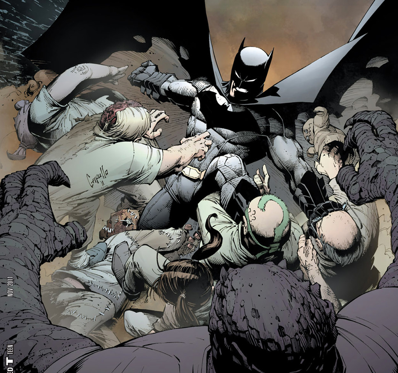
    Batman is worth returning to, perhaps the biggest reason being Greg Capullo’s art. Of the Batman family books, only J.H. Williams III’s Batwoman has a more captivating take on Gotham City, though Capullo’s is closer to what I’ve always identified as the “real” Gotham, the one of Batman: The Animated Series. He draws a dynamic Batman, at once human and cartoon, and while the Arkham Asylum slugfest that opened the book was a little bland, brief glimpses of his Two-Face, Clayface, and Mr. Freeze have me looking forward to possible future storylines involving those characters.


    Batman and Robin #1

    Writer: Peter J. Tomasi / Artist: Patrick Gleason

    If Batman and Robin #1 (and likely the Grant Morrison Batman and Son arc that preceded it) is anything to go by, having a superhero as a father would not be a cool experience. Matter of fact, it’d be a life fraught with mistrust, disobeyed orders, and, perhaps worst of all, constant bickering. It’s not that Batman isn’t cool, because what isn’t cool about fighting crime and driving souped up machines of death? The problem is that Damien Wayne, the fifth person to take up the mantle of Robin, is a petulant, self-important brat, and, even if that’s the way he’s supposed to be, I’m not going to cop well to a 10-year-old pointing in Batman’s face while yelling about being “light years ahead” of the other Robins.

    Maybe Damien (hopefully not named after the kid from The Omen) and his sour temperament are the result of being raised by the League of Assassins, but, as written by Peter J. Tomasi, the relationship between Batman and Robin is stock parent/teen disagreement, but over ridiculously high stakes like irradiated fuel rods. When they speak to each other, it feels a bit like Edward Furlong talking to the Terminator, if Furlong’s John Conner suddenly desired for his pet cyborg to start waxing random passers-by. I don’t know that the failings of Batman and Robin #1 are Tomasi’s–usually a solid hand–or those of the character at the heart of this book. At the center of the Batman/Robin partnership has always been Bruce’s obligation to whatever orphan was dropped on his doorstep. The thing was, those characters–even Tim Drake, by no means a victim of tragedy until Identity Crisis–had a way of humanizing Batman that socialite girlfriends and weekly dinner parties couldn’t. They needed him, and he needed them. I get the sense that Damien is relatively unchanged by the shifting circumstances of his life, that his conflict doesn’t involve learning to be a hero or learning to accept Bruce as his father, but that he’s going to constantly be whining about a perceived lack of respect. If the goal here was to create a completely unlikable Robin, mission accomplished. Eventually, I hope Batman hauls off and decks the kid for his endless backtalk. Or that I get to phone in a vote for him to be blown up in an abandoned shed.

    That being said, Patrick Gleason’s art is stunning. Scrumptious. If it were in service to a character I enjoyed, I’d buy two copies so I could hand one to strangers and tell them to see how great a Batman comic can look. The Crime Alley sequence, in particular, is A+ stuff, an elevation of material long taken for granted. Were the issue printed without dialog, there’d be something touching about a father taking his son to the last place he saw his parents, the shower of pearls in the gutter, the floating of a paper boat into the great unknown. But that Damien’s got a mouth, man. “You can’t just build a boat and hope darkness sails away with it,” he says, but it’s like Look kid, he can do whatever he wants. He’s the goddamn Batman.


    Batman: Dark Knight #1

    Writer (Co-Plotter): Paul Jenkins / Artist (Co-Plotter): David Finch

    The first image in Batman: Dark Knight #1 is the Gotham skyline, crowded with three blimps and a universe of spotlights. It’s likely that this is ultimately significant of nothing, but combined with the Arkham Asylum breakout (another one?), the giant reception Bruce Wayne speaks at (another one?), and that the first thing Batman does is fly his plane through Gotham, rappel down to the buildings, change into civvies and zipline across town to be on time for his speech on Fear: A Cannibal, Batman: Dark Knight feels a bit like Jenkins and Finch’s interpretation of The Greatest Batman Hits of the 90s, where everything was big, bold, and, above all else, toyetic.

    All of that plays to Finch’s strength as an artist, in particular his ability to lavish a scene in detail, but so much of it is utterly unnecessary. The board room scene, the Arkham breakout. I don’t have a problem that this has happened across so many of the new Batman #1s, but that it’s happened so much period, and that there’s pretty much nothing new under that particular rock. I imagine it’ll be important somehow–how did that weird rabbit-woman get into Arkham? who enabled the issue’s pivotal change to Two-Face? how?–but my concern in reading Batman: Dark Knight isn’t Bruce or Batman or his detective work, and not even the unfortunate and fundamental change in direction Two-Face undergoes, but why every man is over-muscled, why the attractive foreigner wore a hooker’s dress to this particular Wayne Enterprises meeting, why anybody felt the need to toy with and alter a tried and true villain; just why everything feels so dated and insecure as it tries to be all of the most badass things about Batman that having a kid or being a detective don’t allow. The Batman of Paul Jenkins and David Finch appears to be the Batman of slugfests. I grew out of that Batman ages ago.


    Detective Comics #1

    Writer/Artist: Tony S. Daniel

    For those of you who like your Joker grim ‘n gritty, in Detective Comics #1, he rips out the throat of a “big fan” while completely nude. In a post-Flashpoint world, it’s tough to know how familiar Batman is with the Joker (considering the turn at the end of the issue, my guess is “pretty familiar”), but he seems perplexed by the Joker’s choice to not wear clothes and, like Rorschach planning to delve further into Ozymandias’ sexuality, makes a note of it for later. When, at the end of the issue, the Joker blows up a building full of cops, he walks away from the scene declaring “Amatuers!” with a sneer, a comedian miffed that his audience isn’t in on the joke.

    Then again, the Joker’s always played to an audience of one, so it makes a certain amount of sense that he’s the only one laughing, and it makes perfect sense that he’s able to play Batman and the Gotham City Police Department like a fiddle, murdering and fighting so that he can end up back in Arkham Asylum, where he has an appointment he’d like to keep. That, along with the “amateurs” moment and Batman’s tenuous working relationship with the GCPD, including the use of the Bat Signal (despite cops firing on him) and the appearance of Harvey Bullock, are reminiscent of Batman: The Animated Series, if the seminal cartoon took on the darker aspects of the work of Frank Miller. Detective Comics #1 is incredibly gory for a main title depicting the adventures of the world’s most popular superhero, but that’s not at all a reason to discount what writer and artist Tony Daniel is doing with the old Batman/Joker tropes. As a matter of fact, I’m not sure what I think about the end of issue #1, other than that it’s a compelling, deft hook–one that’s worth giving another couple issues to, for everything to pan out.
  • The New 52: Aquaman #1

    The New 52: Aquaman #1

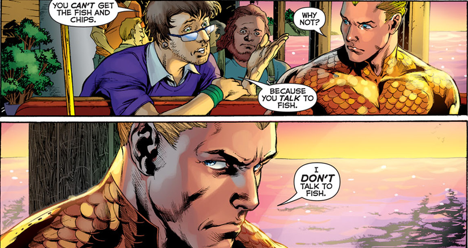
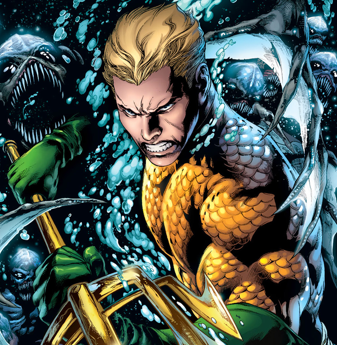
    I’m having a tough time figuring out exactly how to take a comic book like Aquaman #1, which may be the first comic book in the Aquaman canon (I’m sure one exists) to assume that nobody–nobody–finds anything redeemable about the character when he’s not in or near one of the seven seas. Most first issues attempt to establish the hero as a man of valor, even in the face of poverty or enormous circumstance. The X-Men, for example, protect a world that hates and fears them. Superman is the protector of his adopted world. Their hardships are nothing compared to Aquaman, who walks away from the throne of Atlantis to protect those who make fun of him simply for trying.

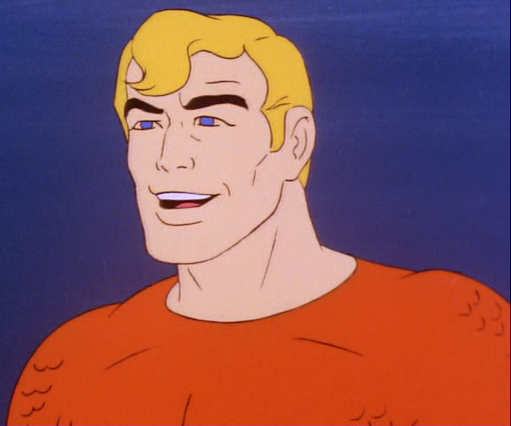
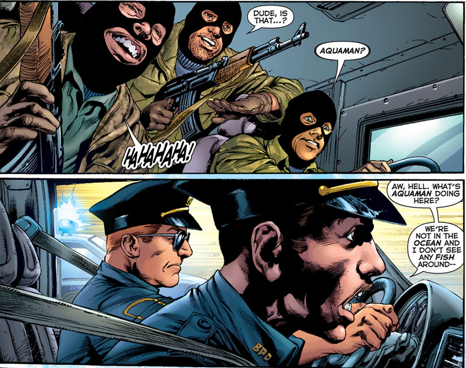
    It’s like Aquaman has been birthed into a world where everybody but him is aware of Challenge of the Superfriends, and his every selfless deed is met with scorn and derision. I imagine that this phase will pass as soon as he dispatches with some deep-sea baddies seen here swimming up from the bottom of the ocean, but stopping an armed robbery and carrying around a freaking trident aren’t enough to make people forget about his orange shirt or his fluency in dolphin. His Friend of the Fish persona is put to rest quickly, as Aquaman decides to dine at a local seafood restaurant after stopping the robbery.

    No doubt, Aquaman is a tough property to revamp. His problems are perhaps a microcosm of that which has vexed DC Comics in their seemingly eternal struggle to eat into some of Marvel’s market share. The 1960s and 70s did an excellent job of delegitimizing every DC character not named Clark Kent and, after the Allan Moore/Frank Miller serious superheroics renaissance birthed the ultraviolent boom/bust of the 1990s, DCs roster walled itself off from the mainstream, killing and replacing iconic characters, bringing them back, hiding behind nerdier and murkier storylines that were longer, more complex, and more intimidating than a semester-long study of Ulysses. Aquaman’s actually had a few good runs, including one where a portion of the city of San Diego was sunken into the ocean, its inhabitants suddenly able to breathe underwater. Like so many other things in DC continuity, that piece of business was swept under the rug, and Aquaman continued to be the dude who rode a seahorse in Superfriends, whose main villain had a head like a hamburger.

    HA HA, I'm a huge tool!

    It’s cool that they’re trying to turn Aquaman around, and Geoff Johns, who has rebooted nearly every DC property under the sun, is the wise choice. The problem is in Aquaman’s petulant response to the bespectacled hipster and his later explanation that fish are, in fact, too stupid to converse with. Comic book fans, like wrestling fans or Star Trek fans, are locked in an eternal battle with respectability, and heroes like Aquaman don’t get it because they talk to fish. Green Lantern, to an outsider, is ridiculous because his weakness is the color yellow. Green Lantern probably wouldn’t stop to explain to a random stranger that his weakness isn’t really yellow in a strict sense, that it takes something deeper and more cosmic than a color wheel to ruin his day, but Aquaman is not above that. He’s a nerd. It’s one thing to be a hero nobody appreciates. Being a nerd? Correcting people? You save my ass from bank robbers, give me enough gold doubloons to put my children through college but if I ask “Hey, aren’t you the guy who talks to fish?” and your answer is “No, stupid. Fish have mudbrains too primitive for me to communicate with,” I am going to resent the hell out of you.

    Ultimately, I’m hung up on a very small piece of Aquaman #1, and I think it’ll be interesting to see Aquaman do his thing despite the mockery he endures on a day-to-day basis. I suspect that Johns, whose work I’ve never been keen on, is reveling a bit in the lameness of Aquaman, or at least Aquaman’s perceived lameness, but there’s a chance that he’s wounded by the charges against his latest project, that Aquaman brandishes his trident at the snooty blogger and makes out with his hot wife on the ocean because he pictures him an aquatic badass, sees the work of his series not as establishing Aquaman in the larger universe of the DC reboot, but as lecturing readers about how wrong they were to mock the Atlantean king. If that’s the case, I give me the Aquaman of Superfriends. I’ll take seahorses over wounded egos every time.

  • The New 52: Batwoman #1

    The New 52: Batwoman #1

    In 2006, the debut of Kate Kane, the second iteration of Batwoman, was met with such praise/derision that the character managed to land in publications like USA Today and The New York Times, old media juggernauts whose pages rarely covered the world of four color cape-and-cowl superhero comics, unless a new movie featuring the X-Men or Batman was slated for release. It was a rare moment of cultural penetration for DC Comics, who so often appear inept when it comes to garnering anything resembling outsider press, but the thing about Batwoman that nobody could seem to make up their minds about was if DC Comics was presenting the adventures of a gay, Jewish superheroine without comment, in an innocent attempt to diversify a superheroine roster that trended Caucasian, ample-chested and straight, or if Kate Kane was merely a cry for attention, one that the media was, indeed, suckered by. Considering that I was largely done with comic books by the time she debuted in 52, the weekly comic book that promised to further shake-up the DC Universe in the aftermath of one of their yearly infinite crises, I was in no position to find out myself. But the character has persisted, even to the point that she ousted Batman from Detective Comics for a brief period of time and now is the focus of her own book, co-written and drawn by the indomitable J.H. Williams III.

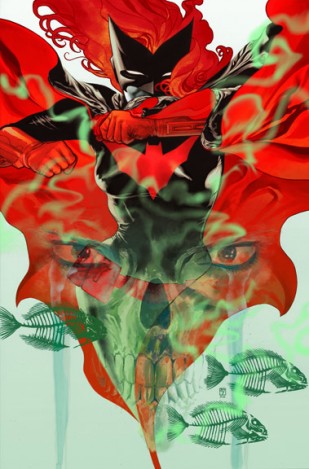
    Assuming that you don’t know anything about Batwoman (and I don’t, so we’re in the same boat!), Batwoman #1 has an irresistible hook–a supernatural killer/kidnapper of children who is the creepiest thing to come out of Gotham in some time. The Weeping Woman, apparently an urban legend of some kind, is the vengeful spirit of a woman who drowned her children, then drowned herself. Appearing to be made of water, she occupies a room, crushing the lungs of those inside. When she leaves, taking a child with her, the room smells like the sea. Regardless of any plot thread involving the government, Batman, or Kate Kane’s personal life, this is compelling stuff–far and away the most captivating mystery of any of the new Bat-books. A lot of that is due to Williams’ art, which is not only evocative, but frequently outside the lines of typical comic book presentation. This splash page, for instance, fleshes out the Weeping Woman through some police procedural while making her the center of focus, visually, despite her absence:

    Other pages, including the title page, push towards a sort of psychedelia, an is-it-or-isn’t-it-real stream of events that navigate the murky reality of Batwoman #1‘s ghost story in ways that other mediums would struggle to reproduce, the actions and dialog converging so that the confusion of the victims feels more real than that of, say, the disbelieving girlfriend in a haunted house movie.

    The things that don’t deal with the Weeping Woman are a little confusing to a first time reader like me, as the middle of the book serves as an infodump of things I’ve missed over the past five years. Kate Kane is no longer in a relationship with Renae Montoya, whose sexuality I would have never guessed from Batman: The Animated Series. She’s training a sidekick who, apparently, was less than useful in the recent past. Her father (at least I assume that’s her father) shows up, leading to another infodump about Kate’s sister and family history, and, while it’s all rendered very nicely, the book feels weighed down with words that, this early in the game, don’t feel as important or central as the kidnappings, or even the two page splash detailing the government’s interest in bringing Batwoman down.

    However, Batwoman is an interesting character, one that I’m interested in seeing more of. It would be hard for me to ignore a monthly book by one of my favorite artists, but, buoyed by Williams and W. Hayden Blackman’s script and the sense that DC Comics has managed to create a real minority hero of consequence and purpose in five years, with a minimum of exploitation, the book speaks for itself, offering things to new and old readers alike.

  • The New 52: I, Vampire #1

    The New 52: I, Vampire #1

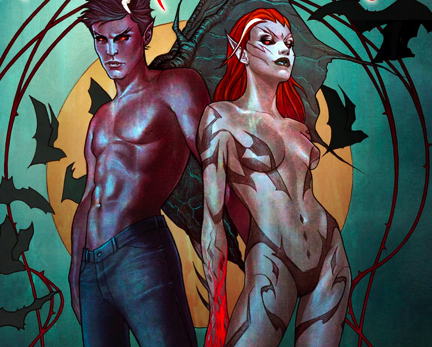
    In 1981, perennially underrated comics scribe J.M. DeMatteis began writing I…Vampire, a back-up feature in DC’s monthly horror anthology House of Mystery. It’s main character was a vampire (obviously), who, in order to maintain his humanity, drank only animal or bottled human blood. It’s been over 25 years, but the concept of the “vegetarian vampire” has permanently embedded itself in pop culture, not only because of the sullen Cullen clan at the heart of the Twilight series, but because of the synthetic human blood that’s allowed vampires to come out of the casket in HBO’s True Blood and the Sookie Stackhouse mystery novels that inspired them. Not that Stephenie Meyers or Charlene Harris were DeMatteis fangirls in the eighties (if they were, they might both be better at depicting the human element that is so often absent in their work), but it’s understandable why DC Comics, in relaunching their entire universe, would choose to publish a book like I, Vampire, no matter how obscure the original property was. Like a dog, the company is returning to territory it’s previously marked. Yes, DC Comics are fighting well out of their weight in the vampire market–comic books that aren’t about Batman or the X-Men stand virtually no chance outside the ever-shrinking comic book market–but there’s still some cash left to be milked from the vampiric cow and, by rights, I suppose some of that cash should go to the company that unwittingly gave much to the new vampire.

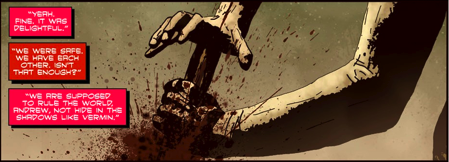
    Unfortunately, I, Vampire can’t quite break free from the new vampire’s current deathgrip on culture, meaning that any money it does manage to wring out of a seemingly coffinbound genre will be grubbed up by being exactly like everything else. Essentially a romance with the promise of world-ending destruction, Andrew Bennett’s a vampire-killing vampire, the sort of dude whose been around the block several thousand times, the kind of cat who puts others out of their misery so he can hang on to whatever scrap of humanity is left after a few centuries of nightjobs and vampire slayings. Unfortunately, Andrew turned his lover, Mary, into a vampire as well and–surprise!–she likes the experience, tires of drinking animal blood and, unsurprisingly, calls for a vampire uprising. The book will eventually get to the uprising, but first there’s a lot of hand-wringing, a ton of baby-come-ons that are pretty much like every discussion a vampire’s ever had on the subject of their humanity.

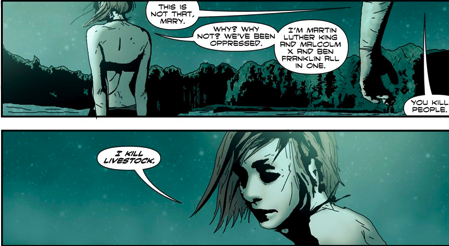
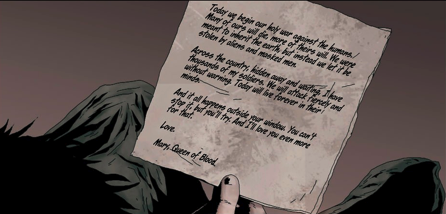
    Maybe there’s something to the theme of vampires finding or losing their humanity, but I, Vampire does not do a good job of bringing something new to an incredibly crowded party. Matter of fact, it rushes into some decidedly Twilight-esque platitudes, particularly where the male/female dynamic is concerned. Granted, it’s hard to write a piece of vampire fiction with a vampire villain that isn’t couched in cliche, but after Twilight, it’s hard to read something where the male protagonist harshly chastises his lady-love over a disagreement. Andrew even goes so far as to warn Mary that starting a war against the human race might be dangerous, especially considering that said race calls Batman, Wonder Woman, Superman, and half the Green Lantern Corps its protectors. Were another guy sitting with Andrew by the lake, casually chatting about his plans to kill everything and have the vampires take over, the conversation would end with a stake in that vampire’s heart. Here, Andrew is hesitant because it’s his lover, sure, but when are we going to move beyond the point where the male is The Protector in a male/female relationship? Moreover, when will women in popular entertainment realize that their men are unsupportive jerks and leave them in the dust without a pleasantly written note pledging her undying love despite their differences?

    As if the dynamic between Andrew and Mary wasn’t enough, I, Vampire‘s another book where the fate of the world seems at stake. Andrew wakes up one night and sees the streets of Boston littered with corpses, casualties of Mary’s newly-declared holy war. I understand the need to quickly ramp up excitement, but I would be more interested in the eventual Andrew vs. Mary showdown had not other #1s in the DC relaunch done the “we’re all gonna die” thing much better. I, Vampire very clearly isn’t interested in exploring the relationship between the two, is clearly convinced that the way to a reader’s heart is through the sort of vampire-cum-video-game violence that derailed the half-brilliant Daybreakers, the emotional investment of a beach read. I should have known all of this going in. The difference between this and the 80s iteration is as clear as the difference between a comma and an ellipsis, I…Vampire and I, Vampire. One is hesitant, full of trepidation. The other doesn’t give a damn. Full speed ahead. Blow everything up and pick through the rubble later. I don’t know–I guess I figure that, in 2011, we deserve a better class of vampire lit.

  • The New 52: Justice League Dark #1

    The New 52: Justice League Dark #1

    Magic is a curious thing in the world of mainstream superhero comics, cryptic and undefined, with the power to do precisely what the writer or editorial edict decrees necessary. In (forgotten?) Marvel Comics mega-event The House of M, the Scarlet Witch used magic to significantly alter the reality of the world, creating a dystopian society ruled by her father, where mutants were supreme beings and humans were second class. The biggest complaint, looking past Hawkeye’s rather inconsequential death, was that House of M represented a massive upgrade in Scarlet Witch’s power–before that event, she’d never displayed any powers of the magnitude required to change reality. But changing reality is at the heart of all magic, even parlor tricks. When the way we perceive reality changes, when magicians are writing the rules, anything is possible.

    This is why, in the DC Universe, Superman’s other weakness is magic, writ large and ill-defined. His physiology follows very precise rules, but comic book magic undermines all of those, replaces the rules with its own logic. The magician says that Superman is capable of feeling pain? Superman is capable of feeling pain. This is the unexploited crisis of the DC Universe: There are a lot of magicians running around, many of them driven mad by their power. That’s a lot of extranormal juju to be messing with, and a guy like Superman, hell, any number of guys in the DC Universe, are going to be helpless in the face of chaos. When this is the case, who ya gonna call?

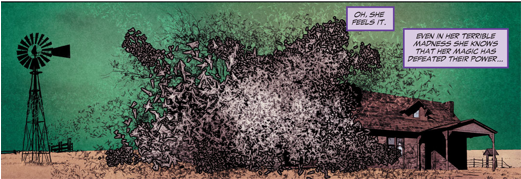
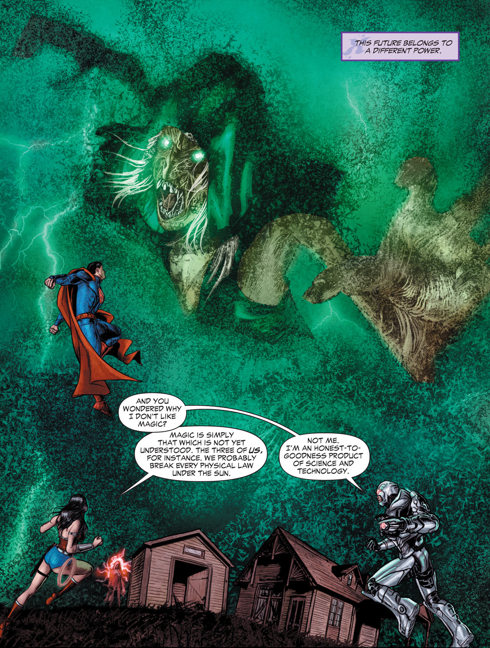
    In Justice League Dark #1, it’s a yet-unnamed collective of hero magicians, comprised of the expected (Zatanna, Madame Xanadu), the unexpected (John Constantine, back from his incredibly lengthy stay in the Vertigo “universe” ), and the somewhat obscure (Shade the Changing Man). None of them seem particularly pleased to be in this circumstance, which is to be expected, but when Superman, Cyborg, and Wonder Woman fail to stop the encroaching madness of The Enchantress, it’s up to a league of oddballs to stop a mad witch.

    The Justice League’s involvement in Justice League Dark is tangential at best, so people picking it up hoping that there’ll be new team adventures featuring Batman, Wonder Woman and Superman may be disappointed to find them easily defeated/on the sidelines. Justice League Dark is a horrible name for a book, and in it, Superman seems to have forgotten both about his weakness against magic and his costume change, but, beyond the book’s ties to the DC Universe’s heavy hitters, Justice League Dark #1 manages to get me interested in DC’s magic-based heroes, which isn’t easy. Seeing Shade the Changing Man and Constantine–who is literally dropped back into the DC Universe–back in DC continuity is welcome, and writer Peter Milligan (X-Force) not only has a handle on his widely disparate cast of characters, but he’s an expert with team dynamics and the offbeat. If Justice League Dark is allowed to be weird and on the outer limits of what constitutes a DC Comics superhero book, it’ll continue being one of the more pleasant surprises of  the brand-wide relaunch.

    The art, by Mikel Janin, shows a surprising amount of depth as the issue sinks further and further into the Enchantress’ madness. The first seven or so pages are fairly standard of mainstream comics, but the Enchantress’ attack on the Justice League is drawn huge and intimidating, the chaos enveloping the Justice League convincingly morbid, rightly grotesque. Watching the team come together against a world-threatening event would be enough to get me to come back, but I’m especially looking forward to seeing how the Enchantress pulls reality away from a group of heroes whose ties to it were tenuous at best.

  • The New 52: Wonder Woman #1

    The New 52: Wonder Woman #1

    Of the DC Trinity, Wonder Woman was arguably the hero who stood to gain the most from a universe-wide relaunch. She’s been mucked-up and un-mucked-up so many times that my head spins a little just thinking about her recent history. Of course, the biggest problem with the series has been the nonexistent but perceived need to update Wonder Woman, who, whether written by a New York Times bestselling author or wearing pants, couldn’t sell more books if doing so would save a besieged Paradise Island. The best two Wonder Woman runs in recent memory, Greg Rucka’s and Gail Simone’s, focused not on her image in relation to modern society, but her place in it. Both modernized Wonder Woman, but in ways slight and not off-putting; Rucka’s Diana was an ambassador to the United Nations, and Simone’s was a modern take on John Byrne’s conception of Wonder Woman as a heroine of gods and monsters for our time. They weren’t looking to sell Wonder Woman as anything more than the protagonist of a great comic book, and now, with the TV series dead in the water and hopes for a non-Batman DC Comics movie doing well quashed by the failure of Green Lantern, Wonder Woman is free from the shackles of consumerist oppression.

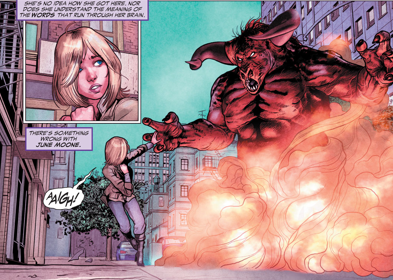
    The resulting comic book, Wonder Woman #1, is exactly the kind of thing I hoped for from the New 52 initiative, movement in a positive direction for a favorite character of mine. In it, a woman is visited by Hermes, who tires to warn her of an impending attack by a duo of centaur-assassins. The shotgun-wielding woman with a pixie haircut doesn’t believe Hermes, of course, until the assassins beat down her door, brandishing swords and bows. Hermes gives the woman a key, which spirits her off to an apartment belonging to Diana Prince, who you might know as Wonder Woman. As you can see in the picture above, she’s pretty good at protecting those who randomly drop in on her while she’s sleeping. She’s freakin’ Wonder Woman.

    What’s most appreciable about Wonder Woman #1 is that it does not question who Wonder Woman is, nor does it treat the reader like an idiot. You don’t need to be a mythology buff or a Wonder Woman fanboy to understand that ancient Greek gods walk among us, and that it’s Wonder Woman’s charge to protect those effected. Sure, one’s appreciation of Wonder Woman #1 likely increases if you can spot Hera (she of the peacock cape) or know who Apollo is (the oracular god of the Sun…hence the three young women he uses as oracles), or have read any mythology where either a) a powerful being is told that he’ll be killed by a soon-to-be-born child or b) a god sleeps with a mortal and is mysteriously absent to deal with the consequences, but these are stories as old as storytelling, they’re familiar, they’re still good, and here, added to them, is our time and place and a superhero.

    I was surprised to see this from Brian Azzarello, whose previous DC work beyond the fantastic, gritty crime saga 100 Bullets and other adult-orientated comics includes a shaky run on Batman and two mini-series featuring more “realistic” takes on iconic villains–Lex Luthor and the Joker–that didn’t really do much for me. The story here is solid, updating some gods as one would expect, keeping others as they were, and focusing on Wonder Woman’s heroism, though I suspect one “life changing” factoid or another will be dropped on her soon enough. The art, by Cliff Chiang, is what really pops here, both in its scale and its attention to detail. Despite the fact that the two women at the center of the book are barely clothed, neither is sexualized. Considering the mild controversy that arose over the cover of Justice League #1, where Wonder Woman, as is typical for the female character in a mostly male book, struck a lascivious pose that looked out of place amid the scowly, barrel-chested bros behind her, who somehow towered over Diana despite her being an Amazon.

    Chiang’s artwork, if nothing else, shows him as an artist capable of portraying a Wonder Woman of mythic proportion without salivating over her. The art’s dynamic nature is helped in large part by some bold inking and a reverence for the style seen in DC’s classic animation, pioneered by Bruce Timm. I wouldn’t return to Wonder Woman just for the artwork, but, combined with Azzarello’s confident tone, Wonder Woman #1 joins Simone’s Batgirl on a very small list of titles that has me both interested in the direction of a character that I like, and a universe that is open to its own curiosities.