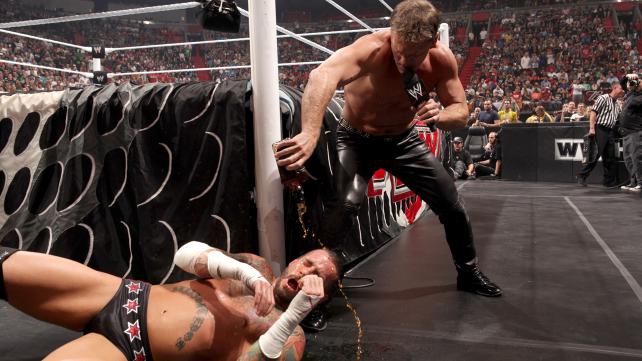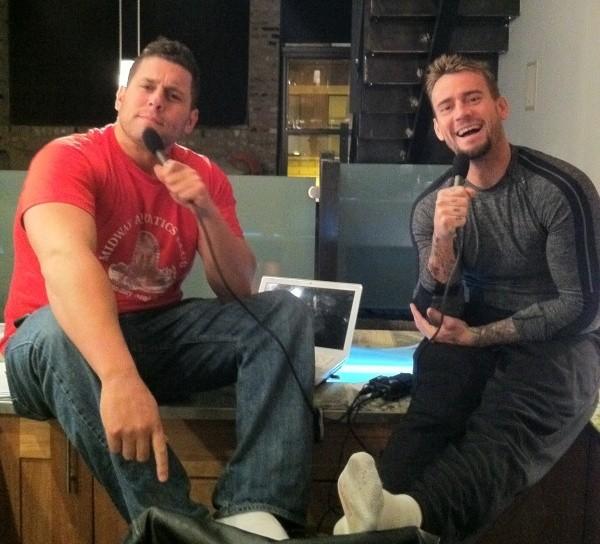
First, CM Punk on The Art of Wrestling. Somebody sent me a question through Date with a Wrestler asking what I thought of Punk and his position on the WWE. I may or may not write a more robust post on this later, but here’s some brief thoughts:
- All I want for any wrestler is to get out on their own terms and to be happy with their decisions. It seems thats what CM Punk did. Good for him.
- I never had an issue with him leaving. He is, indeed, an independent contractor, free to “take his ball home” if and when he so chooses. He’s not harming anybody through his decision to not wrestle. If anything, it seems like he would have been harming himself were he to continue under conditions that made him unhappy and were dangerous to his health.
- If anything comes out of this (and, sadly, it won’t be a union), I hope it’s that WWE starts to treat the health of its wrestlers as something more than an obstacle to be overcome for the sake of the next segment. The stuff that they did in the wake of the Chris Benoit murder/suicide was nice on a public relations front, but if all you’re worrying about is public relations, something is going to come along and submarine whatever minuscule changes you’ve made to get the public off your back. Fix it now. Hire better doctors. Don’t pressure people back into the ring before they’re ready. Give the people who actually make you money comprehensive health insurance. Treat your workers like they’re members of the family you claim they’re a part of.
I may also eventually get around to Vince McMahon’s (non-) rebuttal on the WWE Network, where he walked around on eggshells and said that he wanted to work with CM Punk again in the future. I suspect that, had he listened to The Art of Wrestling, he may have been less forgiving. I’m also really, really interested in McMahon’s take on Cesaro’s position on the card, given that you could argue he was the second hottest wrestler in the world after Daniel Bryan before, during, and the day after WrestleMania. His lack of success since probably has more to do with the direction the writers pushed his character in than the fact that he’s Swiss. But we’ve got an overly long wrestling show to cover, featuring the return of the most derided authority figure in the history of that singularly awful trope, so let’s get to it.
BEFORE THE SHOW:
- If you want to check out more Raw reviews, do so here.
- Social media garbage: I am at @gh0stplanet. Follow me if you wish. I’ve got a few wrestling Tumblrs you may enjoy. Those are Date with a Wrestler and Wrestling Fashion. Also, you can follow Fear of a Ghost Planet on Facebook, if you dig it. You should dig it. Ohh, yeah.
- I’m sure you have friends who will be impressed that somebody can write 5k words about a wrestling show. Why not share this post with them? There are buttons to the side and at the bottom to do all of that.
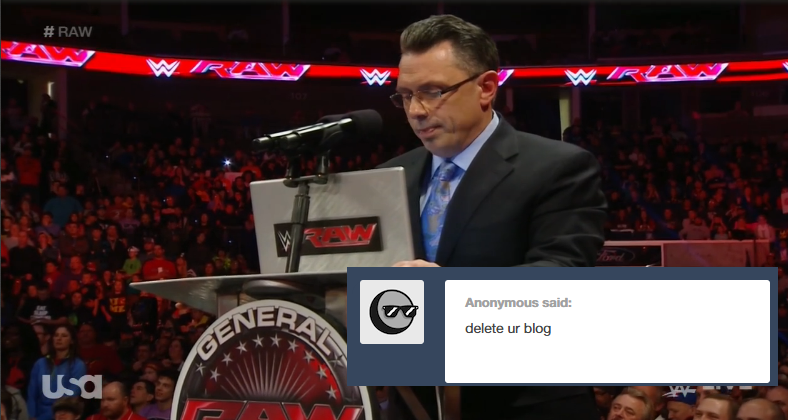
The show starts out on a sour note immediately, with Michael Cole receiving an e-mail from the Anonymous Raw General Manager. Nothing could be more exciting at the start of a wrestling show than watching Michael Cole read text off of an aggressively hideous laptop. Nothing could be further from the truth than that last sentence. The Anonymous Raw General Manager says that he should be back in charge because he’s respected industry-wide and doesn’t have a name or a face, but before he can make his matches for the night, John Cena hits the ring. Tulsa loves the guy. There’s a dude in a cameo cowboy hat and Steve Austin shirt doing loud, monster truck rally, C’MON LET US HEAR YOU whistles, and he’s in his mid-40s at least, which serves to illustrate that, when it comes to wrestling, it doesn’t matter what the gigantic cities want. It’s all about Real America, and zero people are as Real America as John Cena.
John Cena isn’t happy to see the Anonymous General Manager back in action. But he is happy with his team from Survivor Series. Still. Even though it’s been a week. Cena is going to tell us why he’s proud of his team, which is unnecessary because Survivor Series is already a distant memory, but the General Manager sends another e-mail. Cena backs Michael Cole away from the laptop and partially closes its cover. His team’s victory was too important to be handed over to a machine. But now it’s Seth Rollins’ time to interrupt John Cena. He compliments John Cena on his many talents. One of them is taking credit for things he didn’t do. Like with the match at Survivor Series. This is a good point. Rollins, in fact, eliminated Cena from the match, and probably would have won were it not for (the man called) Sting. Cena reminds Rollins that Dolph Ziggler almost beat The Authority on his own, and that he would have done it, too, were it not for Triple H. Cena is here to give credit where credit is due. But Seth Rollins isn’t here to recount history; he wants to know if WWE is better off without The Authority. The crowd seems to think so. Rollins tries to name some GMs who might be worse than the Anonymous Raw General Manager, and boy does he flounder. JBL gets a pop. Batista gets a meh. Eric Bischoff gets a moderate pop. We’re living in chaos, he says, only we’re not because that’s not how wrestling works. If they made an effort to promote that WWE shows were a chaotic wasteland without Triple H and The Authority at the helm, then maybe this would make sense. But Team Cena vs. Team Authority changed nothing. Raw is still Raw, and that’s all it is. I remember, not too long ago, when Raw GM William Regal shut the cameras off 15 minutes early and smash-cut to a rerun of Law and Order. That’s the sort of chaos that might make this angle work, but instead we’ve been treated to two weeks of philosophical debate between two dudes who need to shut the hell up and fight already. Cena’s not bringing The Authority back, Jack, so whatever.
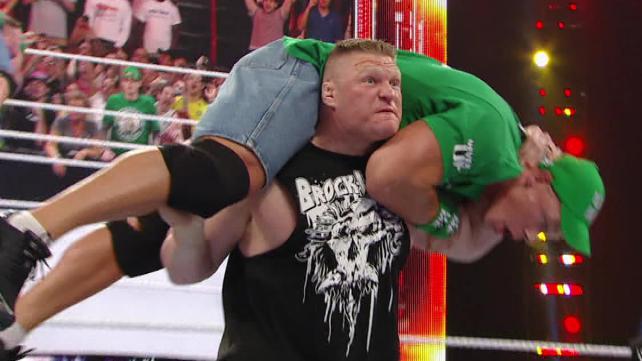
Cena talks over the Anonymous Raw General Manager’s instant message noise, but Michael Cole can’t ignore its siren song. The GM books a Tables Match between Rollins and Cena, the worst possible goddamn match ever. If Cena loses at TLC, he’ll lose his number one contendership to Brock Lesnar’s WWE World Heavyweight Championship. This gets Cena salty, and the distraction provided by Cole’s reading an e-mail allows Rollins to attack. But Cena fights back quickly, taking Rollins and his security out before Kane enters the ring and hits him with a chokeslam. Rollins goes under the ring for a table, because it’s a metaphor, goddamn it. Ryback sprints to the ring and saves Cena, hitting all of the bad guys with his signature moves. But Kane recovers and starts hitting Ryback with a chair. This, too, is a metaphor, as he’ll be taking Ryback on in a Chairs Match, which is also awful. Erick Rowan hits the ring now and clears it, only to be attacked by The Big Show. He picks up the ring steps and smashes Rowan in the face with it. Dolph Ziggler rushes the ring and takes Big Show out, then tries to put a ladder in the ring. This is also a metaphor, as Luke Harper takes Ziggler out and the two will have a Ladder Match at TLC (which might be good. You never know). Cena tries to fight everybody off, but he can’t. Rollins and his security team put Cena through a table with The Shield’s old triple-powerbomb finisher. This. Took. Twenty-one. Minutes.
Back from break, John Cena is seen stumbling to the back as WWE doctors check on he and his team. The Anonymous Raw General Manager doesn’t care about the health and safety of his employees, and has thus booked two matches: Rowan vs. Big Show, and Ziggler/Cena/Ryback vs. Rollins/Harper/Kane. Oh no.
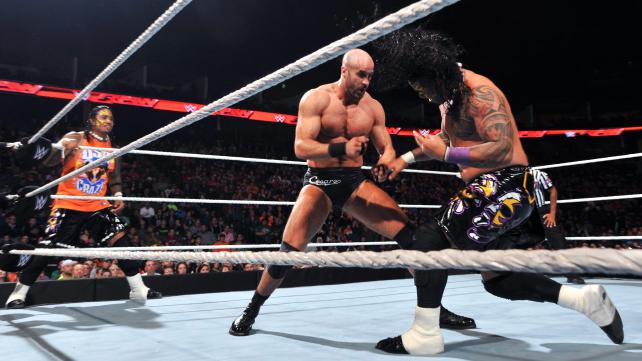
Tag Team Turmoil to Determine the Number One Contenders to the WWE Tag Team Championship: This is a gauntlet-style match, where two teams fight until one wins. Then the winning team faces the next team, and the team that wins that encounter goes on to another match, and so on. First up, we have Goldust and Stardust against The New Day. The New Day didn’t make their promised debut on Raw, but on SmackDown! instead. Michael Cole says that the trio are “a lot of fun,” so I guess in deciding which direction they were going to take with Kofi Kingston, Xavier Woods, and Big E., they went with smiling, dancing, black stereotypes. Noted. I really can’t explain how terrible their entrance— which is all HAND CLAPS and GOSPEL CHOIRS and GIGANTIC SMILES—is, so here’s a screencap of everybody posing in their hideous powder blue gear:
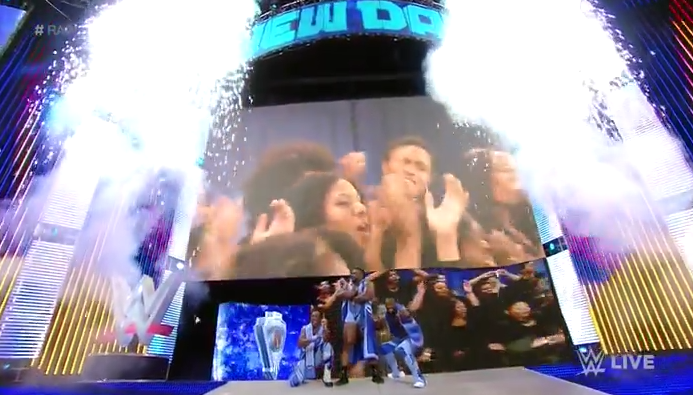
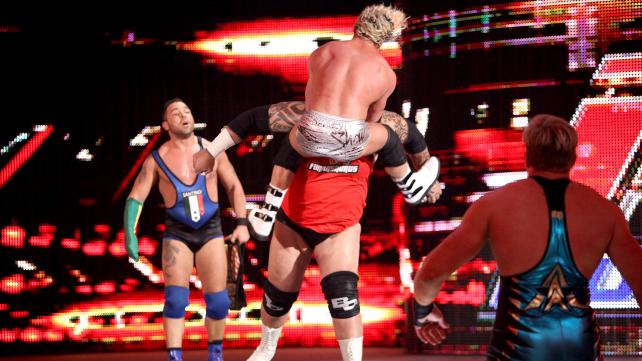
They pretty much gave all three men Rocky Maivia’s SMILING, HAPPY PEOPLE gimmick, hoping that it doesn’t get eaten alive. Or maybe they hope that it will. More likely, this garbage will be met with indifference. They determine who will wrestle via a game of Odds and Evens, and it’ll be Kofi and Big E. Kofi takes over on the Dust Brothers early and tags Big E. in. They’ve got some big, exuberant double-team moves. Goldust chops Big E.’s knee and tags his brother in. Kofi makes a blind tag on Big E. while Stardust is running off the ropes. Big E. catches Stardust and hoists him in the air, then he and Kofi bring him crashing down to the canvas. This move is called “The Midnight Hour,” I guess, which makes me think of Madonna’s “Like a Prayer,” which had a black Jesus in the music video, I guess? Goldust waits around to see if his brother can kick out, but they can’t, and that’s it for the former champions. (Goldust and Stardust are eliminated.) Cesaro and Tyson Kidd are out next, accompanied by Natalya. This would be exciting if there were an actual plan for either. But they’re just here to fill space. Cesaro muscles Kofi Kingston up and over for a belly-to-belly suplex and tags Kidd in. Kidd kicks Kofi Kingston in the chest and chokes him against the ropes. He bridges on the chinlock, which rules. Kidd bodyslams Kofi Kingston and takes his sweet time following up, which lets Kofi make the tag to Big E.
Kidd catches a charging Big E. with a kick to the gut, but Big E. hits Kidd with a belly-to-belly and wipes the sweat from his brow with a handkerchief that he’s got in his singlet. Michael Cole says that I’ve got to love this, but, uhh, I don’t. Big E. hits Kidd with an Ultimate Warrior splash and looks for the Big Ending, but Cesaro gets involved. Big E. takes them both out and tags Kofi in. Big E. launches Kofi Kingston over the top rope and to the outside, where he crashes down on Kidd and Cesaro. Kofi rolls Kidd back into the ring and goes for a springboard forearm. He connects. Goldust and Stardust return and attack Big E. and Xavier Woods, which distracts Kofi enough that Kidd is able to roll him up and hold the tights. The New Day is over before it even began. (Kofi Kingston and Big E. are eliminated.) Beyond putting The New Day into a feud against Goldust and Stardust, there is no reason for them to lose this match. None. Especially to a team that isn’t a team. Cesaro and Kidd celebrate for a bit, but The Usos are out next.
Jimmy Uso and Cesaro brawl, but Cesaro’s strength is unreal and he’s able to quickly throw Jimmy Uso around like he was nothing. He celebrates a bit early though, and Jimmy takes over. He hits Cesaro with his running butt smash and tags Jey Uso in. Cesaro isn’t fazed for long though, and quickly tags his partner in. Tyson Kidd gets in the ring, but Jey gains the advantage back quickly. Cesaro tags in without Jey Uso seeing it, just before Kidd hits the floor. Jey Uso goes for a dive, but Kidd is using Natalya as a shield (this is something the cameras miss), and Cesaro sneaks up from behind with a German Suplex. He gets a two count. Back from break, Cesaro and Kidd are still in command. Not for long, however, as Jey fights back and tries to tag out to his brother. Cesaro prevents this with a powerbomb and brings Kidd back. Jey thwarts a double team effort but is taken down by Tyson Kidd, who hurts himself on the move. This allows Jimmy Uso to get back in and take Kidd out with a Samoan Drop. Cesaro saves the match for his team before the three, then is clotheslined over the top rope by Jey. Jimmy Uso tries to get Tyson Kidd back into the ring, but Natalya prevents it. Kidd goes for a springboard Flying Nothing and gets superkicked and splashed for his effort. Cesaro is taken out with a dive, and Jimmy pins Kidd. (Cesaro and Tyson Kidd are eliminated.)
This brings out Adam Rose and The Bunny, so fuck everything. Adam Rose sends his Exotic Express away because they’re getting paid by the hour or something, and this is what it comes down to: The worst gimmick in wrestling against a pair of competent tag team wrestlers. Start up the dumb bunny joke machine. Adam Rose gets rolled up, but kicks out. Why? Why prolong this agony? Rose manages to gain an advantage on Jimmy Uso, and we cut to the back, where Naomi is just casually watching the match, by herself.
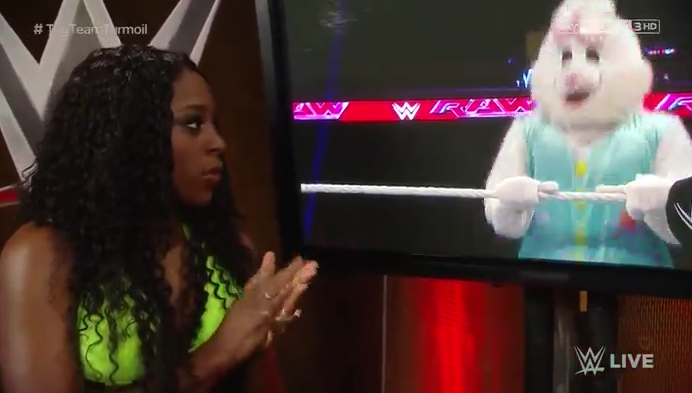
Her marriage to Jimmy Uso is only important if you watch Total Divas or are the kind of backwards asshole who defines a woman by who she is married to. WWE is counting that you are both of these things, so Naomi will be the focus of the feud between The Usos and The Miz/Damien Mizdow. Jimmy, meanwhile, gets spinebustered by Adam Rose. He has everything under control, so naturally The Bunny tags himself in and nearly gets superplexed. But he counters and hits a sunset flip powerbomb. Now Adam Rose tags himself in. THE BUNNY WILL NOT STAND FOR THIS. Rose gets superkicked and splashed, and, mercifully, it’s over. (Adam Rose and The Bunny are eliminated.) WINNERS: The Usos via pinfall. Grade: C
There’s nothing great about Tag Team Turmoil or gauntlet style matches. No real drama, and no real thought given to the booking. If this was being used to move The Usos into a match against Miz and Mizdow, then why not just run the angle where The Miz hits on Naomi and skip the bits where you devalue your new team (The New Day), expose the glaring holes in your roster by sticking a first time team into a match for a shot at the titles, and continuing the Rose/Bunny affair? Backstage, The Miz joins Naomi in the vacuum where one watches Raw on a television dangling from space. Mizdow is with her, bearing his replica belts. The Miz congratulates Naomi on her husband’s win and says he voted for her on the WWE App to be AJ Lee’s partner later on tonight. What a scumbag, right? Oh wait, he’s impressed by Naomi’s twerking in a music video, so yeah, fuck him. Naomi is pretty pumped that a white dude digs her dancing, though. Miz offers Naomi a contact with a Hollywood producer and gives her his card. Mizdow gives her an invisible one. In the carpark, Vince McMahon steps out of a limousine. This gets the biggest reaction of the night. Seth Green will be hosting next week’s Raw, which is the Slammy Awards. And I’m supposed to be excited about this for some reason.
Some dude interviews Erick Rowan, who is still fiddling with his Rubik’s Cube. The interviewer has done some investigating and has discovered that Rowan has an I.Q. of 143. Borderline genius. He’s a classically trained-guitarist and an award-winning vintner. Rowan nods as if this has been true all along and says that he’s going to fight The Big Show because The Big Show is a bully. He then hands the guy his finished Rubik’s Cube. I…I dunno. They’re trying a bit hard, but I guess they’re trying. Big Show makes his way to the ring and says that Rowan is right, he is a bully. Because he has to be one. People, after all, have been betraying him his entire life. Now all The Big Show cares about is hurting people. That’s rad.
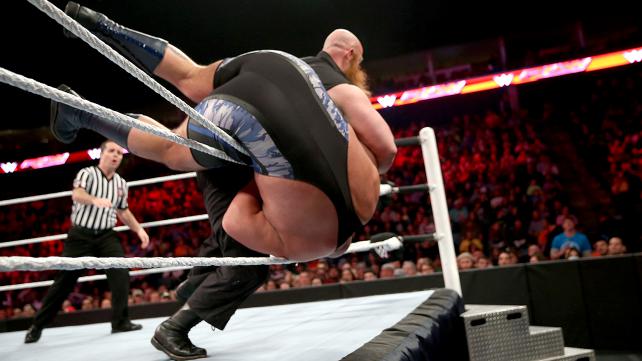
The Big Show vs. Erick Rowan: Despite being a classically-trained guitarist, Rowan’s entrance music is some weird swamp garbage. JBL thinks that Rowan’s large fingers are the reason he’s able to solve the Rubik’s Cube so quickly. Rowan takes Big Show out quickly, forcing him outside the ring. JBL starts calling Rowan “Big Red” and tries really hard to make it happen. Trying too hard to make things happen is a theme. Meanwhile, Big Show’s crafty ring generalship is enough to outsmart the borderline genius, and he takes Rowan out with a clothesline. Show bullies Rowan around, because that’s what he likes to do. Another clothesline puts Rowan down, and Big Show sinks in the cobra clutch. Rowan fires back with some clotheslines and splashes of his own, finally sending Show over the top rope with another clothesline. It doesn’t matter how many times I see it: Watching Big Show spill over the top rope to the floor is always impressive. On the floor, Big Show reverses a whip and sends Rowan careening into the stairs. He then smashes Rowan with them and is disqualified. Winner: Erick Rowan via disqualification. Grade: C+
This wasn’t bad, but it’s being used to build to a Stairs Match, which is a thing that doesn’t exist. The stairs, I guess, are another metaphor. What they symbolize is your undying commitment to the WWE Network and contrived gimmick matches. Backstage, Vince McMahon is wandering around aimlessly. He comes to the realization that The Exotic Express was a bad idea.
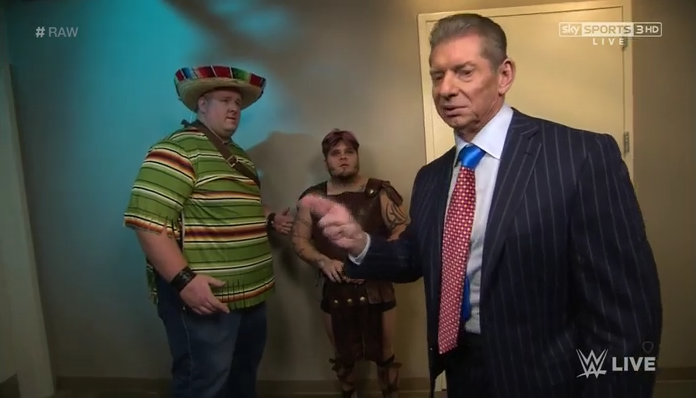
His power tie might be the worst fashion choice in this frame, which is saying something considering that there’s a white dude in a sombrero and polo shirt poncho. Renee Young intercepts Vince McMahon and tries to ask him about the state of the WWE. But Vince blows her off and says that he’s happy he could whistle, but that he can’t whistle because he never learned how. I have no idea why he said that. He’s pumped up about being on Steve Austin’s podcast. Podcasts are not a thing Vince McMahon knew about before tonight. When asked about bringing back The Authority (why anybody cares when Raw is proceeding as usual, I don’t know), he says that it’s not in his hands. In his hands (cue evil Vince hand motion from when he bought out WCW) is Stone Cold Steve Austin. All Vince McMahon is here to do tonight is relive the glory days, Renee. They recap last week’s AJ Lee/Bella Twins deal to put over the fact that WE HAVE THE POWER to decide AJ’s partner against the inexplicably reunited Bella Twins. Our options are Natalya, Naomi, and Alicia Fox. Your winner, as dictated by an earlier segment, will be Naomi.
Fandango vs. Jack Swagger: The New and Improved Fandango, aside from being one more thing that the WWE is trying hard to make everybody like, is actually the same Fandango as before, just without heat. His new dance partner, Rosa Mendes, might be worse dancing than she is wrestling, but since she never wrestles who knows. Jack Swagger’s music hits, but Swagger doesn’t come out. Backstage, Zeb Coulter is gripping his leg while Swagger acts poorly, asking nobody for a doctor. In the ring, Fandango smiles and accepts his victory. Winner: Fandango via forfeit. Grade: N/A
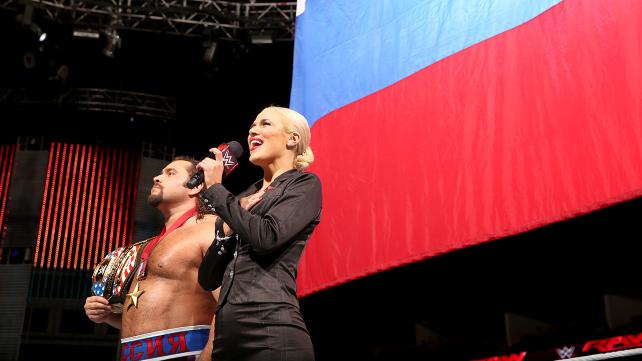
Michael Cole criticizes Fandango for taking the win, which was totally not something Fandango had planned for, because here’s Rusev and Lana. Fandango waltzes away unscathed, however, as Rusev has no time for anything but Jack Swagger. Lana recaps last week’s events. If you remember, Rusev was forced to recite the American pledge of allegiance, lest he be entered into a battle royal to defend his title. Rusev refused, so he took on 19 other men on SmackDown!. Rusev won, however, giving Lana a reason to call America pathetic. Rusev has the microphone and goes into his Drago routine. He is the man. He claims to have broken Zeb Coulter, which, considering how horrible that character is as a face, might be considered a mercy killing. Lana recites a pledge of allegiance to Rusev, and it’s the first bit of promo she’s done that I absolutely hated. Lazy, terrible parody writing. Just do whatever they do in Russia. Jack Swagger makes for the ring now to avenge America and his tea party daddy, hurling Rusev into the barricades a number of times before the referees pull him away. There’s not much reason to revisit this feud beyond a noticeably thin talent roster, and the crowd reacts like they’ve seen it all before. Which they have.
Damien Mizdow (w/The Miz) vs. Fernando (w/El Torito): They did a pre-show angle where El Torito stole one of Mizdow’s fake titles, but he already has it back. The bell rings and the crowd starts chanting for Mizdow, and the way he sells surprise is pretty tremendous. Damien Sandow has always been one of the more underrated guys on the roster, so I’m glad that he’s still making the most of this otherwise horrible situation. Mizdow out-wrestles Fernando and gets a one count off a trip, but Fernando’s quickness enables him to take over. Meanwhile, The Miz talks about how he wants to help Naomi. Mizdow gets a two off of a backslide, and Fernando gets a two off of a clothesline. Fernando applies an armbar, but misses a Stinger Splash. Mizdow takes Fernando out with a pair of clotheslines and The Miz’s backbreaker/neckbreaker combo, then kips up from it, which is impressive for a dude of his size. The crowd digs it. Mizdow goes for the Skull-Crushing Finale, but Fernando rolls out of it. Fernando goes for a sunset flip, but Mizndow counters into a Figure-Four Leg Lock! Mizdow’s facial expression is so good that Fernando has no choice but to tap out. Winner: Damien Mizdow via Submission. Grade: B-
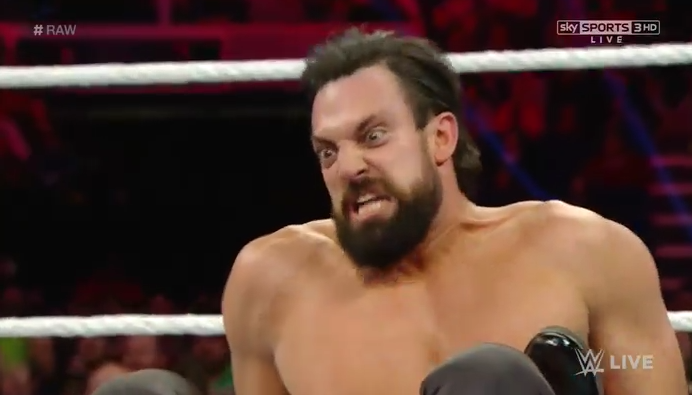
This was a good squash, but it would have been even better had Mizdow tried to imitate Miz doing guest commentary. I guess, in a way, this match breaks Mizdow’s character, but that’s not a bad thing. Maybe they’ll start evolving Mizdow. Maybe they’ll realize that he’s the hot hand right now in the midcard and continue to feature him. Maybe, but probably not. The Miz, as ever, is the long-term project here. Mizdow’s just along for the ride unless the crowd continues to dig him. Jimmy Uso comes out, and The Miz is like “Oh man, he’s here to thank me for appreciating his wife’s talent,” but that is not how the world or wrestling or marriage in the context of the hypermasculine universe both our world and the world of wrestling work, so Jimmy hauls off and decks The Miz. The way he smiles before he does it is the most charismatic thing he has ever done. Someone in the crowd yells “Kick his ass, Sea Bass,” and I can’t imagine it’s because he’s seen Dumb and Dumber To. Damien Mizdow watches on from the ring, absolutely confused, and The Miz sells this like he’s absolutely terrified, which is the right response to being assaulted. Jey Uso checks the situation while wearing a hoodie, so you know this is not official Uso business. This is personal. This is about his wife. I tend to get uncomfortable about feuds in wrestling that involve wives, because the language of marriage in professional wrestling is still very much the language of ownership. The Miz maybe stepped his bounds in telling Naomi that she twerked well (because Jesus Christ, white dudes should not be talking about twerking), but this is something Naomi did in a public context to further her career. Jimmy Uso, if he’s that bent out of shape about it, should be tracking down every dude who watched the video so he can punch them in the face, too. But The Miz offered Naomi some help in advancing her career (which is necessary, since the WWE isn’t going to do it for her), and this is what has Jimmy angry. They try to sell it as The Miz hitting on someone’s wife, but really it comes across as Jimmy being insecure in his masculinity. Michael Cole supports this theory without meaning to, suggesting that The Miz should have given his producer’s business card (not his business card) to a Diva who wasn’t seeing anybody. JBL mentions that The Miz is married to an actual, real life model, which is true. But if this angle leads to Jerry Lawler getting punched by every dude for saying creepy bullshit about every woman on the roster, then I might support this garbage.
Bray Wyatt vs. R-Truth: The most impressive thing about this match will be Bray Wyatt’s entrance. The thing that sucks about Bray Wyatt, aside from WWE’s unwillingness to just run with him and see what happens, is that he only ever wrestles in squash matches, like this, or big matches, like the one against Dean Ambrose at TLC. There are no even contests for him except the ones on pay-per-view, so it’s tough to get a sense of how his character has evolved in the ring, if it has at all. This is important, since Wyatt has not evolved as a character outside the ring, despite the numerous setbacks he has faced. I’d argue that his character is stagnant (though it shouldn’t be), but the audience still loves him. Even as handicapped as the character has become through the writers’ fear of what he represents (the unknown, that which fits no mold), he’s still the most unique individual on the roster. It’s fitting that he’s in a feud with Dean Ambrose, since Ambrose is in the exact same position. Wyatt assaults R-Truth to begin the match, calling out for Dean Ambrose. Truth avoids a splash, but gets taken out with a clothesline. JBL continues to say that Wyatt and Ambrose were trying to “out crazy each other.” If only that were true. Lawler says that the two of them together would be “cray-cray,” presumably because he watches The Disney Channel to stay young and hip. This match is an absolute vacation for Wyatt—Truth’s only offense is a hope-spot that sees him hit two moves that I vaguely remember being his finisher at one point in time, but Wyatt gets back up from both immediately to feed for more. He misses a scissor kick and gets taken out with Wyatt’s uranage. Wyatt pushes Truth to the ring apron and DDTs him onto it. One yoga back bend and Sister Abigail later, and it’s over. Winner: Bray Wyatt via pinfall. Grade: B-
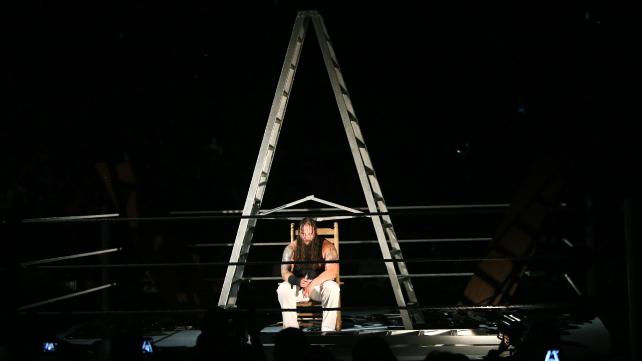
JBL says that “Sister Abigail” is a great name for Bray’s finish, but doesn’t say why. Without the context provided by Wyatt’s character, it’d actually be terrible. R-Truth rolls out of the ring while Bray begins to put the implements for a Tables, Ladders, and Chairs match into the ring. This, the metaphor we’ve been using all night (and last week) for Vince McMahon’s plea to us watching at home to just buy the WWE Network already, confuses Michael Cole. When we come back from commercial, Wyatt is in the ring, sitting under a ladder in his rocking chair. He tells us about Jacob’s ladder. I can’t find any video evidence of this promo, but Cactus Jack once said that “If the Gods could build me a ladder to the heavens, I’d climb that ladder and drop a big elbow on the world.” Bray Wyatt is good, but no promo about climbing ladders is going to top that one. Jacob’s ladder led to Jacob’s maker, and at the top of that ladder Jacob was promised that he’d always be safe. But that’s not what Bray Wyatt’s ladder leads to. Nobody is up there for Bray. He climbs the ladder and laughs at all of us. He laughs at Dean Ambrose. And he sees tables, ladders, and chairs. This brings Ambrose to the ring, and they brawl. It’s not particularly spirited, but it’s there, reminding us that these two will be having a very dangerous match on the WWE Network, and that, I guess, is what counts. For me, the most agonizing part of Raw is that every feud is built the exact same way. A man cuts a promo. Another man interrupts him. They fight. One of them gets the advantage. The next week, someone else gets the advantage. The only thing distinguishing the build to Ambrose/Wyatt from the one leading to Jack Swagger/Rusev is that Dean Ambrose broke a rocking chair and Rusev broke an old man. Swagger and Zeb Coulter are life partners, but that rocking chair was sacred to Bray, goddammit. Dean Ambrose finishes the segment by standing underneath the ladder, and that, too, is old and tired and expected.
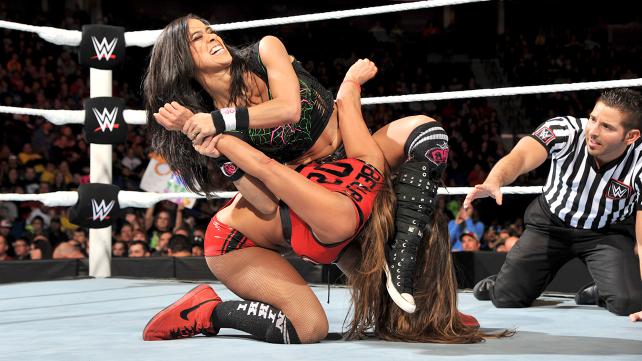
The Bella Twins vs. AJ Lee and Naomi: They are never going to explain why The Bella Twins are back together, I guess. I mean, Brie’s insubordination got Nikki beaten up for months, which caused Nikki to turn on her sister and sell out to Stephanie McMahon, which led to months of Nikki having Brie beat up, which led to a match where Brie had to be Nikki’s personal assistant if she lost, which she did, so she dressed up like a butler and served her tea and was made to look foolish… but now everything is okay again, and we’ll never know why. Forget about those videos where Nikki was super sour over Brie stealing her prom date, guys. Twin magic conquerers all. Naomi wins the fan vote because wrestling is rigged. AJ’s running gimmick since she became an actual player is that she’s never been successful in tag competition, but that gimmick is over starting now. Nikki and Naomi start the match off, and Nikki takes Naomi to the mat with a vertical suplex. This gets a one count. Nikki dropkicks Naomi, and it’s the last dropkick she should throw for awhile because it was not good. Brie tags in and continues the onslaught, hitting Naomi with a running back elbow smash. Michael Cole only remembers the 30 days where Brie was Nikki’s personal assistant, because he has the memory and attention span the WWE assumes its fans possess. Nikki gets back into the ring and clotheslines Naomi as the “CM PUNK” chant starts. THEN SOME FANS START CHANTING “AJ LEE.” Bless. Jerry Lawler has been informed that he can never say “cray-cray” again, and while Lawler is talking about himself Naomi flips out of a back suplex and tags in AJ Lee. The former Diva’s Champion flies at her rival with a Thesz press. She follows with a splash/neckbreaker combination, knocks Brie off the apron, hits Nikki with a pair of knees and a tornado DDT and gets a two count for that sequence, as Brie is able to make the save. Nikki then gets dropkicked by Naomi, and Naomi should continue throwing dropkicks because it’s a skill she has. AJ Lee throws Brie out of the ring and hits Nikki with the Shining Wizard. She puts Nikki in the Black Widow, and that’s all she wrote. Winners: AJ Lee and Naomi via submission. Grade: B-
This is more indicative of the time and attention they give to the women’s division, but that might have been one of the best five women’s matches on Raw in 2014. Backstage, Santa Claus (who sounds suspiciously like Mick Foley) plugs WWE’s Cyber Monday sale. I only mention this because Santa Claus sounded suspiciously like Mick Foley. There’s a bunch of recap of Michael Cole reading e-mails, recaps also being a big reason why Raw drags and drags and drags, but hey, Paul Heyman is here!
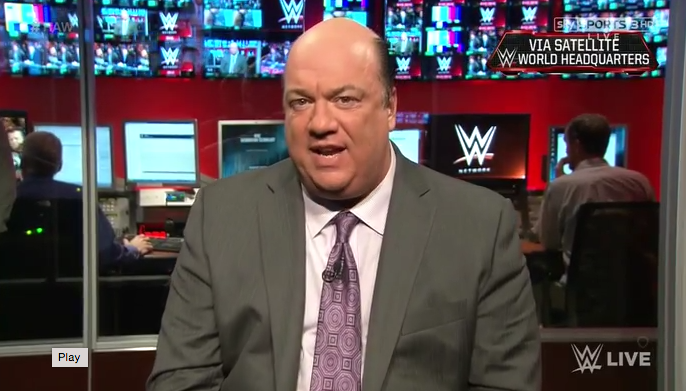
He heard what John Cena had to say about Brock Lesnar not being around defending his title every week. Heyman says that Brock Lesnar is like Christmas, and you don’t do Christmas 365 days a year. Lesnar is can’t-miss, must-see talent. Cena, should he get past Rollins, will have to fight a fresh, well-trained Brock Lesnar, and that’s a fight Cena can’t possibly win. But if Cena loses, who becomes the number one contender? Seth Rollins? Lesnar’s a bit salty about the curb stomp, so good luck, pal. The Undertaker? That, too, would be ugly. Sting? If Sting and Brock Lesnar fought, it’d be Sting’s retirement match. Then Heyman says to make the whole WWE roster the number one contender and to line them all up in front of his client. That would rule, because it’s pretty much the only way Cesaro is going to get a title shot at this point, and because I could picture Brock Lesnar on a throne made from the cleaned and polished skulls of the entire roster, everything burned around him, end of wrestling. And considering that the highight of this show thus far is a medium-shot of a middle-aged talent agent suggesting hypothetical opponents who will never step into the same ring as Brock Lesnar, ending wrestling sounds like a mercy killing. According to Paul Heyman, the man who has the WWE World Heavyweight Championship has all the power. That power, obviously, is Brock Lesnar. His power is undisputed. Kneel before him and tremble, ye mortals.
John Cena, Ryback, and Dolph Ziggler vs. Seth Rollins, Kane, and Luke Harper: I have a feeling that this is going to be the least of the six-man tag team main events presented by the WWE this year. They’ve been an unexpected strength of the product in 2014, but Rollins and Harper were elements of those great matches between The Shield and the Wyatt Family, and not the only dudes carrying the ball. During the five minutes it takes for everybody to get into the ring, Michael Cole mentions for the seventh time that TLC “is WWE’s version of demolition derby,” because we’re trying to get the wrestling over as a niche, hobbiest endeavor. Luke Harper and John Cena begin the match, and Cena starts off by punching the hell out of the Intercontinental Champion, knocking him to the mat a few times. He drags Rollins into the ring and locks in the STF. Beyond the fact that he “cost” Cena his rematch against Brock Lesnar, the beef between these two is synthetic at best. Cena’s STF is broken up by Harper, who is thrown to the mat by Cena for the interruption. He tags in Dolph Ziggler, and the two hit a double dropkick. Ziggler covers Harper, who kicks out. Harper manages to tag out to Kane, and Ziggler brings Ryback in. These two, as mentioned, will have a Chairs Match (which, as mentioned, is a thing that should not exist), so Ryback is beyond pumped to test himself against an old dad in business slacks. Ryback Thesz presses Kane, dribbles his head like a basketball, and hits his splash for a two count. Kane gets Harper back into the match, but Ryback can’t be stopped by any ol’ dirty swamp monster and clotheslines Harper for a one count. Harper gets Seth Rollins into the match for the first time, and he takes over on Ryback. He’s out as quickly as he’s in, though, and Ryback wastes no time in turning the tables on Luke Harper. The two exchange blows in the corner until Harper goes for his suplex/punch. Ryback blocks it and goes for a suplex of his own. He holds Harper up… and we go to commercial. In the ring after the break, Ryback gets another suplex in, garnering a near fall. He tags Dolph Ziggler in for the first time, and he gets a sleeper in on Kane. The sleeper is broken up when Kane runs backwards into the turnbuckles. Kane tries to charge at Ziggler, but he gets dropkicked in the knee and falls face first into the turnbuckles. Ziggler continues building momentum until he tries a double ax-handle, which Kane counters with an uppercut to the throat. Kane gets a two count and tags in Seth Rollins.
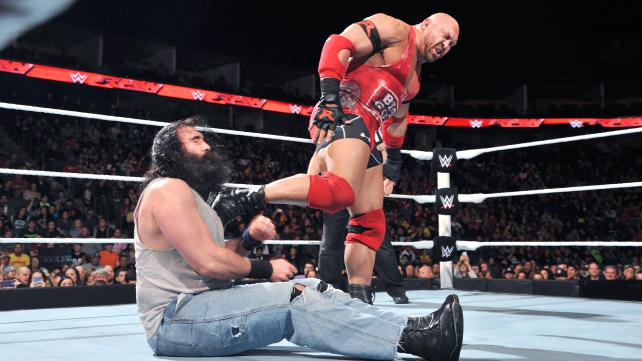
Again, Rollins tags out quickly to Harper, who gator rolls the former Intercontinental Champion and cinches in his chin lock. Ziggler fights his way to the corner, but Harper chops Ziggler in the throat and does his suplex/punch in before tagging out to Kane. Ziggler’s got nothing for Kane, who obliterates the Survivor Series hero with a clothesline before hitting him with a knee to the gut. He tags Rollins into the contest, and he whips Ziggler from corner to corner. Rollins brings Ziggler down to the mat with another chinlock, and Ziggler fights out with a jawbreaker. Rollins goes for a splash and misses, and Ziggler tags in John Cena. Cena immediately goes through his routine and lifts Rollins for the Attitude Adjustment, but Rollins slips it. Luke Harper isn’t that lucky though, and he gets drilled. Kane enters the ring, and he eats a double suplex from Cena and Ryback. With things in disarray, Rollins’ security squad attacks Cena, and Rollins covers him for a two. Kane still has the advantage after the commercial, getting another near fall after a sidewalk slam. Cena powers out of a chinlock and dropkicks Kane into a tag from Luke Harper. Harper gets into the match and lifts Cena for a back suplex, but he changes course, instead throwing Cena face-first to the mat. It’s worth two. Harper lays in another throat thrust and tries to whip Cena across the ring. Cena counters and sends Harper into the turnbuckles instead. When Cena gets up, however, he is met with a superkick. Harper tags Rollins in, and he climbs the turnbuckles and hits Cena with a flying punch. Rollins does some trash talking, and it allows Cena a brief bit of hope. He charges for his corner, but Rollins is there with a clothesline. Cena breaks his way out of a rear chinlock, but Rollins clubs him on the back of the head and puts him in the corner. He goes for a splash, but Cena moves. He dives across the ring and tags Dolph Ziggler in. Harper’s in as well, but Ziggler is on fire, clotheslining everyone he sees and eventually hitting Harper with the Fameasser for two. The match breaks down again, everybody in the ring, and John Cena dives onto the pile. He tries to hit Kane with the Attitude Adjustment, but Kane gets out of it for the first time in years and kicks Cena in the face. Everybody starts exchanging high impact moves “out of nowhere!” and Harper finishes sequence with a black hole slam for another near fall. Harper tries to follow with a sit-out powerbomb, but Ziggler has too much momentum and manages to counter with a sunset flip. That catches Luke Harper off guard, and the referee counts the three. Winners: John Cena, Dolph Ziggler, and Ryback. Grade: B
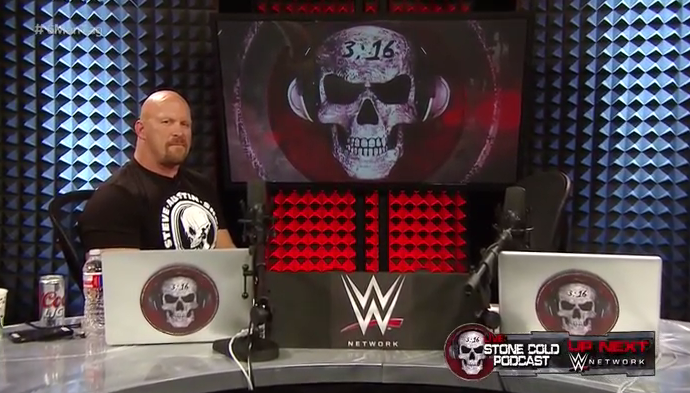
Harper is up immediately, and he knocks Ziggler out. Now all six men are in the ring and Cole calls TLC a demolition derby again. Stop. Stop, please. Just stop trying to make stupid phrases happen. The Big Show sneaks into the ring and headbutts the world. Erick Rowan charges the ring with an extra set of ring steps and starts taking out the bad guys. Big Red is what they’re going to call him now, which is a mistake. Big Show tries to double chokeslam Rowan and Ryback, so he ends up eating everybody’s finish. Rowan picks up the stairs and, with three men holding an already knocked out Big Show, gets his revenge from earlier in the night. Despite Ziggler winning and Rowan getting the last word, John Cena’s music plays to end the show. Oh wait, it doesn’t end the show at all because Steve Austin is just hanging out in a nightmare world of Tetris blocks and skulls, drinking a coffee, a Coors Light, and a bottle of water before his podcast with Vince McMahon.
Rating:
 In WWE, the episode of Monday Night Raw before a pay-per-view is colloquially referred to as the “go home show,” the company’s last opportunity to embellish the storylines going into the weekend’s big matches. For me, that description has never worked for any episode of Raw besides the one before WrestleMania, which is, of course, the show, the one that events like this Sunday’s Hell in a Cell serve as a pyrokinetic PowerPoint presentation for, building up a year-long resume for the evening’s stars before the Monday after WrestleMania, where everything resets in order to build up to next year’s show. Regardless, this is the internet, and once nerds like me catch glimpse of phrases like “go home show,” every episode of Raw is evaluated not in terms of entertainment or plot, but in terms of how well it sells the upcoming pay per view.
 Stray Observations: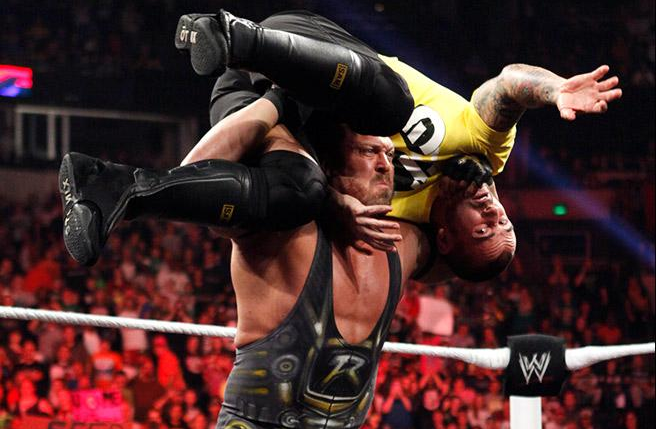
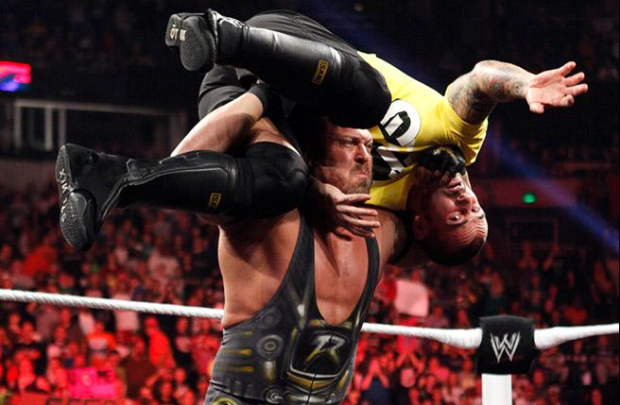 For weeks now, the narrative of WWE Monday Night Raw has been this: to cement his legacy as an all-time great champion, CM Punk would need to defeat John Cena within the confines of Hell in a Cell, WWE’s steel cage warzone that’s seen its fair share of company defining moments. On one level, this makes sense: many of the company’s top feuds, from The Undertaker’s battles with Shawn Michaels and Mankind to Triple H’s beefs with Chris Jericho and Cactus Jack, have wound up there, and Cena/Punk is certainly worthy. On another, it’s a complete mystery: Punk’s been involved in two Hell in a Cell matches and hasn’t outright lost to John Cena since before last year’s WrestleMania. The cell has mostly loomed in the background as another specter of WWE past, taunting the long-tenured WWE Champion like Bret Hart, Mick Foley, Jim Ross, and Vince McMahon have over the past few weeks. Tonight was billed as the night CM Punk chose between John Cena and Ryback as his eventual challenger, and also as an evening during which Vince McMahon would potentially choose Punk’s opponent. In a move unsurprising to folks who follow injury reports but inconsistent in terms of overall narrative, neither Punk nor McMahon chose who would be stepping into Hell in a Cell, but John Cena, who abdicated the ring and led the audience in Ryback’s chant of “FEED ME MORE.”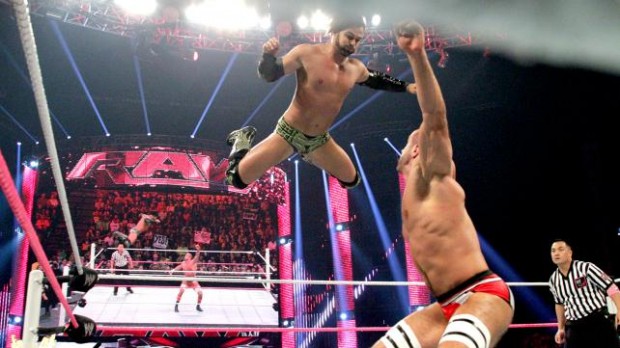
 Stray
Stray 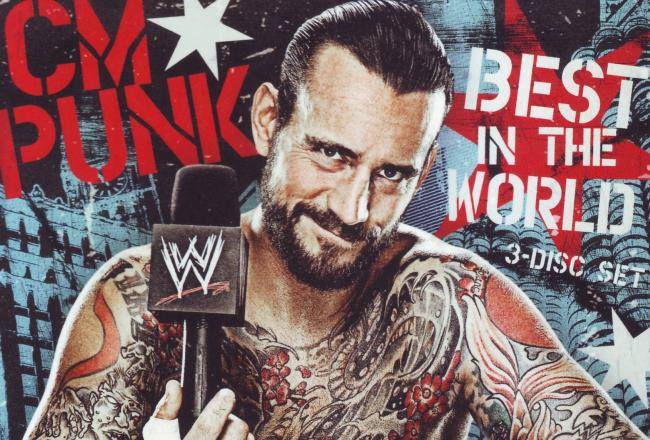
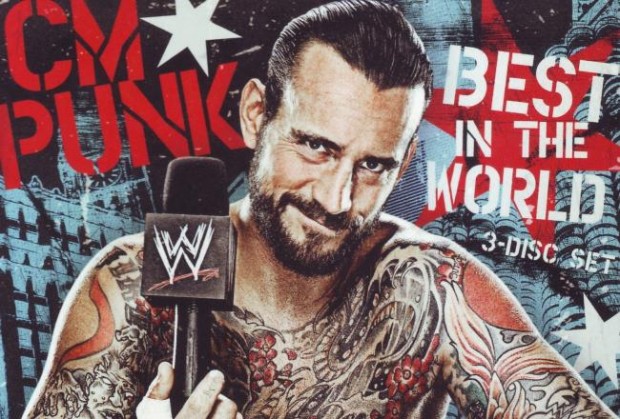 If you’re even remotely familiar with World Wrestling Entertainment, just one look at CM Punk on a Monday Night Raw telecast will tell you everything that makes his narrative so compelling: in an industry built upon and carried by Herculean physiques, CM Punk doesn’t fit the mould. If you are familiar with WWE, familiar enough, perhaps, to’ve seen one of their many retrospective documentaries, then the difference between Punk and men like Dwayne “The Rock” Johnson, “Stone Cold” Steve Austin, and John Cena are even more clear cut.
 CM Punk: Best in the World. Directed by Kevin Dunn. A documentary featuring CM Punk, Colt Cabana, Chris Hero, Daniel Bryan, John Cena, Triple H, Michael Hayes, Paul Heyman, and others. Released October 9, 2012, by WWE Films. Extras include documentary footage and matches across Punk’s career.