Tag: Bradley Cooper

  • Movie Review: American Sniper (2014)

    Movie Review: American Sniper (2014)

    American Sniper

    There are other movies out right now—better ones, too—but I chose to see American Sniper because it is the film everybody has an opinion on right now, and I guess I felt like I needed to formulate one of my own. The memoir that this serves as an adaptation of is likely something I will never read, so I can’t comment on Clint Eastwood and screenwriter Jason Hall’s ability to bring Chris Kyle’s story to the screen as Kyle told it. I know that he uses the word “savage” to describe Iraqis, and I know he later falsely claimed to’ve punched out Jesse Ventura at a bar for mocking veterans. I also know that Kyle said he was responsible for more kills than the Navy SEALs will confirm, and that the government parked him atop the Superdome in New Orleans during Hurricane Katrina, where he allegedly shot and killed “dozens” of American citizens. I don’t know Chris Kyle, but he sounds like a complex, flawed, dangerous fraud, the fabled Good Guy with a Gun who exists only in the collective fantasy of the American right whose life is worth reflecting upon as a means of deconstructing such myths. Clint Eastwood, however, is not the man for such a job. A man who is given to lecturing invisible Barack Obamas on the significance of America and her ideals, Eastwood sees his protagonist as a man wearing a white hat though stranded on a black sea. The war isn’t just something that happens; it’s something that happens to him. Kyle’s story, in the hands of a director more interested in the fact of a hero than his psyche, is as complex as a bologna sandwich.

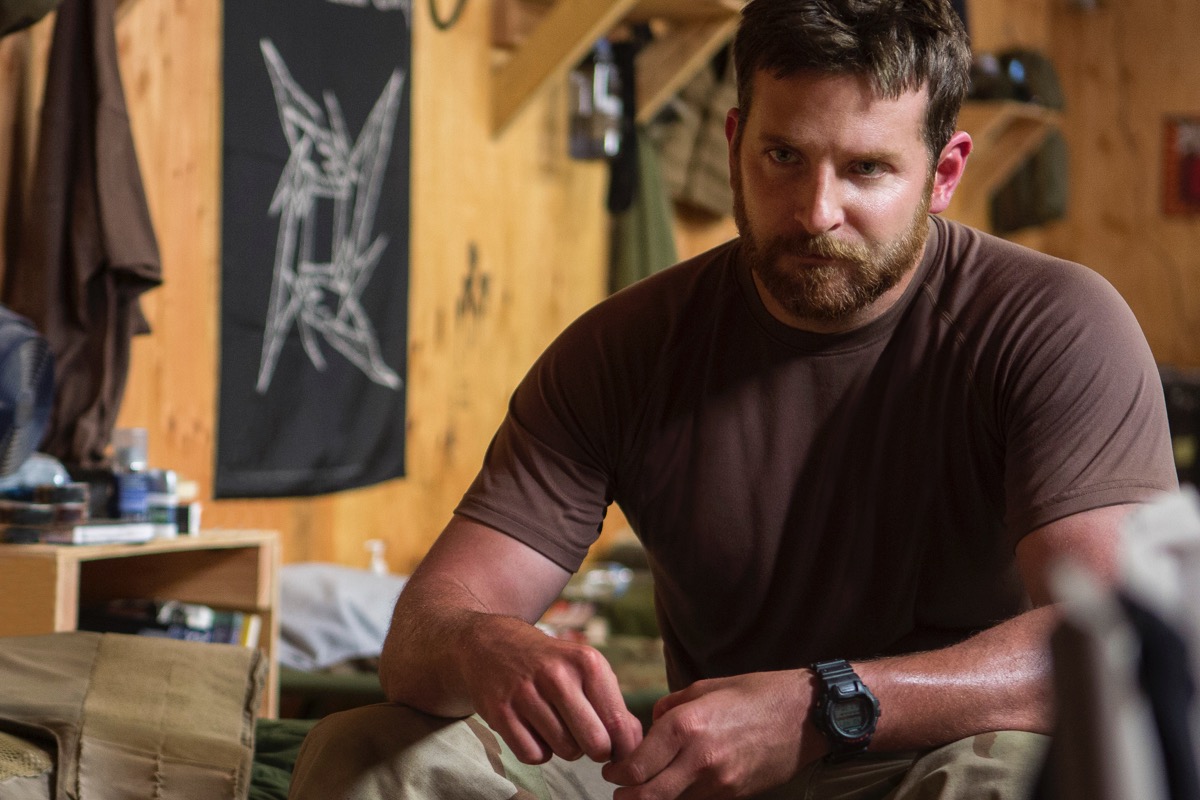
    American Sniper, rather than linger in the details or fret about the larger implications of what Chris Kyle (Bradley Cooper) does for a living, is largely desensitized to the brutalities he perpetuates and has perpetuated upon him. Exactly one kill shown here has any weight, his first, and that is largely because, as cut for the trailer, it’s a rather compelling microfilm about the weight of one’s choices. That the choice being made here is a white man’s decision to kill or not kill an Arabic woman and her son is shown to be largely irrelevant—it’s not how Kyle imagined his first time pulling the trigger, but he stopped a pair of suicide bombers from wiping out a patrol of Marines. Mission accomplished, end story.

    Between his placing a finger on the trigger and his pulling it, there’s a rather lengthy bit of exposition explaining the kind of person Kyle is. In short, he’s a red-blooded American, an honest-to-God cliché. He loves his country and he loves his woman. The first three images of American life shown in this film involve hunting rifles, bibles, and a football. The suburb Kyle grew up in is shot as beige and featureless as the Iraq he will later occupy. He has sex with the woman who will become his wife (Sienna Miller) and wakes up to live footage from New York City on September 11th, 2001. Both the sex and the act of war inspire Kyle to get better at his job. He says he’s protecting his country. He says his country is the greatest on earth. It’s all been said before, but Chris Kyle is a real man with a real (if embellished) record, a soldier whose funeral filled a football stadium, so coming from the actor occupying him, I suppose all of that’s supposed to lend the script’s bumper sticker platitudes the kind of gravity repeated sequences of bodies spasming, geysering blood, and collapsing dead just can’t earn these days.

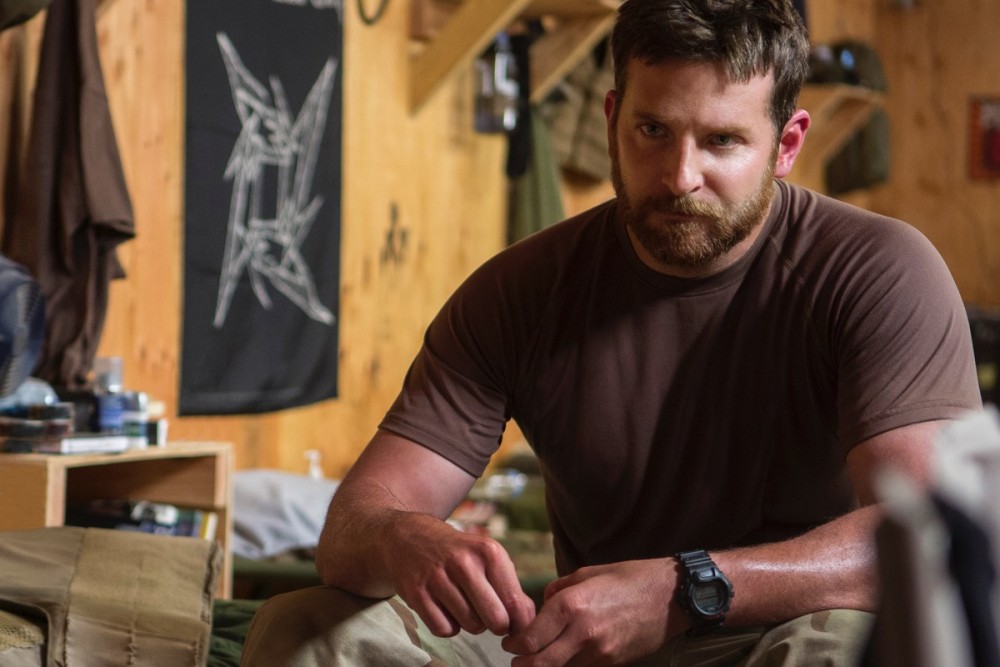
    Given a relatively straightforward script and Eastwood’s by-the-numbers direction, Bradley Cooper isn’t exactly taxing himself as Kyle. Without the real man’s penchant for dehumanizing language, all Cooper has to do is set his jaw firm and speak with a slight drawl. Even when he’s under fire, taking shots from elite enemy snipers—one of whom is described as a former Olympic medalist fiercely loyal to bin Ladin—Cooper’s Kyle doesn’t seem too stressed. His wife can hear gunfire and other soldiers shouting over their cell phone connection, but Kyle always seems to be a readjustment away from leaving the battlefield with his life and a few more notches on his belt. When a sandstorm kicks up over a late-film op, it’s merely one more shade of beige.

    Plenty has been made of the fake babies used to simulate Chris Kyle’s newborn children, which betrays that there’s really not much to American Sniper that’s worth discussing. There’s the political angle and the race-baiting of Kyle’s memoir, but Eastwood seems decidedly uninterested in why we’re at war and what Kyle thinks of the people he is shooting. That’s a problem perhaps, but one of adaptation and not morality. It’s been impossible to log in online without seeing dozens of tweets from morons who saw this film and said how it made them want to kill Arabs, but I suspect the folks responsible for those missives harbored their racist feelings before seeing American Sniper, just as I suspect that the editors responsible for publishing those tweets on every website that leans even slightly left know that morons on Twitter draw a lot of clicks. But I’m a white guy myself, and all I know about movies like this is that it takes a really good one or a really offensive one to get my attention. That’s a failing on my part, I know, but I thought I was going to leave this film convinced of its evils. Instead, I’m at something of a loss. What this film should have done with its subject matter is a matter for debate until the next film about war during the Bush presidencies is made. What it did, however, is nothing.

    American Sniper is further evidence that Eastwood is continually regressing as a director, or that time has finally passed him by and is no longer as interested in the merits of American muscle as he is. I don’t think that filmmakers are necessarily obligated to create pictures that take a hardline stance on the War on Terror, but that this is the story Eastwood has chosen to present as a somber occasion set to taps is disingenuous to all parties involved, including Kyle. Cooper plays him as a man who is somewhat uncomfortable with his notoriety, but Eastwood is set on making him a paragon. So be it. There are better films about this war out there, and still more yet to be made. In terms of fiction, Kathryn Bigelow’s The Hurt Locker and Zero Dark Thirty diptych remain the best place to start.


    American Sniper. With Bradley Cooper (Chris Kyle), Sienna Miller (Taya), Luke Grimes (Marc Lee), and Kyle Gallner (Goat-Winston). Directed by Clint Eastwood from a screenplay by Jason Hall, based on the memoir American Sniper by Chris Kyle, Scott McEwen, and Jim DiFelice.
  • Movie Review: Silver Linings Playbook (2012)

    Movie Review: Silver Linings Playbook (2012)

    Silver Linings PlaybookDavid O. Russell was seemingly born to make movies about the modern American male. As codified in Three Kings, The Fighter, and now Silver Linings Playbook, an American man is intense, uncompromising, and without a filter. He is always underestimated. He is driven to conquer. In search of Kuwaiti gold, championship belts, or the satisfaction of winning a high stakes gambit, an American man never rests. To rest is to die. Patrick Solitano (Bradley Cooper) is unquestionably an American man. Told by his wife that he needs to lose weight, he dons a hoodie and a garbage bag and sprints through the neighborhood. Wishing to reconnect with her, he reads every book she assigns to her high school students. Told by doctors, friends, relatives, and the police that he can’t see his wife again, his mind races; he has to see her—the only question is how?

    Pat has recently been diagnosed as bipolar. As Silver Linings Playbook opens, his mother is signing the papers necessary for his release from a Baltimore mental institution. He was there because, upon finding his wife in the shower with another man, he nearly beat that man to death. Pat dedicates himself to overcoming his disorder, but he is unwilling to take medication, his friends and family treat him much differently than before, and his wedding song, which was playing when he found his wife in the shower with another man, is a trigger for his rage. One wonders if his release from the mental hospital was a good idea—not necessarily because it’s too soon, but because his support system isn’t exactly the world’s finest. His mother (Jacki Weaver) is nice enough, but his dad (Robert De Niro) is a case study in obsessive compulsive disorders and likely has a gambling addiction. Having taken up bookkeeping, he spends his Sundays watching Philadelphia Eagles games. He has three remote controls, all angled a certain way. He clutches and rubs his Eagles handkerchief. He intends to get his son in on his compulsion, but Pat. Jr. is always running, always reading, always trying to get his wife back.

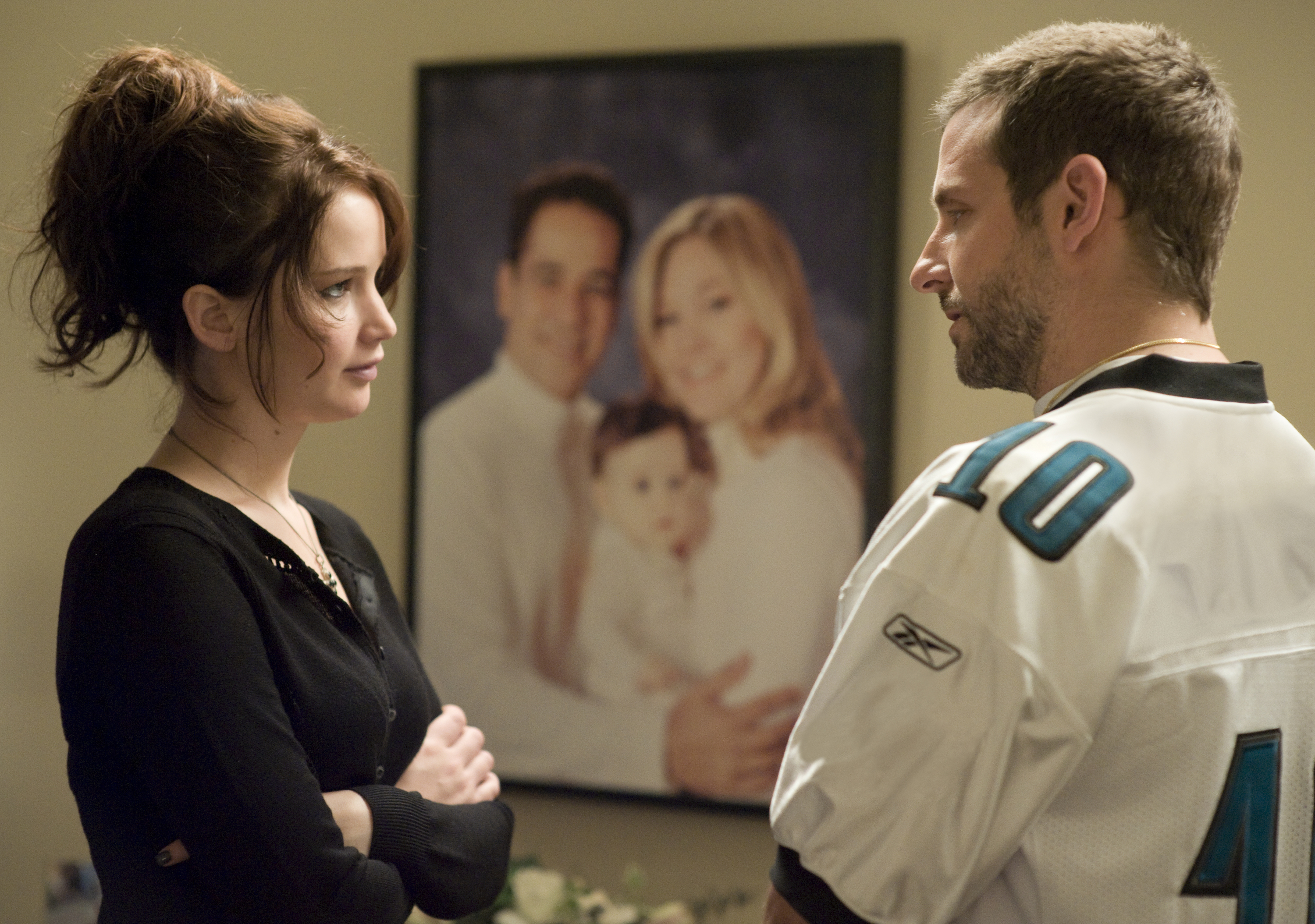
    He meets Tiffany (Jennifer Lawrence), a widowed woman whose coping mechanism is sex. Meeting each other for the first time, they compare medications. It’s clear that there’s something between them, but Pat doesn’t see it; eyes on the prize. Until Tiffany offers to circumvent the restraining order placed against him by his wife, she’s just somebody Pat can compare his ailments to, another crazy person. Pat wants to write a letter to his wife. Tiffany wants to enter a couples dance competition, but was never able to do it with her husband. With the specter of the letter hanging over Pat’s head, Tiffany is able to blackmail him into learning a dance routine. As the Philadelphia Eagles tortuously navigate their way towards the NFC Championship game, Pat and Tiffany grow into a cohesive unit.

    Silver Linings Playbook is structured like a standard romantic comedy and is replete with hang-ups, half truths, and quirky parents who just want the best for their son. The difference—really, the privilege of a David O. Russell rom-com—is not just a matter of talent: Bradley Cooper, Jennifer Lawrence, and Robert De Niro all have ability, and have leant it to a fair number of undeserving vehicles. Silver Linings Playbook—as is true of all of Russell’s films—not only plays on the strengths of his cast, but adapt them to suit the emotional response of the widest possible audience. Christian Bale, for example, had already bent his body into a grotesque horror-show for the purposes of The Machinist, but it was The Fighter that won him an Academy Award. Robert De Niro has been playing an aging tough guy for decades now, with the caveat that very few of those tough guys have been vulnerable. Here, De Niro’s character isn’t just suffering from his OCD and gambling problems, but from the very real possibility that he has failed his son. Though there have been bright spots here and there over the past few years, Silver Linings Playbook gives De Niro the most he’s had to work with in years, and watching him is every bit as invigorating as when he was at the peak of his power.

    Of course, the bulk of Silver Linings Playbook depends on the relationship between Cooper and Lawrence working, which it does. Though Lawrence has detoured post-Winter’s Bone into the much more lucrative world of comic book and young adult novel adaptations, she remains a phenomenally talented young actress. Though her age goes mostly unremarked upon, there’s something deeply unsettling about this young widow and the way she feeds on tragedy. Unlike most romantic comedy misunderstandings, the game she plays with Pat’s unshakable desire to reunite with his wife borders on cruelty. By the time her ploy reveals itself, however, Pat’s unstable brain chemistry—convincingly played by Cooper in a number of wrenching, early scenes—is no longer the often unconquerable monster of reality, but a movie illness. With the help of his family (De Niro and Jacki Weaver are one of the more convincing screen couples of recent years), his friends (Chris Tucker, John Ortiz, and, as his therapist, Anupam Kher), and a few well-applied montages, he’ll pull through.

    It’s easy to envision a darker, less comic version of Silver Linings Playbook, one that maintains the tone of its early scenes, where much about Pat is uncertain and those around him are almost queasy remembering what landed him in a mental institution. Indeed, that version exists on the cutting room floor, where De Niro is meaner and less understanding of his son’s condition, nodded at with the brief presence of Pat’s lawyer brother, who is quick to point out his successes and Pat’s failures. Instead, with its climactic dance sequence and what follows after, Silver Linings Playbook practically wills itself to be a saccharine sweet crowd-pleaser. It’s not the wrong instinct to follow, by any means; Silver Linings Playbook is an easy film to be won over by. That being said, the film also has a certain responsibility to the disorders it invokes, one it willfully ignores in its push to send the audience home grinning. Even with the film’s conscious decision to play as something nice and minor on the table, it’s one nudge too far.


    Silver Linings Playbook. With Bradley Cooper (Pat Solitano Jr.), Jennifer Lawrence (Tiffany Maxwell), Robert De Niro (Pat Solitano Sr.), Jacki Weaver (Dolores Solitano), Chris Tucker (Danny), Anupam Kher (Dr. Patel), John Ortiz (Ronnie), and Julia Styles (Veronica). Directed by David O. Russell and produced by Bruce Cohen and Donna Gigliotti. Screenplay by Russell, based on the novel The Silver Linings Playbook by Matthew Quick