Tag: book and comics reviews

  • First Issue Collectors Item: Batgirl #0 (2012)

    First Issue Collectors Item: Batgirl #0 (2012)

    First Issue Collector’s Item is a periodic, ongoing look at that most illusive (and, in many instances, ultimately valueless) pop-culture artifact: The first issue of a comic book series. This week, DC Comics continues to offer issue #0s looking at the origins of the heroes at the focus of the New 52, and Oni Press has something new from Greg Rucka. First, lets take a look at Gail Simone’s slightly tweaked Batgirl origin story in Batgirl #0.

    Though I fell somewhat short of my goal to write about all fifty-two new or relaunched series DC Comics trotted out sometime last year to the chagrin of folks who obsess over the way comic books are numbered (in my experience, a staggering amount of people) and the eventual glee of the DC bigwigs whose calculated gamble paid off better than anybody could have anticipated, allow me to float forth a theory on why this massive undertaking rocked the DC Universe to its core. Though several changes have come down the pike that haven’t been universally well-received—Wonder Woman’s Amazonian tribe as a group of maneating baby killers, Superman having never dated Lois Lane, Superman making out with Wonder Woman, Batgirl getting over the whole quadriplegia thing—The New 52 wasn’t ever an initiative to tear the multiverse asunder, assassinate your favorite characters, or front an unstated cultural agenda. The purpose of this whole thing was to make collecting individual issues into trade paperbacks an easier enterprise, one that wouldn’t scare casual readers off a page on Amazon as soon as they saw that a trade collected issues 634-645 of Detective Comics. (more…)

  • First Issue Collector’s Item: Fashion Beast #1 (2012)

    First Issue Collector’s Item: Fashion Beast #1 (2012)

    First Issue Collector’s Item is a periodic, ongoing look at that most illusive (and, in many instances, ultimately valueless) pop-culture artifact: The first issue of a comic book series. This week, Alan Moore returns to monthly comic books with Fashion Beast #1.

    I can’t exactly say I was shocked to learn that the genesis of Fashion Beast was an unrealized script from the mind of punk rock provocateur Malcom McLaren. Afterall, McLaren had as chaotic a relationship with film as he did with music. In 1977, McLaren hired Russ Meyer to make a movie about the Sex Pistols. Meyer, in turn, hired Roger Ebert to write the movie, and the two men responsible for Beyond the Valley of the Dolls set out to create a film about a band neither had listened too. Ebert’s brilliant script, Who Killed Bambi, includes scenes wherein Johnny Rotten confronts a religious group quite like the Church of Scientology and Sid Vicious shoots heroin with his mother. When Russ Meyer—whose tastes were good and clean, if perverse—asked McClaren if Vicious would be up for that sort of thing, he shrugged the question off entirely. “Why wouldn’t he?” McClaren said. “It’s all based on fact.” Why not, indeed? McClaren, after all, was just throwing every idea he had into a manic, potentially unfilmable script.  (more…)

  • The New 52: Green Lantern: New Guardians #1, Green Lantern #1, Green Lantern Corps #1, Red Lanterns #1

    The New 52: Green Lantern: New Guardians #1, Green Lantern #1, Green Lantern Corps #1, Red Lanterns #1

    Green Lanterns: New Guardians #1

    Writer: Tony Bedard / Artist: Tyler Kirkham

    I’ve never been much for any Green Lantern not named Guy Gardner (best jacket in comics, best hair in comics), but start me off with a gaggle of dead ones, victims all of a seemingly apocalyptic intergalactic battle, and I’m going to take notice. The new Lantern in question here is Kyle Rayner, and, if this is what the characters always been like, I don’t see what people have been complaining about since his 1994 debut. He’s a nice enough guy, and, as a comic book artist, he’s able to bend the Green Lantern power ring to more creative uses than giant boxing gloves or the current popular manifestation of supreme cosmic willpower–the giant machine gun. He saves a crane operator from certain doom by willing to life three giant, Depression-era construction workers…and is promptly criticized by some random kid for designing his own costume.

    Thankfully, Green Lanterns: New Guardians #1 isn’t as preoccupied with defending the legacy of its main character as Aquaman was, and the result is a 22 page comic that both effectively introduces its hero and hurls him into an incredibly dangerous predicament. Out in space, the power rings belonging to other cosmically-powered spacemen are disappearing, which is understandably upsetting to the factions missing their rings. They all converge on Kyle and, wouldn’t you know it, a Lantern from each corps is hot on its tail, ready to tear apart the poor bastard unlucky enough to draw their attention.

    Tony Bedard, whose Route 666 remains a favorite–if unheralded–comic of mine, is effective in cramming everything into one issue. Not only does Rayner get the ring, the other Lanterns lose theirs, the crane falls, there’s a whole lot of dead dudes on Oa, and the ring hunters drop in on Rayner at the end. That’s big stuff for a first issue, particularly considering that many of the New 52 first issues have been content to tease at a threat, meander with a character, then jump to the cliffhanger; but Green Lanterns: New Guardians #1 is as tight and controlled as a comic mid-way through its run. Tyler Kirkham’s visuals–particularly his handling of alien species and Rayner’s saving the crane–are stunning and clean, cosmic but still human. I can see a situation where I’d quickly tire of Kyle (he’s a bit sassy, and that can go overboard quickly), but I’m hooked for a couple of issues at least, if not more.


    Green Lantern #1

    Writer: Geoff Johns / Artist: Doug Mahnke

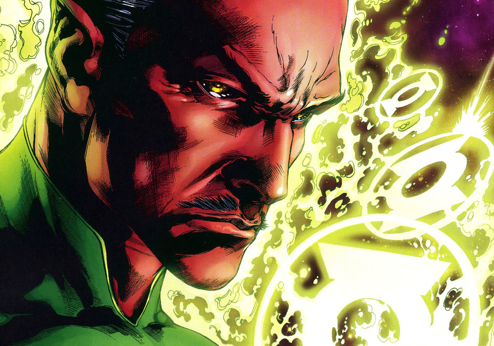
    In Green Lantern #1, Hal Jordan becomes the sad, divorced dad of comics, out of touch with the world around him because he’s spent so much time among the stars. His power ring abandons him and chooses Sinestro, he’s jobless, can’t make rent, is dead to a world that doesn’t realize he protected them, and is hapless when it comes to speaking to Carol Ferris, maybe the only person on Earth who understands him and what he’s been through. Of course, that doesn’t make it any better when Carol takes Hal out to a fancy restaurant, where he charmingly asks her to co-sign the lease on his car where another, better man may have asked her to marry him, but it’s kind of fun watching Jordan and Ferris get their hopes up about two things that couldn’t be more different, only to see both dreams smashed.

    This seems to be Geoff Johns’ specialty, to bring superheroes low and raise them back up. Hal Jordan, having shrugged off prior events where he killed billions of people, is an odd reclamation project, but Johns brought Jordan back into this world, and it seems he’s going to be the one to shepard him as the DC Universe moves forward. Having been around the block with a few titles written by Johns, I feel my interest in the adventures of Hal Jordan; Civilian waning even before Green Lantern #1‘s cliffhanger, which looks like the set-up for the world’s dullest, lecture-filled buddy cop movie. While giving Sinestro a place in the Green Lantern Corps is an interesting thought, Johns simply doesn’t write with the short of urgency or poise that I’m looking for. His heroes are ponderous and lost beings, looking for redemption and trying to reclaim their old glory. They’re also too well-aware that they’re better than the people around them. His villains are like that, too, but that I can shrug off. You give a guy phenomenal cosmic powers, and the best he can do is conjure a giant pair of binoculars? If I were the jobber Sinestro easily kills in this issue, I would have tried to attack him from behind, too.


    Green Lantern Corps #1

    Writer: Peter J. Tomasi / Artist: Fernando Pasarin

    Because it’s not enough to have both Kyle Rayner and Hal Jordan down on their luck, Green Lantern Corps #1 sees Guy Gardner apply for a job as a high school football coach and get rejected, as his being on the sideline could make the team vulnerable to extraterrestrial attack. If Hal Jordan is the divorced dad of comics, Guy Gardner is now the sad uncle–he’s wistful for normalcy, has his own goofy nickname for the men and women of the Green Lantern Corps, and still wears the (awesome) jacket that got him laid in high school. John Stewart–actually referred to as the black Green Lantern in another book, in another bit of weird meta-awareness these books probably don’t need–is similarly listless. He’s hired to design a building specifically because he’s a Green Lantern, then he finds out that the building firm wants to cut a few corners, and Stewart quits. Meanwhile, in space, several Lanterns are being hacked to death by a mysterious entity. The moral to Green Lantern Corps #1? It ain’t easy being green.

    There’s really not much more to say beyond that. Either Gardner is getting lectured to, or Stewart is doing some lecturing, and neither path is of particular interest to me. The larger, cosmic implications of Green Lantern Corps #1 will take center stage, I imagine, but of all the New 52 books I’ve read, this comics Threat/Hero Building/Threat set-up is the least compelling one yet. There are some nice touches, like when Gardner is being interrogated by the other men applying for the high school coaching job, but, maybe because I read Star Wars novels as a kid that did the same thing, the prospect of an entire planet being drained of its water–especially a planet that isn’t Earth–just doesn’t excite me, and Stewart, by using his ring to send his potential employers hurtling Earthward in a lantern-powered elevator because his standard of excellence is nothing short of impractical, strikes me as somewhat petulant. Like many of the books DC has recently launched, Green Lantern Corps #1 features some very strong art, here by Fernando Pasarin. But, like with many other books in the line-up, strong art isn’t enough to get me to plunk down $2.99, and Peter J. Tomasi’s script, like the one he did for Batman and Robin #1, does more to turn me away from a good concept than interest me in seeing what happens next. He’s reaching for quiet, character defining stuff in both comics, but both are let-downs.


    Red Lanterns #1

    Writer: Peter Milligan / Artist: Ed Benes

    Red Lanterns #1 is a curiosity to me, as I missed out on the crazy widening of the Green Lantern mythos’ color spectrum, and I knew who exactly zero of the characters in this book were going in. I assumed that it was going to be a villain book, since the dudes and dudettes on the cover looked pretty feral and of the teeth-gnashing variety, but the Red Lanterns are given their power and motivation by a desire for revenge. They are, in fact, so powered by vengeance that they’re mentally crippled by rage, unable to do much more than rip people apart and fight each other. But, two pages in, there’s a cute housecat who rips apart some S&M-themed aliens, so I was immediately attached to the concept, which I’d otherwise be tetherless to.

    The leader of the Red Lanterns, Atrocitus, is a kind of cosmic Conan the Barbarian. Like Conan, he’s motivated by the death of his family, is a man of phenomenal strength and rage in a universe that doesn’t understand him, a tool by which a reader is allowed to mull over the value of violence and rage in society. Atrocitus saw his whole planet wiped out by the machinations of an insane Guardian of the Universe, so there’s plenty of fuel in the tank. But, just the same, that Guardian is dead now–can one still feel rage once vengeance is claimed? Atrcitus looks into the future, sees much suffering, and determines that yes, such things are possible.

    As much as I like Atrocitus (I dig Conan and Red Sonja and other barbarians, so I suppose that makes sense), Red Lanterns has some ground to cover before it becomes something I’d gladly spend my money on. Apparently, the rage-infected humans of 28 Days Later are what inspired Geoff Johns and Ethan Van Scriver when they created the Red Lantern Corps, and that influence is certainly evident in the way the Lanterns who aren’t Atrocitus behave–they’re barely capable of speech. Not that Red Lanterns is a zombie book, but my interest in the other Red Lanterns right now is like the interest that I have in a zombie that isn’t threatening a potential meal–nil. I see that there are a few possible recruits to the Core, and perhaps the potential to increase the awareness of the other members. That would be splendid.

    I trust Peter Milligan, whose run on X-Force and the resulting X-Statix are perhaps the best commentary on the absurdity of superheroism, superhero teams, and fame I’ve read in mainstream comic books. I also like Ed Benes, whose art has matured considerably since I last saw it in Birds of Prey. I previously had him figured as a cheesecake artist, adept at drawing the ridiculously implausible curves of DC’s superheroines and little more, but beyond Bleez, Atrocitus’ second in command, there is little room for T&A. His Red Lanterns look properly demonic, ready for war.

  • The New 52: Batman #1, Batman and Robin #1, Batman: Dark Knight #1, and Detective Comics #1

    The New 52: Batman #1, Batman and Robin #1, Batman: Dark Knight #1, and Detective Comics #1

    To be honest, I sometimes worry about things like Batman. I know that in a world plagued with real problems, it is mostly ridiculous to care about the portrayal of a comic book character, but if comic books are one of the ways I choose to escape the kung-fu grip of reality, I will likely find myself worrying about my unreality. The way things were in 2006, when I stopped reading comics regularly, my unreality was in a shambles. Batman, my barometer for all things mainstream comic book, had been brought low by the events of Identity Crisis and, in DC’s mad scramble to create another Hush, he’d been pushed through some pretty lame storylines across his own books. In Detective Comics, he stopped detecting. In Batman, he did more brooding over ancient history than punching the crap out of crime. Jason Todd was coming back. Bruce Wayne was going to die or be zapped to the past or something. His mind had been erased. There were chinks in the armor. It was too much to truly care about. But nothing will attract my attention quite like promising a line-wide relaunch, so here I am, reviewing all 52 of DC’s new number ones while the company presses on, this month releasing issue #3s and, for the first time in quite awhile, actually eating into Marvel’s previously unchallenged marketshare. Once again, I find Batman to be my barometer. If the Bat books are shaky, with this much on the line, why bother? I’m racing to catch up with the DC Universe, so today, and until I’ve written about all 52 new books, I’ll be cramming my reviews together. Here are my thoughts on Batman #1, Batman and Robin #1, Batman: Dark Knight #1, and Detective Comics #1. This, too, will serve as a preview of how weekly comic book reviews will be handled in the near and glorious future when I’m not trying to get my bearings in a strange new universe.

    Batman #1

    Writer: Scott Snyder / Artist: Greg Capullo

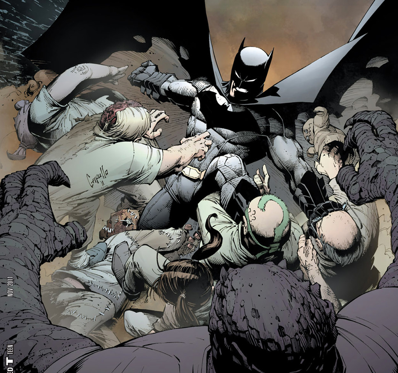
    Were I the sort who judged a book by its cover, the sight of the Riddler with his hair buzzed to a green question mark would have turned me off of Scott Snyder and Greg Capullo’s take on Batman immediately. That’s not the Riddler I want, I would have bemoaned, little realizing that that the Riddler I want is, in all likelihood, the one of my imagination. It’s easy to project my expectations, my wants, my wishes onto a comic book, easier still to not pick one up because it seems like those things will not be satisfied in 22 pages, for three dollars, but the Riddler was hardly a factor in Batman #1, which, beyond featuring the most interesting detective narrative of the four big Bat books, also had the most compelling take on Bruce Wayne the philanthropist. I don’t know if it was editorial edict to have Bruce spend half the pages of his books standing behind a podium at a fundraiser or cocktail party, talking hopefully of one project or another, but the Bruce Wayne of Batman #1, issuing platitudes about what Gotham City is (“Gotham is hell,” “Gotham is damned,” “Gotham is Batman,” etc.) and the wisdom of his father, does more to show Batman’s sense of civic pride and obligation more than the Bruce Wayne who promises not to give birth to a cannibal, to not be afraid of the unknown. Batman here is much more capable of putting on a public face and, early, it leads to something more interesting than a confrontation with the thousandth cop to piece together the Wayne/Batman connection.

    The mystery at the center of this book, involving the grisly murder of a man with the use of old throwing knives, is also compelling, though the twist and the end of the book comes off as a little expected, and will likely wind up being some kind of framejob. Scott Snyder’s script effectively flips the switch from Bruce Wayne: Philanthropist to Batman: World’s Greatest Detective, though it probably helps that the touches defining both are familiar: Batman is always encroaching on Bruce Wayne, making him look absent minded at times, and the way the threat on Bruce Wayne’s life is handled comes straight out of the past. Though these elements lack novelty, it is good to see the character getting back to basics.

    Batman is worth returning to, perhaps the biggest reason being Greg Capullo’s art. Of the Batman family books, only J.H. Williams III’s Batwoman has a more captivating take on Gotham City, though Capullo’s is closer to what I’ve always identified as the “real” Gotham, the one of Batman: The Animated Series. He draws a dynamic Batman, at once human and cartoon, and while the Arkham Asylum slugfest that opened the book was a little bland, brief glimpses of his Two-Face, Clayface, and Mr. Freeze have me looking forward to possible future storylines involving those characters.


    Batman and Robin #1

    Writer: Peter J. Tomasi / Artist: Patrick Gleason

    If Batman and Robin #1 (and likely the Grant Morrison Batman and Son arc that preceded it) is anything to go by, having a superhero as a father would not be a cool experience. Matter of fact, it’d be a life fraught with mistrust, disobeyed orders, and, perhaps worst of all, constant bickering. It’s not that Batman isn’t cool, because what isn’t cool about fighting crime and driving souped up machines of death? The problem is that Damien Wayne, the fifth person to take up the mantle of Robin, is a petulant, self-important brat, and, even if that’s the way he’s supposed to be, I’m not going to cop well to a 10-year-old pointing in Batman’s face while yelling about being “light years ahead” of the other Robins.

    Maybe Damien (hopefully not named after the kid from The Omen) and his sour temperament are the result of being raised by the League of Assassins, but, as written by Peter J. Tomasi, the relationship between Batman and Robin is stock parent/teen disagreement, but over ridiculously high stakes like irradiated fuel rods. When they speak to each other, it feels a bit like Edward Furlong talking to the Terminator, if Furlong’s John Conner suddenly desired for his pet cyborg to start waxing random passers-by. I don’t know that the failings of Batman and Robin #1 are Tomasi’s–usually a solid hand–or those of the character at the heart of this book. At the center of the Batman/Robin partnership has always been Bruce’s obligation to whatever orphan was dropped on his doorstep. The thing was, those characters–even Tim Drake, by no means a victim of tragedy until Identity Crisis–had a way of humanizing Batman that socialite girlfriends and weekly dinner parties couldn’t. They needed him, and he needed them. I get the sense that Damien is relatively unchanged by the shifting circumstances of his life, that his conflict doesn’t involve learning to be a hero or learning to accept Bruce as his father, but that he’s going to constantly be whining about a perceived lack of respect. If the goal here was to create a completely unlikable Robin, mission accomplished. Eventually, I hope Batman hauls off and decks the kid for his endless backtalk. Or that I get to phone in a vote for him to be blown up in an abandoned shed.

    That being said, Patrick Gleason’s art is stunning. Scrumptious. If it were in service to a character I enjoyed, I’d buy two copies so I could hand one to strangers and tell them to see how great a Batman comic can look. The Crime Alley sequence, in particular, is A+ stuff, an elevation of material long taken for granted. Were the issue printed without dialog, there’d be something touching about a father taking his son to the last place he saw his parents, the shower of pearls in the gutter, the floating of a paper boat into the great unknown. But that Damien’s got a mouth, man. “You can’t just build a boat and hope darkness sails away with it,” he says, but it’s like Look kid, he can do whatever he wants. He’s the goddamn Batman.


    Batman: Dark Knight #1
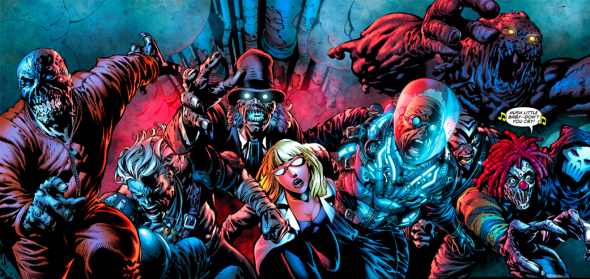
    Writer (Co-Plotter): Paul Jenkins / Artist (Co-Plotter): David Finch

    The first image in Batman: Dark Knight #1 is the Gotham skyline, crowded with three blimps and a universe of spotlights. It’s likely that this is ultimately significant of nothing, but combined with the Arkham Asylum breakout (another one?), the giant reception Bruce Wayne speaks at (another one?), and that the first thing Batman does is fly his plane through Gotham, rappel down to the buildings, change into civvies and zipline across town to be on time for his speech on Fear: A Cannibal, Batman: Dark Knight feels a bit like Jenkins and Finch’s interpretation of The Greatest Batman Hits of the 90s, where everything was big, bold, and, above all else, toyetic.

    All of that plays to Finch’s strength as an artist, in particular his ability to lavish a scene in detail, but so much of it is utterly unnecessary. The board room scene, the Arkham breakout. I don’t have a problem that this has happened across so many of the new Batman #1s, but that it’s happened so much period, and that there’s pretty much nothing new under that particular rock. I imagine it’ll be important somehow–how did that weird rabbit-woman get into Arkham? who enabled the issue’s pivotal change to Two-Face? how?–but my concern in reading Batman: Dark Knight isn’t Bruce or Batman or his detective work, and not even the unfortunate and fundamental change in direction Two-Face undergoes, but why every man is over-muscled, why the attractive foreigner wore a hooker’s dress to this particular Wayne Enterprises meeting, why anybody felt the need to toy with and alter a tried and true villain; just why everything feels so dated and insecure as it tries to be all of the most badass things about Batman that having a kid or being a detective don’t allow. The Batman of Paul Jenkins and David Finch appears to be the Batman of slugfests. I grew out of that Batman ages ago.


    Detective Comics #1

    Writer/Artist: Tony S. Daniel

    For those of you who like your Joker grim ‘n gritty, in Detective Comics #1, he rips out the throat of a “big fan” while completely nude. In a post-Flashpoint world, it’s tough to know how familiar Batman is with the Joker (considering the turn at the end of the issue, my guess is “pretty familiar”), but he seems perplexed by the Joker’s choice to not wear clothes and, like Rorschach planning to delve further into Ozymandias’ sexuality, makes a note of it for later. When, at the end of the issue, the Joker blows up a building full of cops, he walks away from the scene declaring “Amatuers!” with a sneer, a comedian miffed that his audience isn’t in on the joke.

    Then again, the Joker’s always played to an audience of one, so it makes a certain amount of sense that he’s the only one laughing, and it makes perfect sense that he’s able to play Batman and the Gotham City Police Department like a fiddle, murdering and fighting so that he can end up back in Arkham Asylum, where he has an appointment he’d like to keep. That, along with the “amateurs” moment and Batman’s tenuous working relationship with the GCPD, including the use of the Bat Signal (despite cops firing on him) and the appearance of Harvey Bullock, are reminiscent of Batman: The Animated Series, if the seminal cartoon took on the darker aspects of the work of Frank Miller. Detective Comics #1 is incredibly gory for a main title depicting the adventures of the world’s most popular superhero, but that’s not at all a reason to discount what writer and artist Tony Daniel is doing with the old Batman/Joker tropes. As a matter of fact, I’m not sure what I think about the end of issue #1, other than that it’s a compelling, deft hook–one that’s worth giving another couple issues to, for everything to pan out.

  • The New 52: Wonder Woman #1

    The New 52: Wonder Woman #1

    Of the DC Trinity, Wonder Woman was arguably the hero who stood to gain the most from a universe-wide relaunch. She’s been mucked-up and un-mucked-up so many times that my head spins a little just thinking about her recent history. Of course, the biggest problem with the series has been the nonexistent but perceived need to update Wonder Woman, who, whether written by a New York Times bestselling author or wearing pants, couldn’t sell more books if doing so would save a besieged Paradise Island. The best two Wonder Woman runs in recent memory, Greg Rucka’s and Gail Simone’s, focused not on her image in relation to modern society, but her place in it. Both modernized Wonder Woman, but in ways slight and not off-putting; Rucka’s Diana was an ambassador to the United Nations, and Simone’s was a modern take on John Byrne’s conception of Wonder Woman as a heroine of gods and monsters for our time. They weren’t looking to sell Wonder Woman as anything more than the protagonist of a great comic book, and now, with the TV series dead in the water and hopes for a non-Batman DC Comics movie doing well quashed by the failure of Green Lantern, Wonder Woman is free from the shackles of consumerist oppression.

    The resulting comic book, Wonder Woman #1, is exactly the kind of thing I hoped for from the New 52 initiative, movement in a positive direction for a favorite character of mine. In it, a woman is visited by Hermes, who tires to warn her of an impending attack by a duo of centaur-assassins. The shotgun-wielding woman with a pixie haircut doesn’t believe Hermes, of course, until the assassins beat down her door, brandishing swords and bows. Hermes gives the woman a key, which spirits her off to an apartment belonging to Diana Prince, who you might know as Wonder Woman. As you can see in the picture above, she’s pretty good at protecting those who randomly drop in on her while she’s sleeping. She’s freakin’ Wonder Woman.

    What’s most appreciable about Wonder Woman #1 is that it does not question who Wonder Woman is, nor does it treat the reader like an idiot. You don’t need to be a mythology buff or a Wonder Woman fanboy to understand that ancient Greek gods walk among us, and that it’s Wonder Woman’s charge to protect those effected. Sure, one’s appreciation of Wonder Woman #1 likely increases if you can spot Hera (she of the peacock cape) or know who Apollo is (the oracular god of the Sun…hence the three young women he uses as oracles), or have read any mythology where either a) a powerful being is told that he’ll be killed by a soon-to-be-born child or b) a god sleeps with a mortal and is mysteriously absent to deal with the consequences, but these are stories as old as storytelling, they’re familiar, they’re still good, and here, added to them, is our time and place and a superhero.

    I was surprised to see this from Brian Azzarello, whose previous DC work beyond the fantastic, gritty crime saga 100 Bullets and other adult-orientated comics includes a shaky run on Batman and two mini-series featuring more “realistic” takes on iconic villains–Lex Luthor and the Joker–that didn’t really do much for me. The story here is solid, updating some gods as one would expect, keeping others as they were, and focusing on Wonder Woman’s heroism, though I suspect one “life changing” factoid or another will be dropped on her soon enough. The art, by Cliff Chiang, is what really pops here, both in its scale and its attention to detail. Despite the fact that the two women at the center of the book are barely clothed, neither is sexualized. Considering the mild controversy that arose over the cover of Justice League #1, where Wonder Woman, as is typical for the female character in a mostly male book, struck a lascivious pose that looked out of place amid the scowly, barrel-chested bros behind her, who somehow towered over Diana despite her being an Amazon.

    Chiang’s artwork, if nothing else, shows him as an artist capable of portraying a Wonder Woman of mythic proportion without salivating over her. The art’s dynamic nature is helped in large part by some bold inking and a reverence for the style seen in DC’s classic animation, pioneered by Bruce Timm. I wouldn’t return to Wonder Woman just for the artwork, but, combined with Azzarello’s confident tone, Wonder Woman #1 joins Simone’s Batgirl on a very small list of titles that has me both interested in the direction of a character that I like, and a universe that is open to its own curiosities.

  • The New 52: Hawk and Dove #1

    The New 52: Hawk and Dove #1

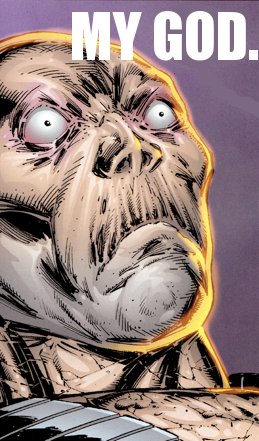
    Because I’m an incredibly mature young man, this review was going to consist of nothing but panels from Hawk and Dove #1 where a character has their teeth clenched. About three pages in, however, I realized that that course of action would result in the longest post in the history of this blog, since almost every panel drawn by 90s comic book superstar Rob Liefeld features a man or woman with his mouth agape, pearly whites smashed together. Seriously, more teeth are gnashed in a single page of Hawk and Dove than in a year’s worth of One Life to Live. Instead of posting single images, I’ve mashed all the teeth gnashing into one image. Observe:

    The horror…

    If you’re a big time Rob Liefeld fan, rejoyce–he’s in full force here, and while his art has gotten a bit slicker since the days of special edition first issues with plated-titanium covers that’ve been preserved and polybagged for future value, slicker inking techniques and better paper quality can’t hide the man’s ineptitude. Liefeld’s cause could have been better helped by Sterling Gates’ script, which sees the titular heroes of the book save the Washington Monument from a terrorist’s hijacked plane (which, depending on your taste, may be a bit too exploitative), but, thinking about it, having an overmuscled action hero and his impossibly proportioned femme-sidekick save America’s favorite phallic symbol makes perfect sense.

    What doesn’t make sense, at least to me, is the decision to relaunch an entire freaking universe in an attempt to move out of the past, only to hand one of 52 new books over to an artist who represents exactly the sort of thing comic books, as a medium, need to run away from. Don’t get me wrong–there’s certainly room for a throwback here and there, and I’m looking forward to checking out DC’s western and military anthology books and hope they do well. Hawk and Dove, however, represents DC’s first major fumble. Yes, Liefeld is a magnet for controversy, but it’s not like he’s a creative giant on the level of, say, Grant Morrison, who is controversial in the sense that he at least does something different or interesting when handed the ball. Rob Liefeld’s kind of controversy doesn’t create cash–it drives money away. The guy hasn’t been cool since his Levi’s Jeans commercial and, fittingly, Levi’s haven’t been cool in 20 years, either. Despite all this, Hawk and Dove will probably go on for another five or six issues, ending either when sales drop or Liefeld gets tired of the project and decides to move on to something “new.” And he’ll probably be paid unjust sums of money to do it, too.