Were it not for Killer Joe, Lawless would almost certainly be 2012’s standard-bearer for stylized violence, regarding blood and guts as substances just as important to its function as plot or character. That’s fair, given the particular violence of the era, but what’s so striking about the throat-slittings and tommy-gun massacres of John Hillcoat‘s film isn’t the level of violence, but the calm its characters exhibit in the face of it. Its protagonists, the Bondurant brothers, are a trio of outlaw bootleggers, the leader of which survived the Great War, the flu, and all manner of worldly calamity. When you’ve got a reputation as an immortal, I guess it’s no big thing, watching another man get perforated. (more…)
Category: Film
-

Movie Review: The Babymakers (2012)
Halfway through director/co-star Jay Chandrasekhar‘s The Babymakers, the movie takes a hard turn from being one of the worst movies of the year to being one of the worst movies I’ve ever seen. That isn’t an exaggeration. To this point, Chandrasekhar’s movie was a failing attempt at a Judd Apatow-styled raunchy-if-sweet romantic comedy, plagued mostly by flat line readings and an almost admirable belief in the endless humor of testicular trauma. Before Tommy (Paul Schneider) knocks on the door of a couple who’ve purchased his sperm from a bank he donated to years ago in order to afford an engagement ring for his wife Audrey (Olivia Munn), The Babymakers‘ only crimes were its catatonic script and a sleepwalking cast and crew. (more…)
-

Movie Review: Total Recall (2012)
The problem with Len Wiseman‘s remake of Total Recall is a lack of imagination. Yes, that’s a problem most remakes suffer from, but this version of Total Recall actually doesn’t clash much with the Paul Verhoeven-helmed, Arnold Schwarzenegger-starring film of the past. The names and plot remain more or less the same, as does the mysterious memory-implanting company ReKall, but where Verhoeven built an entire planet—populating it with mutants and promising that, yes, there is life on Mars—Wiseman shrinks his worldview considerably, ousting Mars entirely to focus on a poisoned-earth narrative where the rich get richer while the poor build the engines of their own destruction. While the living space issue and the rich/poor divide suggest a film mindful of current events (Verhoeven, by contrast, seemed more concerned with having a good time), Wiseman’s fictionalized current events are window dressing to a plot that sees a stock Chosen One fight to dismantle an army of killer robots. There’s a long, distinguished line of movies like that, and Total Recall just doesn’t stack up. (more…)
-

Movie Review: The Campaign (2012)
The Campaign is so obvious in its intent that, within the movie’s brief runtime, two characters are able to lament that “Big Money” controls the government. It concerns a pair of Congressional candidates from North Carolina—both of whom are almost criminally unfit for office—one of which is funded by the shadowy, money hungry Motch Brothers (John Lithgow and Dan Aykroyd), who hope to use their seat in congress to get the ball rolling on something they call “insourcing,” the importing of Chinese labor and regulations to American factories, to double their already stupendous profits.
-

The National Conversation: What Our Response to Aurora, CO Says About Us
I really don’t like writing about politics, so I suppose I’ll start by saying that this won’t be a political post at all. Roger Ebert—a much older, wiser man than I—wrote two different pieces about the major political debate stemming from the shootings in Aurora, Colorado; one in the New York Times, and one on his blog. He introduced the blog post on Facebook with the sentence “I won’t change a single mind,” and he’s right. The “debate” about gun control will continue on as a shouting match with little room for reasoned debate, and the events of July 20 will do little to move people on either side of the fence. Few, if any, shootings have.
When I returned from a midnight showing of The Dark Knight Rises early Friday morning, I immediately knew what’d happened in Colorado: Both President Obama and Mitt Romney were issuing statements of grief to the tragedy-stricken town, and, on Tumblr, I was witness to a deluge of tribute imagery. The next day, articles began popping up on the internet with titles like “Why ‘The Dark Knight Rises?’” There was talk that major theatre chains were going to ban customers from wearing costumes to midnight showings. A Representative from Texas postulated that the shootings may not have happened in a more god-fearing nation, and he wondered why nobody in the theatre had thought to bring their gun along. As the body count was finalized and the composition of the audience in Aurora became known, a legion of internet warriors took to their soap boxes to shame the parents who’d taken their young child to the new Batman movie, insinuating that violent films practically egg on events like this despite the relatively brief history of violence in movie theatres.
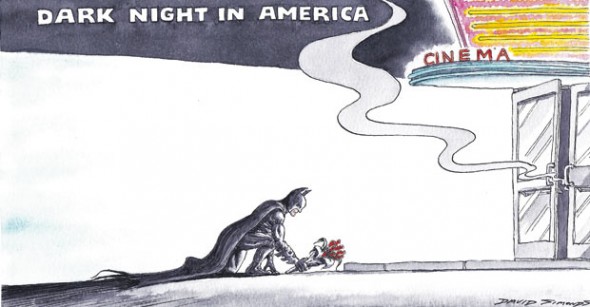
Thousands of midnight screenings of hundreds of hugely hyped films have happened for longer than anybody cares to think about, all without a hint of violence. Heck, thousands of screenings of The Dark Knight Rises happened on the same night as the shooting in Aurora. Why does nobody shame the parents of children who saw a midnight screening of Brave? Had the shooting happened during a different movie, would a blog post titled “Why Ice Age 4: Continental Drift?” be bothered with? (A Slate article helpfully pointed out that the gunman didn’t choose a screening of Happy Feet Two.) If something like this took place during one of many packed midnight showings of Magic Mike, would David Simond’s cartoon above instead depict a chaps-clad Channing Tatum kneeling down to place a bouquet of roses down in front of the movie theatre? Not likely, because none of those films involved Batman. (more…)
-

Movie Review: The Dark Knight Rises (2012)
The word “ambitious” has been used to describe Christopher Nolan‘s The Dark Knight Rises, almost as an apologia. In a summer containing superhero epics that’ve conquered the globe through a combination of charm, polish, and weightless fun, a glum, glowing Batman film can’t help but feel like a party-crasher, a mirthless rebuttal to the joyful hedonism proffered by Marvel Studios. It just so happens that Nolan’s third and final Batman film is ambitious. Functioning as a third act, it introduces a slew of new characters, expounds upon ideas Nolan subtly presented behind the smokescreen of Heath Ledger‘s mesmerizing performance as The Joker in The Dark Knight, and brings his massive, decade-spanning and character-defining story to a close while leaving the door slightly ajar, suggesting both a Gotham without Batman, and a Gotham that can’t survive without one. It’s an audacious juggling act that’d succeed on the merit of sheer scale were it not for the fact that The Dark Knight Rises is just as successful as its predecessors in painting an only slightly-warped representation of our society, gently nudged to its extremes. If The Avengers and The Amazing Spider-Man were long on great power, trading in narrative subtly for titanic struggles between Good and Evil, The Dark Knight Rises is a sobering reminder that any struggle, no matter how titanic, is a grey affair, that the people who fight with the greatest power also have the greatest responsibilities and, ultimately, should make the greatest sacrifices. Its ambition is to hold its characters up to the audience as a mirror. (more…)


