Navigate / search

Hulk Hogan vs. Stan Hansen (4/13/90)

Almost without question the best match Hulk Hogan had after losing the WWF Championship to the Ultimate Warrior at WrestleMania VI a mere 12 days earlier, this encounter between Hogan and Stan “The Lariat” Hansen has a major advantage over most Hulk Hogan matches—from that era or otherwise—in that it takes place in Japan. I’ve written a little bit about the curious effect Japan had on Hulkamania, but this goes deeper than the Japanese expecting more than routine, about their wanting to see the Axe Bomber lariat and not the Atomic Leg Drop. See, in Japan, Stan Hansen was the living, breathing embodiment of America at its meanest, at its toughest, at its worst. Stan Hansen was worse than any ol’ monster Hulk Hogan had chopped down in America. He was a tobacco chewing, bullrope twirling bully, an American Godzilla.

That’s important, because in any other country but Japan, Stan Hansen in a WWF ring is a cartoon cowboy. Oh, maybe not when he broke Bruno Sammartino’s neck in 1976, but plenty had changed in the intervening 15 years. Heck, 10 years after Hansen and Bruno’s feud, Terry Funk came to the WWF as fodder for Hogan’s budding WWF Championship reign and was portrayed as a cartoon cowboy. A middle-aged and crazy cartoon cowboy, which was actually a good contrast for Hogan, but not quite the Terry Funk 1985 needed. In Japan, Terry Funk is Terry Funk. Stan Hansen is Stan Hansen. He’s a bully. The bad man from Borger. And everything about his ring entrance tells you just that.
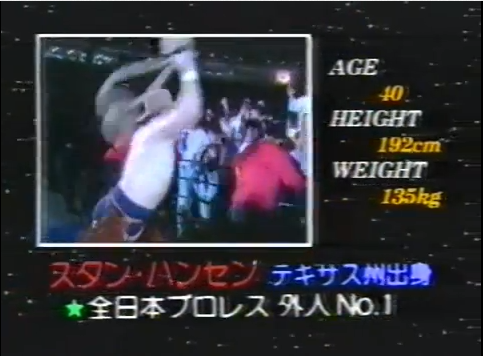
Here he is whipping a fan with his bullrope.
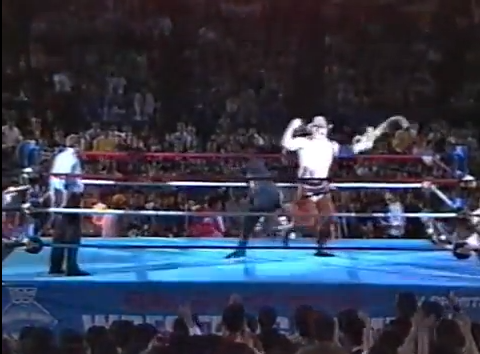
Here he is checking the ring announcer to the canvas.
And here’s Hulk Hogan, presumably terrified.

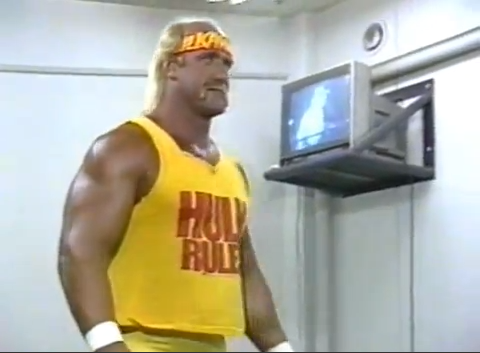
The pre-match segment, with Hogan standing around in his locker room stretching, ignoring the Japanese interviewer, and watching Hansen make his way to the ring, is one of my favorite parts of this match. There’s something to be said for WWE-style ring entrances and what they accomplish, but nobody knew how to create an atmosphere for a wrestling match quite like the Japanese. With Hansen out in the ring whipping every thing in sight and Hogan in the back, silently watching, it was pretty obvious that something special, something living up to the “SPECIAL DREAM MATCH” bulling was about to go down. Hogan and Hansen were two bombs, set to explode.

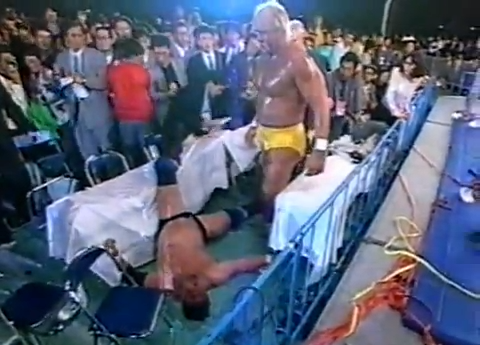
What’s amazing, at least to me, is that Hansen was a last-minute replacement for Terry Gordy, the All Japan Pro Wrestling Triple Crown champion. A loss to Hogan, Gordy figured, would do him more harm than good. The resulting match, however, has a sense of destiny to it. Hogan teamed with Hansen during Hogan’s time in Japan. He’d grown to be this big, shouty, American teddy bear, a nice enough dude, but somebody Hansen would be deeply ashamed to associate with. Instead of one of those cutesy American matches between former tag team partners—you know, where one man knows the other’s move “almost before it happens!”—things escalate very quickly from Hogan’s mat wrestling display (those who’ve long bemoaned Hogan’s five moves of doom should pay attention to his STF, his cravate, his drop toe-hold, and so-on) to a Hansen-style brawl. Both men throw punches. Both men shed blood.  Hogan, in a decidedly anti-Hogan twist, bodyslams Stan Hansen onto an unbreakable Japanese table. Beyond Hogan’s yellow trunks and his willingness to cheat, he’s almost unrecognizable.

That’s what I appreciate the most about Hogan’s one-off appearances in Japan, that they represent something utterly different from what I’m used to. I recently listened to Colt Cabana’s interview of William Regal (one of my top five favorite wrestlers), and Regal said something that reminded me to look up this match. He said that, too often, wrestlers (and people involved elsewhere in the industry) get too caught up in the finer details of their craft and forget what interested them as children. For me, it was Hulk Hogan. Sure, I also loved Randy Savage, Bret Hart, Ultimate Warrior, and Jake Roberts, but it was Hogan who got me in the door and, later, Hogan who I most bitterly complained about.

It’s not my place to talk about Hulk Hogan the person or Hulk Hogan the backstage politician, but Hulk Hogan the wrestler existed, and was not just a figment of my imagination. Beneath his routines, beneath his catch phrases, and beneath his pre- and post-match posedowns there existed a Hulk Hogan who could really go in the ring, but wasn’t called upon to except on the rarest of circumstances. When I watch a Hogan match like this, I think of all the good-to-great John Cena matches I’ve seen, all of the Randy Orton matches I’ve enjoyed despite not really liking Randy Orton, and the divide that exists between people who love those two wrestlers and those who hate them. It’s a wide gulf, one unlikely to be bridged, but take a look at this match and realize that, for 13-minutes, Hogan and Stan Hansen are equals. Then watch John Cena vs. C.M. Punk or Randy Orton vs. Christian and tell me, with a straight face, that one carried the other. I don’t think I’m revealing anything when I say that wrestling, at its core, is a partnership. If the two partners aren’t somehow equal, the match fails. There’s a wealth of Hulk Hogan matches following this one that only proves this point. Wonderfully, none of them take place in Japan.
Carlos Colon vs. Stan Hansen (??/??/87)

The WWE has an odd (if understandable) fetish for second generation wrestlers, and while it certainly counts for something to be a DiBiase or a Rhodes or, heaven help you, a Hart, the poor Colon family—which has been visible on WWE television since the debut of Carlito Caribbean Cool—despite the moderate success of Carlito and the current championship team of Primo and Epico, may as well be anomalous beings from Parts Unknown. Being Rikishi’s son, it seems, carries more weight. But family patriarch Carlos was mentioned almost arbitrarily this past Monday on Raw, perhaps to ameliorate some of the damage done to the credibility of the current tag team champions via a quick loss-and-chokeslam segment, the function of which was to build the Big Show up before his match at Wrestlemania. If one’s only experience of the Colon family is the apple spitting, perpetually frustrating Carlito or the WWE’s quizzical handling of its tag team division, it’s time to fire up YouTube.

Granted, I can’t blame you if you’ve yet to see a Carlos Colon match. Colon may be most familiar to modern fans as the owner of the WWC, a sort of watered-down sports entertainment entity in Puerto Rico that brings in guys like Scott Steiner and Scott Hall in an effort to pop a once-rabid crowd. At one time, however, the WWC was as good, as hot as any other territory, and while their American counterparts were folding-up shop or consolidating, WWC remained a fairly strong territory until becoming part of the WWE machine, having a roster of home-grown talent buoyed by gringos who didn’t fit the Rock ‘n Wrestling mold/didn’t feel like laying down roots in the NWA. Guys like Bruiser Brody and Abdullah the Butcher were frequent visitors and, when thinking of men who don’t fit the WWF or WCW of the time, it’s little surprise that Stan “the Lariat” Hansen wound up embroiled in a feud against Carlos, the godfather of Puerto Rican wrestling. He wasn’t a Rock ‘n Wrestler, and he wasn’t to become part of JCP/NWA/WCW until 1990, when he engaged in a brief feud with Lex Luger (of all people!) for the NWA United States Championship. He was, however, a recent AWA champion, but was close to the point in his career where Japan became his near-exclusive focus. Since I last wrote about him, Hansen’s become one of my all-time favorite wrestlers. This has a lot to do with his wrestling, which was as simple as it was brutal, but also because Hansen may just be the most realistic professional wrestler of all time. Listen to this man talk:

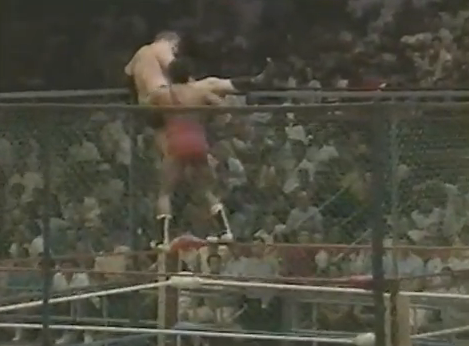
The way he tells it, Hansen’s got a personal issue with everybody walking the face of the planet, and that’s exactly the kind of nastiness he brought to Puerto Rico. So while I can’t blame you if you haven’t seen a Carlos Colon match before (this one is my first, too), if you’ve never seen a match from Puerto Rico before, there are few better introductions than a cage match featuring the bad man from Borger, Texas. This, simply, is a violent match: Two people brawling and bleeding before a near-riotous crowd. The only commentary you’ll hear throughout is the sound of an airhorn bleating nearly every time Colon lands a punch. Towards the end of the match, what looks like (but isn’t, obviously) a real riot breaks out among the wrestlers supporting Colon and Hansen in that giant, empty area surrounding the ring.

It’s tough not to love this match. You’ve got Colon, who is almost cartoonish in his enthusiasm when he gets on a roll, as the superman face. Hansen, for a change, plays the cowardly heel, trying his damnedest to create space between him and his adversary. The cage itself looks ugly and brutal, an odd combination of the NWA’s cage, which allowed for no interference, and the WWF’s cage, the object of which was to escape. That the cage is on the floor means that one has to incapacitate his opponent before leaving the cage. Hansen’s objective is never quite clear, though one suspects it involves the lariat, but Colon’s insistence upon the figure four leglock is tremendous, as is Hansen’s resolve to fight his way out of it. When Colon locks that sucker on, the response from the crowd is as loud and passionate as anything you’ll hear in the United States. I would say that the match is worth watching, but hopefully by this point you already have.

Stan Hansen vs. Leon White (4/8/86)

To the best of my knowledge, this here’s the first meeting between one Stan “The Lariat” Hansen and Leon “Baby Bull” White, who would later ditch what is perhaps the lamest nickname in wrestling history to become The Man They Call Vader, who is my wrestling messiah. It’s nowhere near the level of the later Vader/Hansen wars, one of which saw Hansen legit knock Vader’s eye out of its socket, but this is a good teaser, I’ve yet to post anything of Hansen’s, and I don’t do enough AWA on this blog, so here you go.

The first thing you’ll notice, if you’ve ever seen a Vader match, is that Leon White isn’t the mutilating, punch throwing son of a bitch he’d later be. This match is relatively early in his career, and Stan Hansen’s AWA Title happens to be his first real challenge. Without punches, without powerbombs, White relies on technical wrestling. Here, he’s particularly fond of the headlock. A fan in the crowd loudly shouts “BORING!” at poor Leon as he goes about his headlock, but it can’t be helped. This is the AWA, and technical wrestling is what got done in their ring. The rest of the audience isn’t as convinced as the heckler, however, as they come alive for White’s sporadic strikes against his much more experienced foe. For maybe the only time in his career, Leon White’s the inexperienced, imperiled babyface, and it’s actually pretty awesome. Not that I ever once believe for a second that Hansen is going down to a headlock, but for a young lion, he does well.

As for Hansen, he’s one of those guys who you don’t really beat, even if you’re lucky enough to gain a win over him. He’s a tough, crazy Texan bastard, capable of withstanding hellish amounts of punishment before turning it back on his opponent. And with a nickname like “The Lariat,” you know his clothesline is pretty good. This is the second of Hansen’s two reigns with a North American World Title, which is unfortunate unless you’ve seen some of the man’s Japanese work and realize how much of a legend he is over there. His run with the AWA Title would end disastrously, by the way. It’s pretty astonishing that he won the thing, considering how political/stupid Verne Gagne was (Hulk Hogan “won” the AWA World Title twice in 1983 and probably could have pushed the company to national prominence, but he didn’t, Hogan and a bunch of dudes jumped ship to the WWF, and the rest is history), but he did and, since he was splitting time between the AWA and All Japan Pro Wrestling, Hansen was scheduled to defend the title in Japan. For some reason Hansen was booked to drop the title to Nick Bockwinkle before those defenses took place, but AJPW, understandably, wanted to have Hansen defend the title in Japan as advertised. So Hansen took the title to Japan after he was stripped, which led to a legal injunction–Stan could either hand the belt back or go to court. He ran the title over with his truck and sent it back–mud tracks and all.

I’m going to go ahead and assume that Stan Hansen is better than you.