Note: This essay was originally written in 2015, and published in The Atomic Elbow #22 in June 2017. References to “this year” are to 2015. For more information on The Atomic Elbow, which is the best wrestling zine in the United States, check out its website.
It’s March 21, 2015. Ring of Honor Television Champion Jay Lethal just defended his title without lifting a finger. His scheduled opponent, Donovan Dijak, decided to instead join forces with Lethal, hoping to learn something from the long-tenured ROH star and his manager, and the three celebrate in the ring when, suddenly, music unfamiliar to them all begins to play. At the entrance way, two beefy men are using feather ticklers to obscure a third man. When they lift them, there he is—Dalton Castle, a man in a gold lamé jumpsuit and sequined cape, sporting a head of just-been-fucked hair though it’s only 8:00pm. “Boys,” he says to his boys, “It’s time to break some hearts!”
Once in the ring, Castle displays his peacock cape in its full glory, crowing to the fans as Lethal and his cohort look on, mystified. The crowd, for their part, don’t know what to make of Castle, either. He’s a new character in Ring of Honor, and, to be frank, he’s gay. Really gay. ROH as a touring promotion has existed for 13 years, and Castle is just their second gay act, so far as I can recall. The first—a tag team of mincing rough trade known as The Christopher Street Connection—appeared on the very first ROH show. They were roundly crushed by a pair of big nasties called Da Hit Squad and ushered from the building as the crowd chanted homophobic slurs. The company has grown a lot in size and presentation since that show, but Ring of Honor’s fans are still known as a rough crowd, perhaps the roughest in professional wrestling, which, despite kingpin World Wrestling Entertainment’s overtures to young children, is still largely enjoyed by straight, white men from the ages of 18 to 35, forever the prime Nielson demographic.
Still, there’s Castle, and his valets are stripping him out of his bodysuit—the Party Peacock is molting—and Lethal looks like he’d rather be dead than watch what’s happening in front of him. Castle takes the microphone and begins to speak, not in an overly flamboyant way, but considering that he’s just lovingly rubbed the face of a mostly-nude adonis in a Mardi Gras mask, an affected lisp is unnecessary. As Castle challenges Lethal to a match for the championship, his boys assume the position on the mat, one on his knees and the other on all fours, allowing their man to recline upon a beefcake chaise lounge. At this point, the live crowd is in on Dalton Castle. Not just as a gay professional wrestling character—old hat in 2015—but as a gay hero standing opposite a threat that is clearly evil.
Lethal beats Castle, of course—long-tenured champions rarely lose to debuting characters—but what’s notable here is the role reversal, the gay character as a good man, all proclivities aside. Wrestling has been on television since the birth of the medium. It has seen and addressed every pop culture phenomena, political crisis, and social phobia that could be exploited to make a dollar. This is an entertainment vehicle where men are men, yes, but it’s also one where RoboCop might save a wrestler in peril, or where an in-ring confrontation between “Macho Man” Randy Savage and Kona Crush can be compared to a summit between the United States and the USSR. Just this year, a Russian bruiser rolled to the ring on a tank, backed by a full military escort, and lost to a lone American who pumped himself up by playing audio of Ronald Reagan speeches over videos of amber waves of grain. World Wrestling Entertainment, by far the largest, most successful promotion in the history of professional wrestling, employs an out gay wrestler and has another one in their hall of fame, but despite all of the pomp and circumstance at their disposal, and though 65 years have passed since Wrestling from Marigold first graced the DuMont Network, there has never been a good guy gay character with a higher profile than Dalton Castle.
I’m tempted to ask why, but know the answer begins and ends with homophobia. Sure, there’s a latent homoeroticism to professional wrestling—always has been, always will be—but to acknowledge this aspect of the industry in any other context than one that implies revulsion would be a true revolution. Hulk Hogan strips down to his skivvies and oils up his 305 pounds of muscle because those are the rules, brother. “Adorable” Adrian Adonis does it because he (shudder) enjoys it. The roots of homophobia in professional wrestling are deep, knotted and gnarled in the origins of the product seen today. The gimmick—an outsized human stereotype played for effect in the ring—came to maturation with wrestling’s debut on network television, in the guise of Gorgeous George.
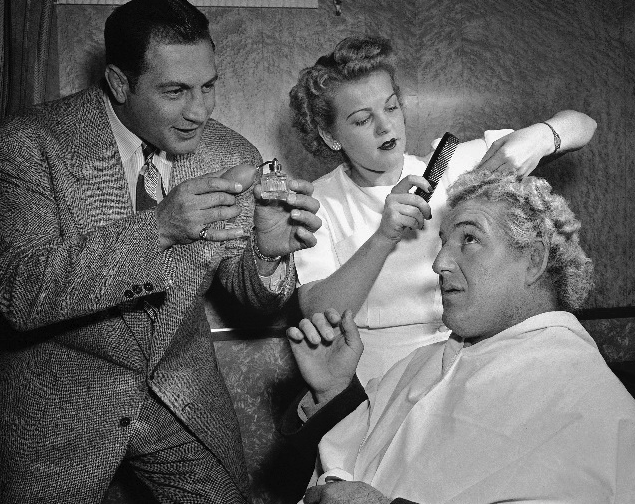
Formerly a mid-card nobody of average distinction, George Raymond Wagner made no bones about his looks being the reason for his success within the squared circle, frequently telling those who came to interview him for the local sports pages the same story: Inspired by the tresses of George Washington’s hair upon the dollar bill, he grew his hair out, dyed it blond, had it marcelled, and legally changed his name to Gorgeous George, lest anyone be fooled by a host of imitators. He was accompanied to the ring by a valet or a manservant, though the manservant garnered more fervor for the act and stuck. Jeffrey, donning similar attire as his master, would stroll to the ring with a bath mat, an oriental rug, and a silver tray bearing an atomizer of cologne. The bath mat was used so George wouldn’t sully his feet on the ring apron, the rug for his corner. The atomizer disinfected the ring, the referee, and, if Jeffrey could manage, his opponent—Gorgeous George was a confirmed germaphobe, as it so happened, and abhorred the sweat on his opponent’s brow and the funk of the evening’s matches upon the ring canvas. If the venue had an organ, it would play him to the ring with “Pomp and Circumstance,” and whatever town Gorgeous George was in would be treated to an appearance by a real, live celebrity, a debonair man of wit and taste who, as it so happened, was skilled in the arts of leverage and deception. He had a family, multiple wives and multiple children, but the presentation of his character was decidedly effeminate. Writing to Grantland Rice in 1948, sports reporter Gene Fowler described his pre-match routine thusly:
In the dressing room, Gorgeous George’s valet, Jeffrey, spreads out the splendid habiliments to be worn in the ring. This night it was Gorgeous George’s pleasure to wear green trunks and green socks. He also selected a pair of white kid shoes worn high up on the calf, like the old Queen Quality numbers owned by the cotillion belles of Frank Croninshield’s day. Gorgeous George’s dressing room that night was a custom-built creation of orchid-colored silk, flamboyantly flowered. When asked if Adrian had made this garment, George replied, “No, my friend, it was designed by an Eastern couturier.” Then he added “It contains seven yards of material.”[note]Rice, Grantland. “Gene Fowler Reports on Gorgeous George.” The Atlanta Constitution 15 Feb. 1948: 11B. ProQuest. Web. 21 Apr. 2015.[/note]
This, in effect, is the prototypical gay wrestling gimmick, an effete man of Wildean graces, a poet who preferred the hammerlock to the pen. Gorgeous George was a genius of marketing, handing gold-plated Bobbie pins to his female faithful and swearing them into his fan club, “So help me George.” The pins could also be used as weapons, jabbed into an opponent’s gullet or stolen from him and used to gain an advantage, what he called a “vulgar stratagem.”
The queerness of the character was not lost on his critics. Reports of upcoming appearances by Gorgeous George practically delight in comparing him to his sweaty, hulking opponents. A 1948 Washington Post article describes George’s pre-match visit to the salon, then wonders “what will happen to those luscious ringlets after [Marvin Mercer] digs his perspiring paws into them”[note]Fishbein, Sy. “Gorgeous George Smells Up the Joint In What’s Called Wrestling at Turner’s.” The Washington Post 17 Nov. 1948: 13. ProQuest. Web. 21 Apr. 2015.[/note]. Clutching her pearls, The Atlanta Journal Constitution’s Doris Lockerman really goes after George, beginning her column by saying she’s glad that Oglethorpe University sealed their time capsule before they had to take note of him, lest the citizens of 2035 despair for humanity, and finishing by claiming that her cocker spaniel hated him so much that he had to be muzzled during the wrestling matches on television. As she puts it,
Even in this mad, mad world, I don’t see how Gorgeous got started. Even in Hollywood some of the residents should have had a normal allergy to a man dressed up like a woman. The only people I know who can get a real laugh out of a caveman dressed up like Belle Watling are the lodge brothers, who enjoy such things as Womanless Weddings on public street corners, or pretend they do in the name of fraternity.[note]Lockerman, Doris. “Gorgeous George, Eyeful for Future.” The Atlanta Constitution 13 Mar. 1950: 12. ProQuest. Web. 21 Apr. 2015.[/note]
A man dressed up like a woman. There it is. That’s the objection to a gay gimmick in wrestling, an objection that has sounded from Gorgeous George to Adrian Street to Adrian Adonis to Goldust and, which, presumably, informs the look of disgust on Jay Lethal’s face while Dalton Castle talks about stretching out his hamstrings. Wrestling, for everything that’s unreal about it, has always been obsessed with degrees of reality. Real women. Real men. Gorgeous George fell between those distinctions and was hated for it.
But, in wrestling, if enough people hate you, you can really make a name for yourself. Beyond modern titans like Hulk Hogan, Steve Austin, or Dwayne “The Rock” Johnson, no other professional wrestler had his life as slavishly chronicled by the media as Gorgeous George. No other wrestler of his era inspired as many rumors or tales of various misdeeds. In one city, the athletic commissioner recommended a lifetime ban because George cheated to win a match. In another, a middle-aged woman sued him because she touched his hair and was punched in the face for it[note]Mosby, Aline. “It Might Cost Gorgeous George $35,000 For Tossing His Curls (and a Left Hook).” The Washington Post 13 Jun. 1948: C1. ProQuest. Web. 21 Apr. 2015.[/note]. Gorgeous George was a straight man, but he was a queer terrorist by profession, a tough fag who transcended the public’s conception of butch or femme. He inspired John Waters and Divine, who watched him as children. Overnight, he transformed professional wrestling from a serious-if-fixed sporting event to the hedonistic pleasuredome millions revel in each week. Before him, the body was a tool. After him, a wrestler couldn’t survive if the body wasn’t also somehow spectacle. Men took to wearing masks and creating secret histories. They had complicated workout routines and demonstrated ridiculous strongman feats. There were midget wrestlers and lady wrestlers, a wrestling bear named Victor who was addicted to grape soda, and, in Andre the Giant, a wrestler who could legitimately be billed The Eighth Wonder of the World. Men have stolen pieces of his gimmick—the atomizer, the valet, the music, even his name—but could never successfully replicate his presence outright. The only thing to do with the Gorgeous George character is to make it more outrageous. To dye your hair blond and drape your frame in boas, to hike up your skirt and mince your way to Parts Unknown.
Looking at Gorgeous George stand across the ring from an opponent of his era—a working class stiff in black trunks and a crew cut, maybe a cauliflowered ear or two—it’s rather easy to mark him as queer by contrast, but, as mentioned, the whole of wrestling quickly became as outsized as he was. Gorgeous George died in 1963. That same year, “Nature Boy” Buddy Rogers became the first World Wide Wrestling Federation World Heavyweight Champion, a title that survives today under the auspices of World Wrestling Entertainment. Rogers, like George, was a pretty boy. He wore robes. He dyed his hair blonde. He had class. Unlike George, he was portrayed as a tough guy, and his “Nature Boy” character, which was later taken up by Ric Flair, became synonymous with slick, womanizing charm—claiming in an interview he’d booked up an entire floor at the hotel, Flair proclaimed himself “Space Mountain” because women were lined up around the block to be seen with him. Or take the case of sad-sack good guy Brutus “The Barber” Beefcake, friend to Hulk Hogan and (presumably) his millions of Hulkamaniacs. How can a gay menace exist in an environment where a part-time hair stylist with a glorious Kentucky waterfall can strut to the ring clad in fishnets to preen and give his opponent a haircut?
Roland Barthes’ “The World of Wrestling” is frequently employed to discuss the roles of face (good) and heel (bad) wrestlers, but Barthes’ argument, that fans show up to a wrestling match to see the idea of justice played out in the ring, does not comment on American professional wrestling, nor does it consider the ramifications of the gimmick and the storyline, two crucial elements of wrestling that were still nebulous as Barthes was writing. His text[note]Barthes, Roland. “The World of Wrestling.” Mythologies. New York: Farrar, Straus and Giroux, 1972. 15-25 Print.[/note], of course, is fundamental to a basic understanding of the wrestling match in a vacuum, but it cannot account for one promoted with an agenda. It’s best, when thinking about how homosexuality is portrayed in a wrestling show, to think of the face as a character the audience is meant to identify with, and the heel as a character they’re opposed to. Beyond good and evil, as Vaughn May wrote in “Cultural Politics and Professional Wrestling,”
Professional wrestling preaches a profoundly conservative message that holds much appeal for cultural traditionalists. The overwhelming majority of “good guys,” or fan favorites, are committed to a traditionalistic moral universe centered on hard work, achievement motivation, self-control, and in some cases, respect for family and religion. The overwhelming majority of “bad guys” have a much more “modern” value orientation that rejects the emphasis on self-control, hard work, and earned reward.[note]May, Vaughn. “Cultural Politics and Professional Wrestling.” Studies in Popular Culture 21.3. 79-94. JSTOR. Web. 19 Apr. 2015.[/note]
The gay villain, given a twisted version of the Gorgeous George template, is a “modern” character. He cheats and connives, but frequently what’s most important about a gay character is that he has no control over his outlandish impulse to paint his face and wear women’s clothing, to kiss men in public without shame or recompense.
The ultimate wrestling face is Hulk Hogan. Here is a transcript of an interview he did with Gene Okerlund in 1986 to promote a match in San Francisco against “Adorable” Adrian Adonis:
Hulk Hogan: Well you know, “Mean” Gene, “controversial” is not the word for this dude, man. I mean, hey A.D., which way is the wind blowing today, brother? Have you taken a walk on the wild side in a while? Well all I’ve got to say to you, Adrian Adonis—Cow Palace, San Francisco! This is Hulk country, brother. And you’re going to take a walk on the wild side. Not the kind of walk you like to take, because there ain’t going to be any swishing around. You’re going to walk right into the pit of the combat zone, brother. You’re going to face the eye of the Hulkster, brother, and then you’re going to go down. You know, “Mean” Gene, I just wonder what kind of entourage Adrian Adonis—Adorable Adrian—is going to have with him at the Cow Palace.
Gene Okerlund: Well, regardless of the man’s personal preferences, Hulk Hogan, you’ve got to say, as a professional, he is mighty good. There is no question in my mind. He is deserving of a title shot.
HH: Well you know, I don’t mind his personal preferences, because that’s really not my business. All I’ve got to say, Adrian Adonis, you’re the number one contender, dude, and that means when you come into the Cow Palace, you’d better be ready to take care of business. And all I’ve got to say—you’d better be serious as a heart attack, brother, because if you come to that ring with all those bows and feathers in your head, you’re going to be the shortest-lived number one contender there ever was. San Francisco’s mine, A.D.! Hit the road!
Leaving aside Hogan’s desire to defend San Francisco (of all places!) from Adonis’ lavender menace, I want to focus on his rhetorical strategy. At the end of his oratory, Hogan focuses on what he perceives to be Adonis’ lack of work ethic, and not because the Adorable One is a fairly rotund competitor. This binary is, according to May, a means of distinguishing a face from a heel. Hogan, obviously, works hard for what he has. He’s got the championship. He has a ridiculous physique. He refers to his desire as “the eye of the Hulkster” and his matches as “the combat zone.” Adonis, by contrast, can’t be taken seriously because of “all those bows and feathers” in his head. Adonis’ look—again the blond hair, Hogan’s mentioned bows and feathers, lavender scarves, and Boy George makeup—marks him as a hedonist, and Hogan’s claim that Adonis’ “personal preferences” don’t matter to him simply are not true. Adonis, who debuted the “Adorable” character by saying he “Jumped out of the closet and there were no brooms behind me” is coded gay, and, even if one doesn’t read much into Hogan nervously repeating the phrase “all I’ve got to say,” his reference to Lou Reed’s “Walk on the Wild Side” can’t be ignored, though it certainly would have gone over the head of any young Hulkamaniac not acquainted with the song. Hogan is either asking Adonis if he’s had sex with a transsexual hooker, or implying that the moment Adonis retired his leather jacket and came out of the closet was the moment when “he” became “she.” The way he wonders about the people Adonis will bring with him to San Francisco is beside the point—one fairy or one-hundred, Hulkamania will run wild over them all.
Here, I find myself at something of an impasse. I began this essay with Dalton Castle as a means of showing how the gay character has changed, intending to argue that, rather than castigate the existence of an Adrian Adonis, that queer pop culture fans, critics, and performers would benefit more from appropriating straight culture’s appropriation of camp. I was thinking about how there have been gay professional wrestlers, how none of them have played gay characters, and how straight men have spent entire careers playing gay stereotypes for an audience of homophobes. I read Henry Jenkins III’s article “Never Trust the Snake” and encountered an anecdote about how, when he was a child, the fun-loving Bushwhackers encouraged the crowd at the Boston Gardens to chant “Faggot, faggot, faggot” at the Beverly Brothers, a team who coded as gay because they wore lavender trunks:
The two brothers, clad in lavender tights, hugged each other before the match, and their down-under opponents, in their big boots and work clothes, turned upon them in a flash, “queer baiting” and then “gay bashing” the Beverly Brothers. I sat there with fear and loathing as I heard thousands of men, women, and children shouting “Faggot, faggot, faggot.” I was perplexed at how such a representation could push so far and spark such an intense response. The chanting continued for five, ten minutes, as the Bushwhackers stomped their feet and waved their khaki caps with glee, determined to drive their “effeminate” opponents from the ring. The Beverly Brothers protested, pouted, and finally submitted, unable to stand firm against their tormentors.[note]Jenkins III, Henry. “’Never Trust a Snake’: WWF Wrestling as Masculine Melodrama.” Steel Chair to the Head: The Pleasure and Pain of Professional Wrestling. Ed. Nicholas Sammond. Durham: Duke University Press, 2005. 33-66. Print.[/note]
And, just once, I wanted that fear and loathing to be felt by the straight crowd. I wanted a version of events where the Beverly Brothers stood tall and defended themselves. Not against the accusation of being gay, but against a culture that insists that two men who hug each other and wear lavender are worthy of public ridicule. But the Beverly Brothers were straight men, not even real brothers, and two straight men pretending to be gay men sticking up for themselves is something I cannot abide. The kind of justice I want to see in a professional wrestling ring can only be doled out by a member of the queer community, but I was willing to settle with Castle, I suppose, because so many minorities are already ill-represented in the major leagues of North America—women and persons of color especially—that a gay character (a character) even existing in 2015 felt special to me.
But I’ve never pulled gay characters out of the complex tapestry that is a professional wrestling program before. Adrian Adonis existed as a splash of color. His precursor, “Exotic” Adrian Street, never intended his character to be coded gay. He dyed his hair blonde in tribute to Buddy Rogers and tried to give a hard, rock and roll edge to the Nature Boy routine, but the fans in his home country of England didn’t read the character that way. According to an interview with Street in the documentary Changing Perceptions[note]WrestleMen.com Wrestling. “Pro Wrestler Adrian Street talks about Gay Character.” Online video clip. YouTube, 10 Apr. 2010. Web. 22 Apr. 2015.[/note], Street says that English fans responded to his look by yelling “Ohh, isn’t she pretty!” and “Give us a kiss, Mary!” Incensed, he responded by playing up the flamboyant aspect of his character and found that it served to further rile up the audience. So he became, to quote his song “Sweet Transvestite with a Broken Nose,” “King Kong with lipstick, Fay Wray with balls.” Up against the hillbillies and musclemen of the National Wrestling Alliance, Street was (and to an extent still is) the kind of freak I could identify with. But he’s a heel. So were Gorgeous George, Adrian Street, and Goldust. And if Vaughn May’s breakdown of the face/heel dynamic is correct, that means that I’ve been identifying myself with outsiders, with gay sleaze who don’t exist, as a John Waters heroine might, to satirize America’s discomfort with queer bodies, voices, and experiences, but to uphold nation’s spoken or unspoken belief that those things are morally reprehensible.
In the course of my reading, I remember why I stopped watching wrestling cold turkey in 2002. During that time, the WWE was flirting with the idea of airing a gay commitment ceremony on SmackDown!, one of their flagship shows. In September, after nearly a year of being tag team partners, Billy Gunn and Chuck Palumbo were convinced by their manager (a mincing hair stylist named Rico) to run to the altar. The WWE had experimented with odd, belittling sexual encounters in the year leading up to this—Kane was accused of having slept with the corpse of his dead girlfriend, and a pointless segment promising “Hot Lesbian Action” aired on Raw—but the company was seemingly serious, or at least serious enough that GLADD consulted them on the storyline. As is par for the course, Gunn and Palumbo weren’t gay (and neither was Rico); they were straight men getting paid good money to go through with a publicity stunt at the expense of the queer community. I was 14 at the time, queer but unable to put words to my queerness, and suddenly these “gay” wrestlers were everywhere in the media. A New York Times headline called Billy and Chuck “Accidental Crusaders,” and quoted WWE executive producer Kevin Dunn as saying “They’ll definitely have a baby-face run. Guaranteed. It will be great television”[note]Miller, Jonathan. “Billy and Chuck, Accidental Crusaders.” New York Times 25 Aug. 2002: H12. ProQuest. Web. 21 Apr. 2015.[/note]. As usual, neither Billy nor Chuck came out and said they were gay. They were called flamboyant. They were called outrageous. They gave each other hugs and chocolate. Then they proposed and went on a media tour. On The Today Show, Matt Lauer gave the beaming tag team a crystal gravy bowl on behalf of GLADD, putting over how the pair were winning over the fans through their in-ring ability.
All of this is in stark opposition to the actual ceremony, where the grooms made their entrance to “It’s Raining Men” and stood before a decrepit old preacher who went on about the importance of commitment. For five minutes, a sold out crowd boos all of this. Then the music of The Godfather, a retired pimp character, plays, and he offers the pair the services of his women if they would just reconsider, playing heavily to Billy Gunn’s straight past. The crowd loves the idea, but Billy and Chuck are convinced to continue until they’re meant to exchange vows. When the preacher asks Billy if he pledges to commit himself to Chuck, Billy reacts like he’s waking from a nightmare, like he has no idea he’s at his own ceremony. The vows? Those get booed. Fans in the arena chant “Just say no!” while Rico looks on imperiously, trying to force the now obviously straight Billy Gunn to pledge his everlasting commitment to a tag partner he’s had for a year. He says yes, passing the buck to Chuck, who also reacts like he has no idea he was playing a gay character the whole time. Rico coerces him into saying yes, but before the preacher can make it official, Billy and Chuck stop the show. Chuck says “It wasn’t supposed to go so far.” Billy says “This was all just supposed to be a publicity stunt. We’re not gay. We’ve got nothing against gay people.” And the fans roar. The men in the ring, they’re not gay. It is safe to be straight at a wrestling show after all. This heavily-promoted farce played out for 20 minutes on network television, all of it causing my guts to churn. I wouldn’t watch wrestling again until 2007, when YouTube came into being and was a haven for wrestling I’d never seen before, both American and otherwise. GLADD, for their part, said that the WWE played them for fools for two months. Obviously nobody involved was watching the product, or they would have figured it out much sooner. When I watch a match with a transgressive, gender-bending gay character, I feel much less offended than when I’m watching something like this commitment ceremony. I can handle being an outlaw. I can’t handle asking for acceptance and having 14,000 people mock me for it.
The question I asked myself, going into this essay, was why an organization like GLADD would embrace a gimmick like Chuck and Billy sight unseen while casting aspersions upon a character like Goldust for promoting unpleasant stereotypes about the gay community. My choice to identify with Goldust, which I did as a child, certainly has as much to do with the kind of queer that I am as does my choice to find revulsion in the Chuck and Billy storyline. I didn’t know the words for it at the time, but I was eight years old and transgender, and here comes this space alien looking weirdo—face paint, latex body suit, blond wig—Goldust looked like the Oscar statuette if the Oscar statuette needed party drugs to get it up. He spoke in this deep, rumbly baritone, referencing movies that I’d never heard of, walking to the ring filmed in slow motion while his luxurious music shimmered in the background. When the Ultimate Warrior (a confirmed homophobe who once went on record as saying that “queering don’t make the world work”) returned to the World Wrestling Federation in 1996, Goldust confronted him in the ring, breathing “Warrior, come out and play” into the microphone. When Ahmed Johnson was knocked out on a stretcher, Goldust administered mouth-to-mouth, leaving facepaint and lipstick on his rival’s lips. To get into the head of Razor Ramon, he drew a heart on his chest in red lipstick and wrote “Razor” over it in black. In Sharon Mazer’s seminal studying of professional wrestling, she notes that the character archetype created by Gorgeous George and extended through to Goldust, in intersecting with “comic book drag” and “rocker/outlaw machismo,” makes the masculinity on display in professional wrestling seem “extraordinarily diverse and by no means mutually exclusive or discrete. … Superficially, it appears that the truth about men is that they are so antagonistically individuated that, while they idealize a brotherhood of man, in practice they cannot come within sixteen or eighteen feet of one another without coming to blows”[note]Mazier, Sharon. Professional Wrestling: Sport and Spectacle. Jackson: University Press ofMississippi, 1998. Print.[/note]. And again, there’s the “real” man and “not real” man dichotomy, signaled by sequins and makeup and how much attention one pays to their hair. I identified with these not real men because I’m not a real man, myself, because beyond them, the only characters in the entertainment I’ve been enthralled with since I was four years old who come close to serving as surrogates for my desires are muscular or curvy or fat cis women who are frequently shamed for what, to me, seems an ideal body.
But I keep running up against the fact that these men are, first and foremost, men, that they are all uniformly straight, and that they all seem uncomfortable with their lived experience as a faux-homosexual. The Adrian Street interview makes it clear that the man hasn’t considered the humanity of the people he spent decades parodying. After his untimely death in a car accident, a television news obituary noted that, after playing the “Adorable” character, Adrian Adonis’ career in America was in a shambles, requiring a tour in Japan to rehabilitate it. Dustin Rhodes, retiring the Goldust character on a 1998 episode of Raw, claimed that the character had cost him his relationship with his father, his wife, and his child. When he asked why all of that had to happen to him, a fan in the audience screamed “Because you’re a faggot, Rhodes!” The Goldust character has since returned on a number of occasions, still referred to as “The Bizarre One,” but his gay past is a long-buried gay past. The one active gay wrestler on the show, Darren Young? After coming out, he lost his character, got injured, and returned as a man who seems genuinely happy to have a job. He smiles. He wrestles. He loses every night. Every now and again the idea of lipstick lesbianism is flirted with on WWE programming—a heel Diva (WWE’s awful trademarked term for “woman wrestler”) will start making gestures at her babyface opponent. She may kiss her. The announcers may imply something about her being bisexual. But female characters in WWE, who I have not given much space to here, are never even truly bisexual—they are one ripped, statuesque man away from forgetting all the time they spent flirting with the Diva’s Champion, none of it mattering until the next time the straight male audience in attendance needs the extra titillation, a little reminder that wrestling isn’t gay.
What does this confirm? Beyond the fact that queerness is still feared in many conservative circles, not much. The tough fag archetype I’ve described throughout, to Mazer, merely conforms to wrestling’s masculine ideal:
[T]he proof of the man is not in his appearance, which he manipulates for his own and our pleasure. The proof of the man is in the force and skill he applies, whether he wins or loses, with and against other men. When Gorgeous George stops patting his hair and grapples with Larry Moquin, when Ricky Starr stops his pirouettes and drop-kicks Karl von Hess into a squirming mass on the floor, when Mr. Perfect pursues Luger out of the arena, when Shawn Michaels pulls himself up from the floor in a last, futile attempt to prevent Razor Ramon’s reach for the championship, what is made visible is nothing less than manliness itself, the will and spirit of a “real” man as it underlies and transcends both character and circumstances, latent (if not immediately apparent) in all men.
If what gay characters serve to prove is the essential masculinity of every male wrestler, then I have been looking in the wrong places for my heroes, my own vulgar stratagem of queering every wrestler I see ending in futility. Wrestlers can recover from their queerness like a snake can shed its skin. In the case of Dalton Castle, who also wrestles as Ashley Remington, a yachtsman who gives his fallen foes a fruit basket in the spirit of good sportsmanship, a queer body is a thing he can leap in and out of in a moment’s notice, within the span of the same two-hour program, if necessary.
Rather than urge for the reclamation of these characters, what I’d like to see is an actual queering of what is a flagrantly homophobic, misogynist, transphobic space. Wrestling, for all the baby steps it has taken in the past twenty years, is so repressive that it is completely within the realm of possibility for a muscular woman or a fat man or an out homosexual or a genderqueer anybody to enter it at almost any level and completely change it. There is evidence for this beyond our borders and in independent professional wrestling in the United States. Gay wrestling characters, exoticos, are held in high esteem in Mexican lucha libre. In Japan, women’s wrestling routinely sold out the same large venues used by male promotions. In the United States, intergender wrestling is the focus of a debate about realism, gender roles, the male gaze, and so on. I want Darren Young to have a long, successful career. I want wrestling to become a safe enough space that more wrestlers can come out, if that’s what they feel comfortable doing. I want to see a trans wrestler. And, above all else, I want all of these things to happen not to reinforce wrestling’s already established brand of hetero and cis sexualism, but in a context where these characters have something going on for them beyond the mere fact of their queerness. Professional wrestling may be a cartoon, it may be empty spectacle, but, like too many other things in pop culture, it has played at being the outlaw for too long. It’s time to retire the old Mr. Wonderfuls. It’s time for something else to take their place.