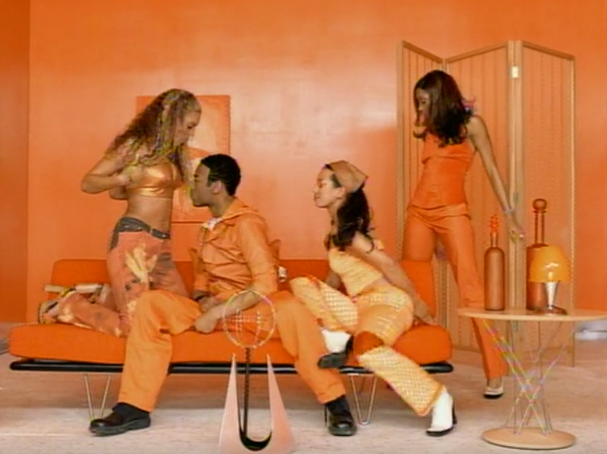
I want to forget about the third act of this otherwise domestic drama, in which Beyoncé, Kelly, and Michelle work out a dance routine before a fleet of Rolls Royces because it is the year 2000 and music videos featuring girl groups or boy bands require choreography as climax. Because it is the year 2000 and I have no concept of inter-band turmoil or management woes, because 15 years later, it feels like Michelle Williams was always there. Because it is the year 2000 and nobody knows that Beyoncé is Beyoncé even if this is mostly a Beyoncé song with two very capable back-ups—you can imagine Kelly Rowland taking lead, or Michelle, but you don’t want to.
Notice that Beyoncé, even when she is to the left of the frame, is always at the center of your eye. The editing seems a little off—the way it establishes Beyoncé as bouncy and fun despite the lyrics (she takes particular delight in the line “Saying everything to me times two,” her vocals trilling, the number two a flashed V-for-victory) is undercut some by the occasional frame of her mid-scowl—but then, this is a song about getting two-timed by a lover, the way a man lies and lies about lying; Beyoncé has every right to her anger and, I suppose, every right to dance it out with her crew in some anonymous parking garage. But I want to skip this third act because I want to skip a third act of my own, one where I’m mashing a tortilla chip into a bowl of salsa and apologizing for being trans. For not understanding why my mother would consciously reject my identity, my name, even in private. For making her uncomfortable. I want to skip this, so I will.
Instead, I want to focus on my discomfort. I want to channel it, and, to do that, I need to talk about cinematic space. The video for “Say My Name” was shot in 2000, minus two original members of Destiny’s Child (who, if you’ll remember, co-wrote the song), plus Michelle Williams. It is important to note the year the video was shot because, watching a music video online in 2017, it is easy to forget that high-definition video did not yet exist. On YouTube, “Say My Name” looks like it was shot using the same aspect ratio as a silent-era Western. That is part of its retro charm, I suppose (and, god, the clothes), but I remember this video on TRL, remember it filling the screen of the living room TV. There is an orange apartment, a red apartment, a white apartment, and a blue apartment. The furnishings are similar but slightly different. The men in each apartment are different. The women are the same. The illusion of cinematic space, that there exists something real beyond the “artificial” frame of the camera, is missing from “Say My Name” now, bordered, as it is, by two thick, black bars. But let’s pretend that it’s there and that four apartments exist, as suggested by the initial cinematography, as separate spaces, different worlds.
The key narrative moment of the music video occurs during the refrain. Beyoncé, Kelly, and Michelle are all harmonizing here—“Say my name, say my name”—and the paintings on the walls in the background begin to move. The couches begin to move. The song is upbeat, danceable, but the situation is right out of a classic haunted house film. The frame created by the camera suggests that there is more to these apartments through the mechanics of cinematic space, through the absence another room or even the suggestion of another room, some surprise lurking at the edge of the screen. The orange couch continues to slide, and suddenly what lies to the right of the frame is visible: it’s the blue apartment, and the orange couch—its man, its Destiny’s Child—are sliding right into it.
Orange and blue are complimentary colors, but we’ve already established that there is a orange room, a blue room, a red room, and a white room—they’re not supposed to mix, but they do (really, are forced to) because each man in this video has been “in the crib with another lady.” The other lady is never seen (unless you want to read her as one of the variously hued incarnations of Destiny’s Child that exists in each room), but she doesn’t need to exist for the thesis of “Say My Name” to work: even seemingly incongruous spaces are connected, and the events of a person in one can upset the workings of another. This doesn’t work as a visual statement unless the camera first establishes a boundary between each apartment before violating it.
I revisited “Say My Name” because, trying to sleep on a battered red couch after deplaning in Detroit, that’s what I wanted: for someone, anyone, to say my name. I was home for the first time in eight months, home for the first time since coming out, and my mom asked f I had chosen a new name for myself. When I said my name, she laughed. She asked me questions in rapid-fire over dinner—was I a lesbian or “a heterosexual,” had I taken to wearing women’s clothing yet, was I thinking about doing anything “permanent”—but it’s her reaction to my name that stuck with me, her refusal to say it unless it came with a caveat. “I haven’t embraced Colette yet,” she said, telling me that she wouldn’t be using it, even when we were alone. Later it was “I don’t understand why you went with Colette over something simpler.” I went to Detroit half-closeted, knowing that I wasn’t going to get my way, but I wanted my fucking name at least. I hummed the song in the dark, fuming and twisting its meaning.
It’s possible to think of real life in terms of cinematic space. Consider everything you can see, then consider that there is a world you can’t see just beyond the frame created by your eyes. That it is always moving and shifting. That it is never at rest, even when you are. Literally anything can happen where you’re not looking; the future is just a reaction to something you’ve yet to see. In “Say My Name,” the circumstances that cause one space to slide into another are dramatic. In life, usually that circumstance is something mundane: work, class, exercise, the promise of brunch. Things happen in places when you’re not around to observe them. I found myself stopping frequently in Detroit to look at some restaurant or store that I had visited dozens of times that was now closed, having an emotional reaction to the fact that some piece of my experience had simply fallen away. My mom kept looking at me sadly, wondering what had happened that her son was now claiming to be her daughter. Everything that happens beyond the frame of your eye, I suppose, is a kind of tragedy when you’re a mother, children sliding out of your home and into the context of one they create for themselves, things changing, refusing to present themselves in a way that’s easily understood.
Think of the word transition, like a camera on a dolly moving from one room to another, or a city’s rise and fall over time. Or the body, which transitions regardless of one’s gender identity, growing into age from youth and taking on new dimensions given the time and space it occupies, the people to whom it is presented. We give these objects names and say them as if that explains their existence entirely. Changing the name of an object changes everything about it, turns memory to fiction, truth to uncertainty, a series of unaccounted for possibilities lurking in places that don’t feel real because they’re beyond lived experience. I’m in an unfamiliar room right now, fragments of a person I’ve never met colliding with pieces of the people I’ve been over the past decade. This room is white. The last one was green. The one before that was white. The one I grew up in was yellow. I’ve been different people in all of them, present in my life and possible in others. Or impossible. It’s not my place to say who I am to somebody else. Where that puts me, I don’t know, but I can’t say that I see a third act where I come out of this dancing triumphantly, as if what happens in one space doesn’t matter in another. Really, I’m envious that Destiny’s Child could.
A previous version of this piece appeared in Tinkypuss #3, a zine published in Athens, Georgia. TInkypuss will soon be relaunching as Spellbook Zine. Check them out here. If you enjoyed this essay, consider contributing to my Patreon, if you will.