Batwing #1

Writer: Judd Winick / Artist: Ben Oliver
There are room for superheroes in Africa, I know there has to be. While the concerns dealt with by American comic book characters–drug abuse, alcoholism, crime, choosing between Betty or Veronica–are pedestrian in comparison to those that would likely be faced by a hero operating in the Congo, there must–must–be a way of portraying that hero in a way that intelligently confronts those issues, and you’d have to imagine that a comic book capable of doing that would be a home run, finally and fairly representing a sorely underrepresented group of people. Unfortunately Batwing #1 isn’t that book. It isn’t offensive, but it has the feel of a comic conceived after skimming through a fairly long essay on the famine and war plaguing the continent. Its heart is in the right place, but, more often than not, its head is up its ass.
Batwing, as you might’ve guessed, is the Batman of Africa, given a suit and a cave by Bruce Wayne in an effort to spread the message and ideal of Batman throughout the world. This is an interesting idea (one of many interesting ideas cooked up by Grant Morrison), but, in execution, I can’t help but cringe watching Batman show up to lecture Batwing on the finer points of crime fighting. In this issue, he admits that Batman was right when he said a bat would scare African criminals, thanks Bruce for the suit, and unnecessarily reminds him that he’s responsible for the bank of computers he works from. He then waltzes into work the next morning and finds the entire police precinct massacred by a warlord/supervillain. Of course, he blames himself. Too bad Batman wasn’t there to lend a hand.
I’ve never been much for Judd Winick’s writing, which is too bad since he is one of the DC roster’s most prodigious writers. I guess I’ve always found that, while dealing with big issues like sexuality, identity, and race, his scripts never reach far beyond the basics, often feeling sloppy, rushed, and half baked. Batwing #1 is much the same way. Great idea, yes, but the execution leaves a lot to be desired, and the end result is a less earnest Blood Diamond clone with capes. The issue is not helped by the artwork of Ben Oliver, who I’m sure has his fans, but I’m not much for comic art that tries to be photorealistic. There’s a kind of uncanny valley effect to artwork like Oliver’s–by trying hard to emulate the looks, emotions, and real life responses of actual people, Batwing #1 is a cold, emotionless shell of a book. I don’t feel anything for the character, and, in a weird way, I almost find the photorealistic dismembered limbs and severed heads a bit disrespectful. These things have really happened in Africa, and Batwing’s set-up doesn’t seem strong enough to resolve those issues with the respect and consideration they deserve. I feel my time would have been better spent looking through a photo essay on the continent. I feel like Batman should have known better.
Birds of Prey #1

Writer: Duane Swierczynski / Artist: Jesus Saiz
I was irked by Birds of Prey #1 immediately upon looking at the cover. I’m usually loathe to gripe about comic book fashion, having long since tired of bat-nipples and endless pouches, but the long sleeves and 90s shoulderpads with hot pants and fishnets ensemble they gave to Black Canary is the second ugliest re-envisioning of a character’s costume since the ill-fated relaunch of Wonder Woman saw Diana Prince dressed up for a night at the club. The worst, if your wondering, also goes to Birds of Prey #1, whose Poison Ivy wears a puke green body suit and limp red hair so horrible I had to check Wikipedia just to be absolutely sure it was her and not some limp-wristed imitation. Poison Ivy, for the record, is my favorite Batman villain. She’s also quite the fashion plate, so what the hell guys?
*ahem*
Even if I were able to look past the seemingly arbitrary and wholly unnecessary costume changes (I can’t! I won’t!), Birds of Prey #1 would only irk me again upon the realization that, in this brave new world, absolutely nothing that was great about Gail Simone’s long, incredible run on the book survived Flashpoint to make it into the new DC Universe. I’m biased, as Birds of Prey was the first book that got me into DC Comics as a young reader and comic shop employee, but it was nice that a book existed that wasn’t just about super heroics, but personal relationships and subtle nuance. The characters in Birds of Prey were smart and well-rounded, and I can’t help but be a little sad that that’s been tossed out the window in an effort to return to the tone established by Chuck Dixon’s run on the title, with the difference being that Black Canary and OracleBatgirl are not only no longer teammates, but that Barbara Gordon isn’t even on the team.
Now were I able to set both of my issues with Birds of Prey #1 aside before I’d read the book, Duane Swierczynski’s take on the team would still be pedestrian stuff–a light, sexless take on Sucker Punch (which wasn’t exactly heavy. Or sexy.) with little ambition beyond showing hot chicks do the cool things people in action movies often do–drive cars, fight thugs, be party to explosions. Everything that happens here feels so unnecessary, so lifeless and stilted and just plain off. A lot of that probably has to do with my strong attachment to Simone’s run. A lot of it probably has to do with the fact that I find dialog like “God, it’s you…the Black Canary. Wanted for murdering a man with a punch” laughable in the way B movies are. Most of it, however, has to do with Birds of Prey #1 having the vitality of a book that’ll be cancelled within a year. It lacks a certain…vitality. I might read a few more issues to see how Poison Ivy is handled (I do bad things for the sake of keeping up on favorite characters), but, one issue in, it’ll be more out of morbid curiosity than anything else.
Catwoman #1
Writer: Judd Winick / Artist: Guillem March
Catwoman, too, was a title instrumental in getting me into DC Comics, as the Ed Brubaker/Darwin Cooke/Cameron Stewart series did more with the noirish elements of the Batman mythos I’d grown up with in Batman: The Animated Series than any other Batman title, both in terms of Brubaker’s strong sense of Selena Kyle as a character, and Cooke and Stewart’s incredible sense of Gotham City as a place. It’s been a long time since the character or a book featuring her has been relevant to my interest, which is too bad because, in the right hands, she’s quite capable of presenting a different side of Gotham, one that Batman, Batgirl, and the Birds of Prey are incapable of exploring. I’m not sure if the Selina Kyle of Catwoman #1 is a woman capable of carrying her own book, of if my displeasure in the road Judd Winick takes is due to my biases, both for the character and against the writer.
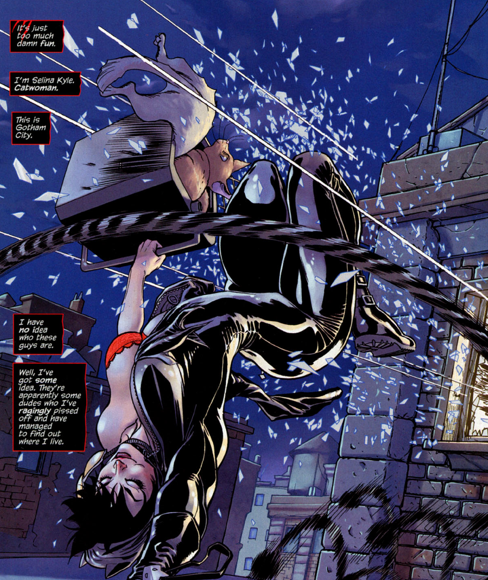
Selina Kyle, as written by Winick, is much the same as she was in the 90s; a woman with an ambiguous moral code and expensive taste. The things that defined her as a person when Brubaker was writing her are gone, replaced with the cat-ridden apartment and a sloppy-but-sexy demeanor that fails to do much in defining her. On the first page, when she’s cramming eight cats into a cat carrier and jumping out the window half dressed, I had to stop myself from closing the book. Sure, my Catwoman would have been prepared, in costume. Yes, my Catwoman probably would have had two cat carriers. But this is Judd Winick’s East End, and I’m just nervously shuffling down the sidewalk, eyes to the pavement.
It’s clear from the narration that Winick’s Catwoman will be couched in Frank Millerisms. Like one of his tough talking prostitutes, Selina Kyle isn’t afraid to be groped by a dirtbag if it means that she gets what she wants, and she’s certainly not above using her body to lure her marks in. It’s lazy and unconvincing, but is a masterstroke compared to the relationship between Catwoman and Batman, which reads like some nerd’s Batman Returns fanfic, if that fanfic somehow won a contest to be drawn by a real comic book artist. I’m cool with Batman and Catwoman having sex, but, here, it seems like it’s defining Winick’s take on the character, that Batman needs to be there, not just for all the kissing and straddling DC will allow, but so that she’ll have something hanging over her head when she goes off to do something that might be morally iffy–a relationship with a man.
All of this is annoying before the issue’s last words invite comparison between Batman/Catwoman and Watchmen‘s Nite Owl II/Silk Spectre II, who, being characters in an Alan Moore comic book about identity (and 900 other things), are much better equipped to deal with the issue. It’s not a fair comparison, but few things are. A more fair comparison: like Birds of Prey, I’m in for a few more issues, if only because I’m curious to see where, exactly, Winick is going. It helps that Guillem March draws an awesome Catwoman. It’s only right, considering that it’s her book, but she stands apart from everything surrounding her–even when the writing tries to tie her down.
Nightwing #1

Writer: Kyle Higgins / Artist: Eddy Barrows
I guess I’ve never really understood the need for Nightwing. Yes, there’s a need for character evolution, and Dick Grayson wasn’t always going to be Robin, but it feels like Nightwing never quite stepped out of Batman’s shadow. He moved to a new town, got himself some villains, saw the town crumble and went back to Gotham, where he took up the Bat-mantle when Bruce died (funny how “evolution” means taking on someone else’s identity) and handed it back when he returned. Now back as Nightwing and back in Gotham, Nightwing #1 breaks no new ground for Dick Greyson. He’s still in Batman’s shadow, still fighting his scraps, still struggling to find his identity without Bruce.
I suppose it’s fitting that the circus Dick once worked for is back in town, as it allows him to visit his old demons and reflect on his history, for those who are new to the character. It’s a big deal, I suppose, that he’s back in hero-choked Gotham, living in a loft in one of the city’s rough (but maybe gentrifying) sections, living in the place he’s trying to improve. There’s also a big carrot dangled at the end of the issue that there might be more to Dick than even he knows, but in this, the first issue of his own book in a new continuity, he’s taking on a nameless, faceless killer. I know that not all of these new books can be barnburners and that a book like Nightwing #1 has an established audience, but it’d be nice to see writer Kyle Higgins going beyond the character’s firmly entrenched comfort zone. Fans of Dick Greyson will probably be mollified, as this is the first time he’s had a solo book since 2009, but beyond those fans, nothing here is going to convince the masses that the character, or the book he’s in, is worth the money.
Red Hood and the Outsiders #1

Writer: Scott Lobdell / Artist: Kenneth Rocafort
Enough bloggers have commented on the economic stupidity of taking Starfire–a character three million children, a number much larger than the thirty thousand your typical comic book would be lucky to get–from her cutsey Teen Titans leanings and hurling her headlong into the COOL and RAD world of Red Hood and the Outsiders #1, where she is not only the most powerful member of the team, not just the one with the biggest breasts, longest hair, and skimpiest costume, but also the biggest slut, so I probably don’t need to add my voice. It is a stupid decision, but then again, it was pretty stupid to publish this comic book in the first place.